
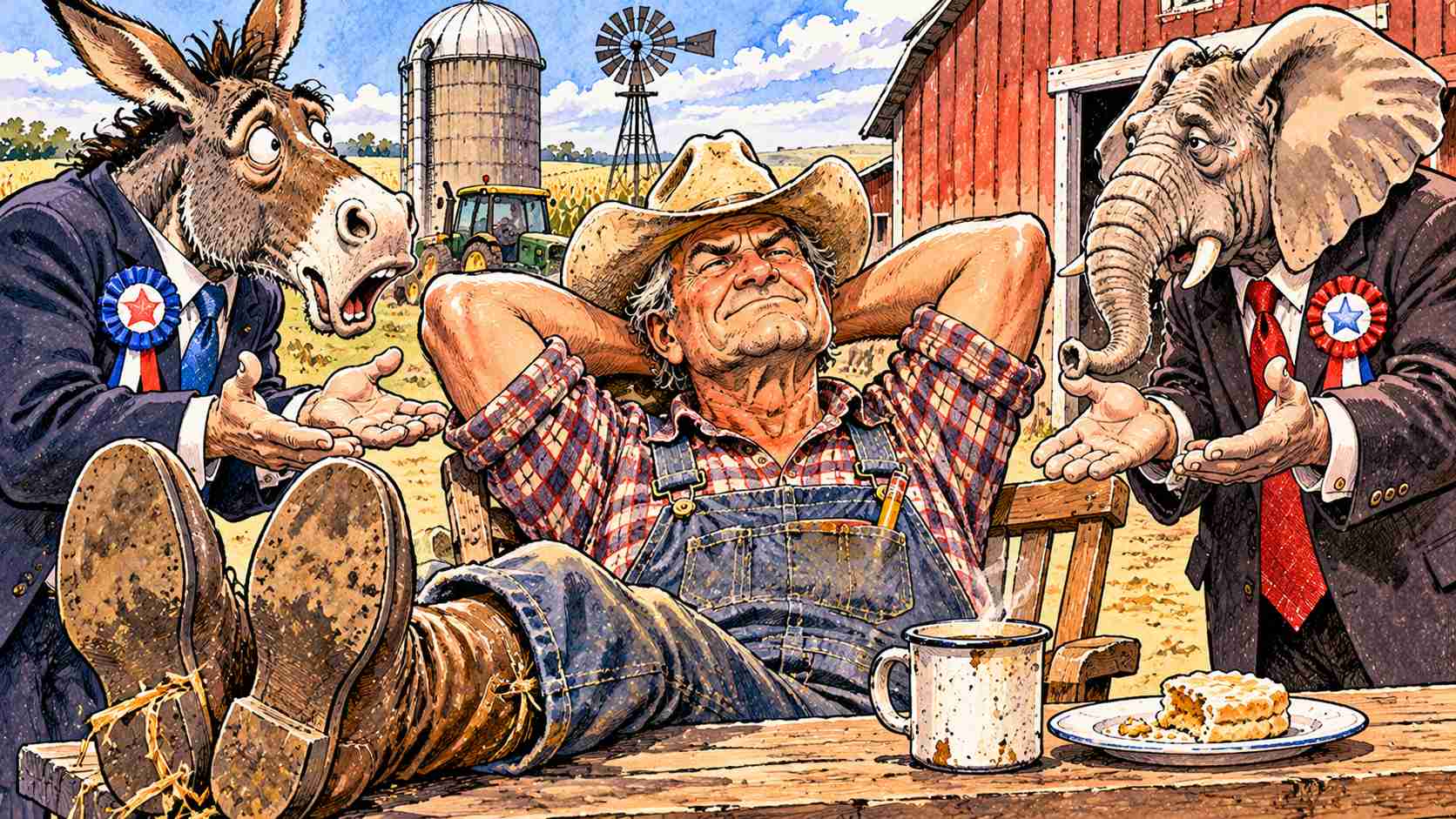
Corn Doesn’t Vote, and Cows Don’t Care About Congress
WICHITA FALLS, Texas — American farmers have launched an unexpected rebellion against the nation’s political establishment, demanding the right to get through an entire workday without somebody asking which political party they support.
The movement began when North Texas rancher Earl Pritchard, 63, was interrupted while repairing a broken water trough by a political volunteer demanding to know whether he was a Republican or a Democrat.
“I’m a farmer,” Pritchard replied.
“But which side are you on?”
“The side with the wrench.”
The volunteer insisted that political neutrality was unacceptable. Pritchard handed him the wrench.
“Then you can fix the damn trough.”
The volunteer immediately returned to Washington, where people are encouraged to identify problems without acquiring the skills to solve them.
Cattle Don’t Recognize Political Parties, Texas Rancher Says
Pritchard said the political establishment fundamentally misunderstands agriculture.
“Cows don’t care who’s president. They’re hungry at six in the morning regardless of which idiot won the election.”
He explained that cattle had shown remarkable political consistency throughout American history. They ate grass under Republicans. They ate grass under Democrats. They ate grass during government shutdowns. And if Washington disappeared tomorrow, they would still be standing beside the gate demanding breakfast.
The only known exception occurred when a politician visited his ranch and tried to explain agricultural reform.
“The cows walked away,” Pritchard recalled. “First time I’ve ever seen livestock recognize a waste of time.”
Washington Activists Demand Farmers Take a Stand, Get Stuck in the Mud
A delegation of political activists subsequently visited the ranch to explain that farmers had a moral obligation to become more politically engaged.
The group arrived in an electric SUV, became stuck in a muddy pasture and requested assistance from a diesel-powered tractor. Before towing them out, Pritchard asked whether they supported fossil fuels.
“Absolutely not,” the delegation replied.
“Well, this is awkward.”
The activists explained that the tractor represented an unsustainable commitment to twentieth-century technology. Pritchard explained that the SUV represented a $70,000 lawn ornament. After three hours of ideological disagreement, the activists accepted the tow.
The responding deputy’s incident report, reviewed for this story, lists the cause of the call as “electric vehicle, stuck, owner offended.” Under “Resolution,” the deputy wrote one word: “Diesel.”
Pritchard’s handwritten invoice for the job reads, in full: “Tow, 1 SUV: $0. Lecture, unrequested: $0. Diesel, 4 gallons: $17.60. Dignity: not available.”
The activists later described the experience as a victory for renewable energy.
USDA Census of Agriculture Shows Farmers Have Actual Work to Do
According to the USDA’s Census of Agriculture, the United States had approximately 1.9 million farms and ranches, a decline of nearly 7% since the previous census. The same census found that only 43% of farms reported positive net cash farm income. The USDA Economic Research Service publishes the income forecasts, and farmers say they read them the way other people read a hospital bill.
Washington analysts were reportedly shocked to discover that farmers had concerns beyond politics. These included paying for equipment, buying seed, managing livestock, finding reliable workers, surviving commodity-market swings and occasionally enjoying a meal that wasn’t eaten while driving a tractor. Diesel alone is a recurring injury; the Energy Information Administration’s diesel price tracker is bookmarked on more farm phones than any news app.
An unofficial government proposal recommends solving these problems by encouraging farmers to participate in more public discussions.
Dr. Lyle Hobart, an agricultural economist who has studied commodity markets for 31 years, said the plan misreads the problem. “A farmer’s margin isn’t improved by a panel discussion,” he said. “Nobody has ever hedged corn futures with a town hall.”
Pritchard questioned the reasoning.
“If talking fixed machinery, Congress would have the finest tractors on Earth.”
Dairy Farmers Reject Mandatory Political Training for Cows
The movement has spread to dairy farms, where producers insist that their animals should be permitted to remain politically independent.
Wisconsin dairy farmer Ruth Mendez rejected a proposal requiring every Holstein to complete a voter-engagement questionnaire.
“Half my cows can’t figure out which end of the barn the feed comes from,” she said. “Now somebody wants them to explain economic policy?”
One activist reportedly demanded to know whether the dairy supported progressive agricultural policies. Mendez pointed toward a recently purchased milking robot.
“That thing cost more than my first house. I’m currently supporting whoever can get it working again.”
The activist asked whether the cows identified with the political left or right.
“Mostly they identify with the feed bunk.”
A particularly aggressive Holstein named Margaret then headbutted the visitor’s clipboard. Farm employees took the incident as a decisive rejection of political campaigning.
Margaret declined further comment, although she did eat the questionnaire.
Farmers Introduce a Revolutionary Political Position: Leave Us Alone
Ranchers across Texas have begun drafting what they call the Agricultural Declaration of Political Independence. Its central principle is that farmers can care deeply about public policy without wanting to spend their lives defending political celebrities.
They support affordable fuel regardless of which party supplies it. They support functioning markets regardless of which politician claims credit. They support property rights, sensible regulations and the ability to repair their own equipment without consulting a lawyer, a position backed by the Federal Trade Commission’s report on repair restrictions. The American Farm Bureau Federation has made similar noises, although nobody there has been asked to hold the wrench.
And they strongly support rain, although Pritchard warned that Washington would eventually attempt to regulate it.
“Republicans will promise more rain,” he predicted. “Democrats will subsidize umbrellas. Neither one will fix the drought.”
America’s Farmers Have One Final Message for Washington
At a gathering outside Wichita Falls, Pritchard announced that farmers would no longer be required to express an opinion on every national controversy.
A reporter asked whether the movement represented a growing political force.
“No.”
Was it a new political party?
“No.”
Would farmers endorse presidential candidates?
“No.”
What did they actually want?
Pritchard looked toward his tractor.
“I’d like to finish planting before it rains.”
The reporter persisted, asking whether refusing political engagement was itself a political statement. Pritchard considered the question carefully.
“Son, I’ve got 300 acres to work, a diesel bill I can’t believe and a bull that’s been trying to kill me since Tuesday.”
He climbed into the tractor.
“If Washington wants my opinion, tell them to come out here and help.”
The movement’s first national convention was subsequently cancelled because everybody had chores. Washington described the absence of delegates as a devastating organizational failure. Farmers described it as the most productive political convention in American history.
Five Observations on Farmers and Politics
- Farmers wake up at four in the morning. Politicians wake up at four in the morning to tweet. Only one of those groups has a cow to show for it.
- Nothing humbles you like a bull. A congressman can lie to a country for twenty years, but a bull will tell you exactly what he thinks of you in about four seconds.
- Every farmer has a drawer full of manuals for equipment he’s not legally allowed to fix. That’s not a drawer. That’s a museum of broken promises.
- Electric SUV stuck in a pasture, diesel tractor to the rescue. That’s the whole energy debate. It takes three hours and nobody learns a thing.
- The convention got cancelled because of chores. Best excuse in America, and nobody’s ever called a cow a flake.