
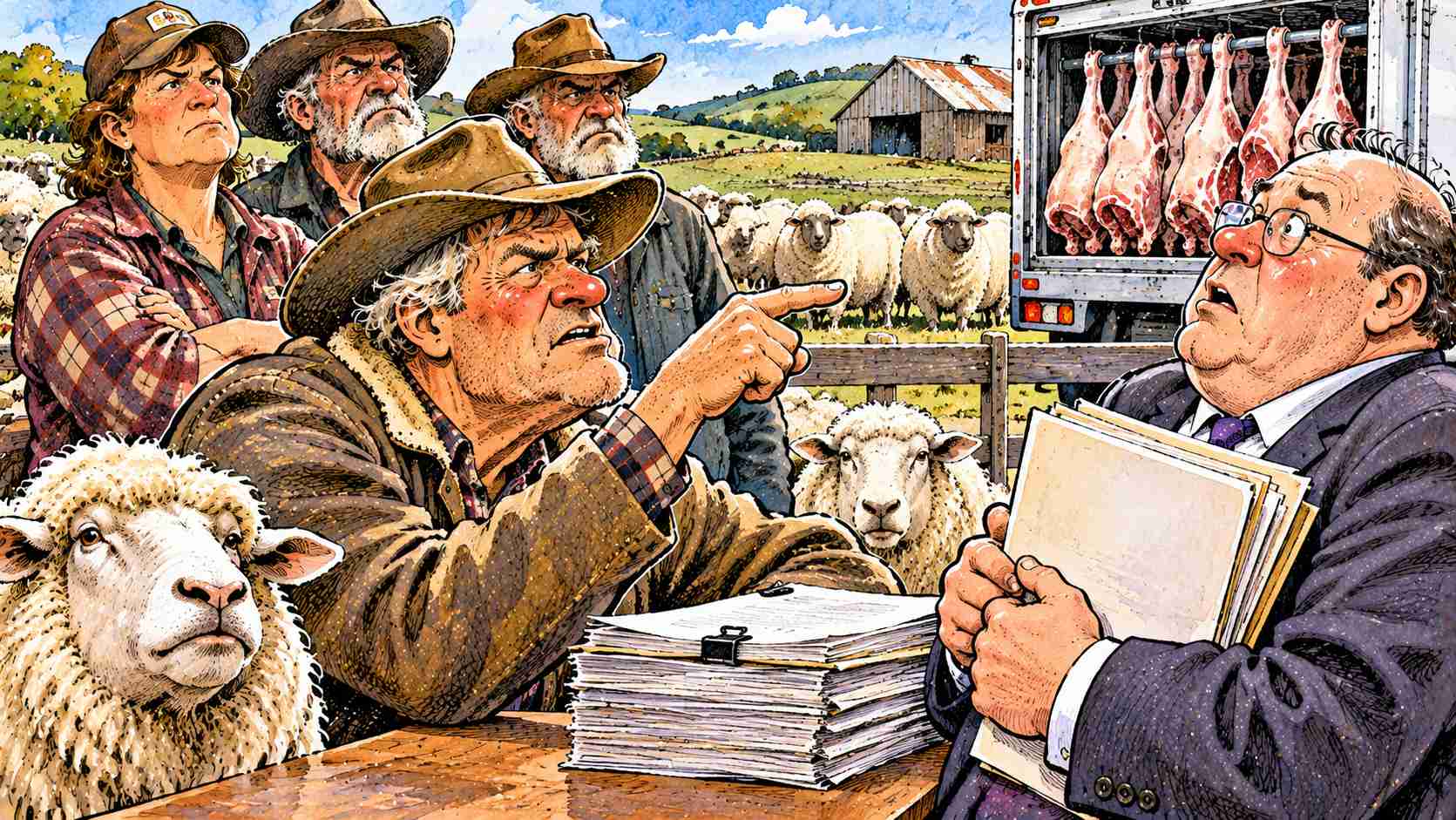
Australians have been eating their lunch for 25 years
WASHINGTON, D.C. (Farm.FM) — American sheep producers are demanding a federal investigation after discovering that Australian and New Zealand lamb has been quietly taking over the domestic market for roughly 25 years.
The revelation shocked American ranchers, who were under the impression the United States was still legally permitted to produce its own dinner.
According to the American Sheep Industry Association, domestic lamb producers once controlled about 75 percent of the American market. Industry representatives say that relationship has now essentially reversed. Australia and New Zealand appear to have read the American lamb business as a dinner invitation, brought their own sheep and stayed for a quarter-century.
“I thought globalization meant we could sell American lamb overseas,” said Wyoming rancher Harold Benton. “Turns out it meant Australians could sell lamb in my grocery store cheaper than I can raise it.”
Cheap Imported Lamb Undercuts American Sheep Ranchers
Industry representatives say imported lamb has regularly entered the American market at prices below domestic competition. Brad Boner, a past president of the American Sheep Industry Association, told RFD-TV that imported lamb was cheaper in 93 percent of the price comparisons examined.
That creates a rough economic problem. American ranchers pay for feed, land, labor, veterinary care, fencing and transportation, plus the occasional sheep that gets its head stuck in something designed specifically to prevent that. Their overseas competitors work under different production systems and cost structures.
The American government, meanwhile, has contributed several decades of speeches about the importance of American agriculture. The speeches aren’t edible. Nobody can deposit them either.
Washington Discovers the International Trade Commission
The sheep industry has asked the U.S. International Trade Commission to examine the competitive situation. This is the federal agency responsible for investigating trade problems after farmers have explained them repeatedly for several decades. The commission may look at import pricing, domestic industry conditions and whether relief is warranted.
Ranchers are cautiously optimistic. “We’re only 25 years into this problem,” Benton said. “Government usually needs another ten before it starts taking notes.”
Some economists argue that inexpensive imports benefit American consumers, and they do. A cheaper lamb chop certainly helps the family buying dinner. But the sheep producer can’t make up for losing his livelihood by buying an inexpensive lamb chop. He already owns the sheep. That’s rather the problem.
The Paper Trail Behind the Lamb Price Gap
The Grocery Receipt
Benton produced a recent grocery receipt showing he paid $14.99 a pound for lamb whose label identified it as New Zealand. “That lamb traveled about 8,000 miles to get to a store 40 minutes from my ranch,” he said. “It’s seen more of the world than I have, and I’ve been to Cheyenne.”
County Wool Growers’ Minutes
Minutes from a regional wool growers’ meeting record two motions on the subject of anger. A motion to be angry passed unanimously. A follow-up motion to be angry with paperwork passed narrowly, after a member pointed out that most of them already were.
The Economist’s View
“Consumers will always love a lower price,” said Dr. Leona Marsh, an agricultural economist at a Midwestern state university. “The trouble is that a market with no domestic producers left has a way of discovering a new price the day after the last one sells his flock.”
Nobody Has Explained Why a Restaurant Lamb Chop Still Costs $42
The trade dispute has also raised a mystery. If imported lamb got so much cheaper, why does a restaurant lamb chop still cost about the same as repairing a transmission?
Ranchers suspect the savings stopped somewhere between the packing plant and the restaurant’s leather-bound menu. A businessman can apparently buy cheaper lamb, arrange an ocean voyage, distribute the meat across the continent and still charge the customer enough to finance a small yacht. The animal is the only participant who doesn’t get a business-class ticket.
Sheep Producers Want a Market, Not a Memorial
American ranchers argue their industry deserves a chance to compete without being squeezed out by a relentless price disadvantage. They aren’t asking consumers to stop enjoying foreign products. They’re asking whether domestic producers can survive long enough to keep offering American ones.
The industry pursued a similar trade case a quarter-century ago, and its members are back asking for another investigation. When a nation can’t compete in its own meat market, something deserves a look. And when the explanation takes 25 years, perhaps somebody should check whether the investigators have been counting sheep.
Five Humorous Observations
- Twenty-five years. A quarter of a century. I can’t get a plumber to call me back in 25 hours, and these guys filed paperwork that takes longer than a mortgage.
- The lamb traveled 8,000 miles and still beat the local guy on price. That sheep has better frequent-flyer status than I do. It probably got the window seat and the little warm towel.
- Restaurant lamb chop, 42 bucks. Where’s the savings going? Somebody’s making money on this animal and it ain’t the animal, and it ain’t the guy who raised it. The sheep gets nothing. The sheep always gets nothing. That’s the whole job description.
- “We’re only 25 years into the problem.” That’s the most optimistic sentence ever spoken in Wyoming. That man has seen a blizzard, a wolf and the federal government and he’s still going, “Give it a decade.”
- Government says it’ll examine the situation. You know what that means. It means a guy in a lanyard will look at a spreadsheet and say “hmm” in a conference room with no windows. And somewhere a sheep is looking at the grass like, you boys figure it out, I’ll be right here.