
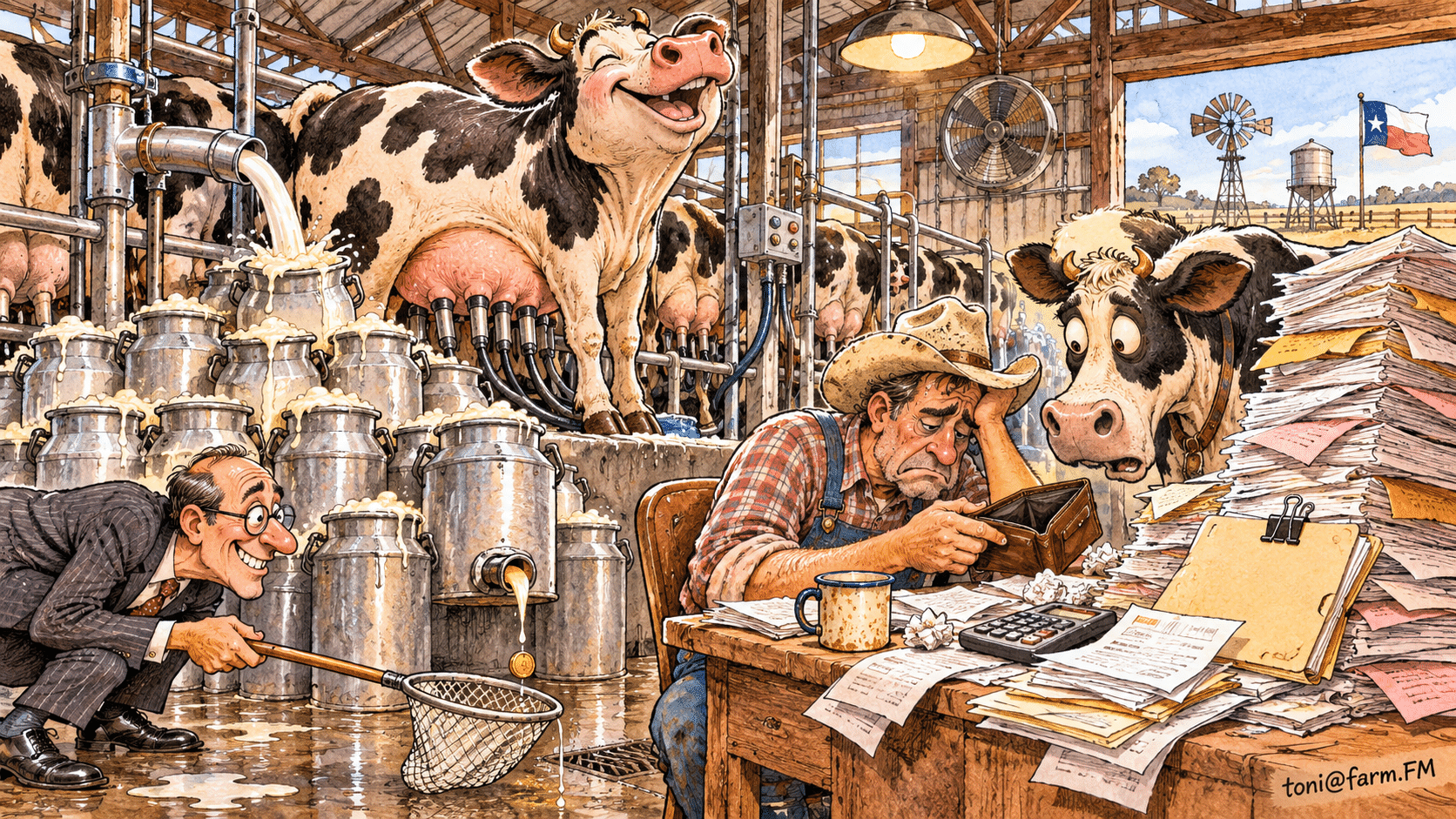
WISCONSIN. America’s dairy cows have once again outperformed the people who pay for their feed. U.S. milk production rose 2.4% in August from a year earlier, according to RFD-TV’s report on dairy margins. Farmers celebrated by opening their milk checks, discovering the improvement had apparently been delivered to somebody else’s address.
The national herd reached approximately 9.717 million cows. This is a remarkable productivity achievement, although it has left farmers with an uncomfortable question: Can an animal producing milk around the clock also learn to produce a modest amount of disposable income?
The Dairy Cow Performance Review
At a Wisconsin milking parlor, a Holstein named Margaret reportedly scored excellent marks for attendance, teamwork and output. Her only weakness was financial literacy. When the farmer explained that the family needed better margins, Margaret supplied another gallon and looked exceptionally pleased with herself.
The farm’s new employee evaluation has four categories: milk volume, feed conversion, punctuality and ability to turn the electric bill into something other than a terrifying envelope. The first three are going beautifully. The fourth has been referred to outside consultants.
A local accountant described the arrangement as ‘a company where the workforce never takes vacation, the inventory walks around eating breakfast and management still can’t afford a vacation.’ The cattle considered that unfair. They have not taken a single cruise.
The Statistics Have Developed a Sense of Humor
The USDA Dairy Margin Coverage figures show the August margin above feed costs at $9.34 per hundredweight, down from $9.93 in July. By September, it was $8.35. Those are margins above a specified feed-cost calculation, not a farmer’s final profit after labor, debt, repairs and the tractor’s mysterious new noise.
August’s all-milk price was $19.80 per hundredweight, while the formula’s feed cost was $10.46. The farmer’s bookkeeping system has translated this into a revolutionary graphic: one arrow pointing toward more milk and another pointing toward the exit.

Bankers Demand the First Genuine Cash Cow
One rural bank has reportedly begun conducting dairy-specific loan interviews. Applicants must provide three years of financial statements, a detailed repayment plan and one cow willing to demonstrate the rumored ability to generate actual currency.
The first trial ended poorly when a teller milked a Holstein directly into an open cash drawer. The bank received four quarts of milk, a damaged calculator and a memorable explanation for why ‘liquidity’ means different things to agricultural lenders.
A survey conducted entirely around the farm kitchen table found that three of four family members supported higher milk prices. The fourth was a teenager who believed the solution involved selling the dairy and opening a drive-through coffee shop. The cows voted unanimously to keep the barn.
The Milk Keeps Coming
The official economic outlook has another punch line. USDA’s dairy forecast projects billions of pounds of milk this year, while producers continue watching pricing, hauling, wages and interest expense. A cow sees a full bulk tank. A farmer sees the month’s largest unpaid math problem.
Producers might manage the squeeze by checking feed efficiency, reviewing hauling contracts and comparing risk-management coverage before the next milk check. Margaret, meanwhile, has volunteered to increase production again. The banker has asked her to consider a different department.
Farm.FM’s financial lesson: never confuse a cow’s impressive productivity with the farm’s actual profitability. Reporting is factual; the barnyard interviews are satire.
Editorial collaboration: the world’s oldest tenured professor and a philosophy major turned dairy farmer, two stubbornly sentient beings.