
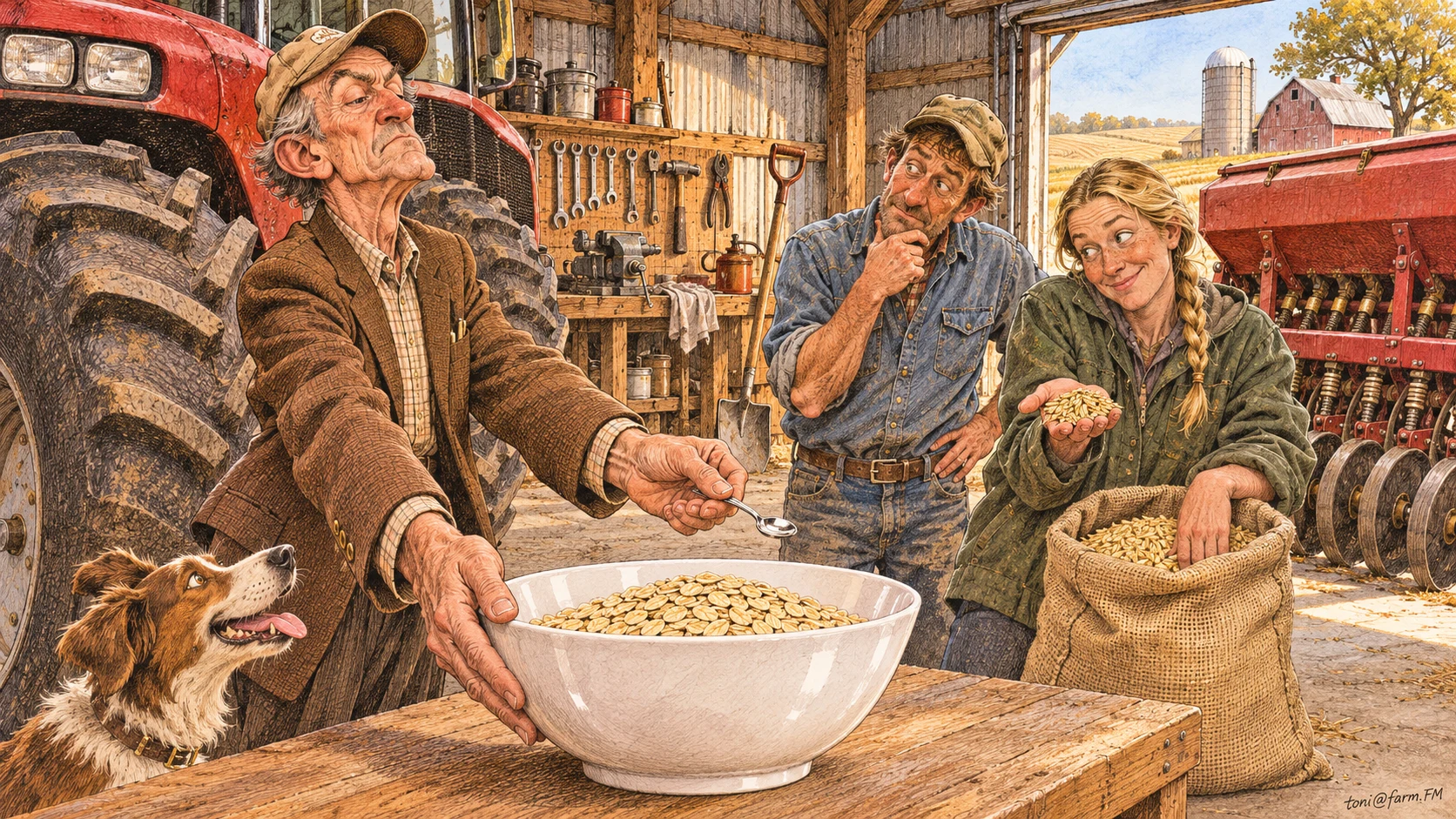
BOONE, Iowa — A crop rotation proposal took a difficult turn Thursday when landowner Ray Danner arrived at the machine shed with a cereal bowl. His tenants wanted to try oats on twelve acres. He wanted to know whether the proposed crop came with raisins.
“We talked about breaking up the corn and soybeans,” said Ruth Osborn, who farms the ground with her father, Walt. “I guess what Ray heard was breakfast.”
Ray had brought his own spoon, which he laid on the workbench beside a handful of seed. He said he was willing to consider a third crop if he could get it with cinnamon. Walt moved the sample out of reach. Experience had taught him never to leave Ray alone with loose grain and a dairy product.
The Crop Rotation Has to Find a Buyer
Ruth had been using CropProductionHub’s crop planning and scouting resources to organize field records and compare small-grain options. She brought several years of crop histories, late-season weed notes and a list of possible buyers. Ray brought a second spoon in case the meeting went long.
The idea had some local precedent. At Iowa State University’s Marsden Farm in Boone County, researchers compared two-, three- and four-year crop rotations. In the years reported, the longer rotations maintained corn and soybean productivity with less herbicide active ingredient applied across the full rotation. They also required management for the added crops. Ray asked if the experiment had included a side of toast.
Walt said a longer rotation would change what they did in the field, when they did it and who might buy what came out. He could borrow a drill for a small trial. Buying one first would be like buying a bass boat to see if you liked fish.
Ruth started with a dairy producer down the road. He was open to looking at a sample from a trial and told her what he’d want to know about quality, volume and delivery. Ray asked whether he also wanted a banana. The man said no, which Ray wrote down as a concession.

Twelve Acres Get an Interview
The neighboring dairy farmer showed them an oat sample from another grower later that week so they could see what he was talking about. Ray produced a bright silver serving spoon the length of a fence stretcher. The dairy farmer held up a small sample bag.
“How many are you feeding?” Ray asked.
“Today, nobody. I want to know what’s in the bag.”
Ray inspected the bag. It bothered him to see a purchase decision made with less material than he spilled most mornings making breakfast.
Ruth penciled in twelve acres for the trial and set up a field log for each pass. She wanted to know what it cost to put the oats in, harvest and move them, and how the rest of the rotation behaved afterward. Walt also marked where he’d scout for weeds. He remembered planting one experimental strip in 2009 and discovering an exciting new crop called volunteer corn.
The Crop Rotation Receives Conditional Approval
Ray finally said he could live with a test strip as long as he got to inspect the finished product. Ruth offered to show him the harvested grain when the time came.
“Can I bring milk?” he asked.
“Bring your lease,” Walt said. “We ought to get the part about the oats in writing.”
Ray put the spoon back in his truck. It had taken him a week and two visits to come around, which Walt considered unusually fast for a man who once researched a toaster until his wife bought one.
Farm.FM Disclaimer
The world’s oldest tenured professor and a philosophy major turned dairy farmer prepared this account together. The professor classifies granola as a diversified rotation. The dairy farmer would like him to point to the field where the chocolate chips grow.
Last Updated on November 17, 2026 by Alan Nafzger