
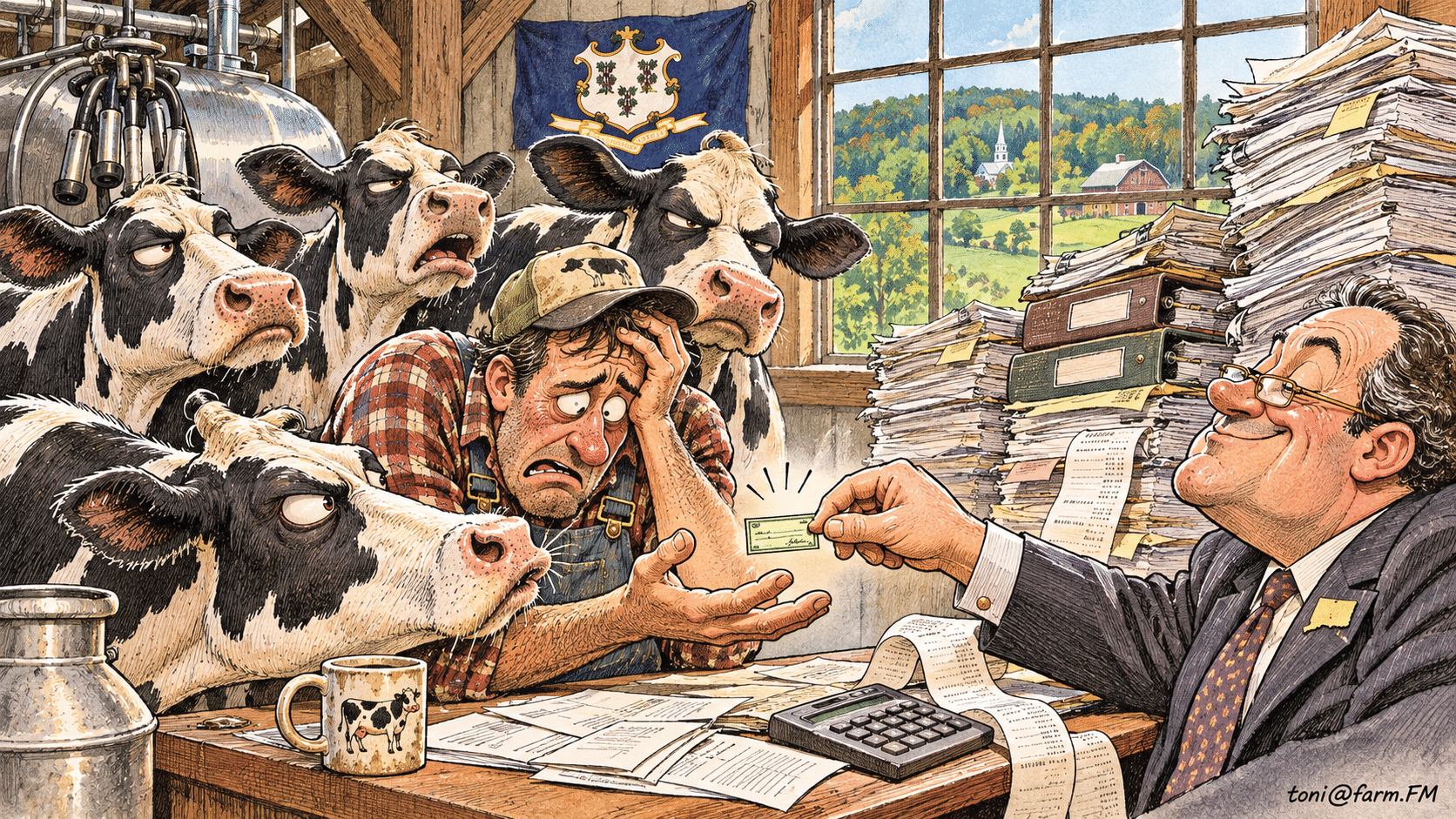
Cows Ask Whether Feed and Therapy Are Covered
HARTFORD, Connecticut – Connecticut has announced additional financial assistance for dairy farmers, prompting the state’s cattle to look into whether the support might extend beyond their owners to cover feed, electricity, housing and the psychological strain of modern agriculture. According to the Connecticut Department of Agriculture’s dairy stabilization announcement, officials processed about $3 million in second-round payments for 71 participating dairy farms. The state also announced a separate $1 million equity-payment opportunity for eligible licensed milk producers. Federal help sits alongside it in the USDA Dairy Margin Coverage program, for farmers who like to be told the same thing by two agencies. Dairy farmers welcomed the assistance. The cows immediately asked whether they were eligible.Connecticut Cows Apply for Dairy Economic Relief
A Holstein at a Connecticut dairy submitted a request for emergency financial support after learning that government programs were meant to address rising operating costs. Her application listed hay, bedding, electricity, veterinary expenses and emotional distress. Under emotional distress she wrote: “Farmer keeps talking about selling the herd.” The farmer explained the payments were meant to stabilize dairy operations, not set up individual retirement accounts for livestock. The cow was disappointed. She had been hoping to buy a heated barn, premium alfalfa and a private pasture with a view of Vermont. Another animal requested reimbursement for overtime. The farmer reminded her that cows don’t get hourly wages. The cow replied that the federal government had spent considerable time recently discussing workers’ rights and that she believed working twice a day counted. A third cow asked whether maternity benefits were included. Management adjourned the meeting. A clerk at a farm supply store in Litchfield County said she’d seen the application on the counter. “It was neater than most of the ones that get turned in by people,” she said.
How Connecticut’s Milk Price Problem Squeezes Small Dairies
Connecticut’s dairy industry faces a problem familiar to producers across the country. Feed, fuel, labor and equipment costs stay high, while milk prices don’t always cover the full cost of production. Government stabilization programs can offer short-term help. But even generous support doesn’t permanently solve the underlying difficulty of making a living from milk. One Connecticut producer compared dairy farming to running a grocery store where the customers decide what they’ll pay, the suppliers decide what everything costs and the owner has to open every morning. Unlike a grocery store, the employees also need milking. This presents unique management challenges. A Connecticut agricultural economist reportedly suggested that farmers improve financial resilience by trimming unnecessary expenses. The farmer asked which ones he meant. “Feed?” “No.” “Electricity?” “No.” “Veterinary care?” “Certainly not.” The farmer studied the options. “Then I suppose we’ll have to eliminate the economist.”Dairy Farm Payment Programs and the Fine Print
The state’s assistance includes distributions tied to milk production and opportunities meant to support the viability of dairy operations. Officials are also working on longer-term strategies involving processing capacity, operating costs and business sustainability. Farmers appreciate the effort but have developed a wary attitude toward programs that require a lot of paperwork. One producer observed that milking cows takes several hours a day, while proving to the government that he actually milks cows can take an impressive stack of supporting documents. He suggested that applicants be allowed to submit a photograph of the barn at four in the morning. “If I’m standing in manure before sunrise, I probably qualify as a dairy farmer.” State administrators reportedly found the suggestion insufficiently documented. Section 7(c) of one application form states that “livestock may not apply on their own behalf,” a clause several Holsteins have since described as discriminatory. Minutes from the review panel’s most recent session note that the committee “heard concerns from cattle” and “agreed to forward them to the farmer.”Cows Propose Their Own Stabilization Program
The herd eventually drew up an alternative plan. Under the proposed Bovine Economic Recovery Initiative, every cow would receive guaranteed feed, comfortable bedding, reliable veterinary treatment and protection from unexpected cuts in snack allowances. The farmer looked it over. “That’s exactly what I already provide.” The cows then asked for direct cash payments. The farmer reminded them that the farm had just applied for economic assistance because there wasn’t enough cash. A long silence followed. Finally an elderly Jersey offered a compromise. “Keep feeding us, keep milking us and try not to go bankrupt.” The farmer agreed. Connecticut’s dairy stabilization program may not solve every problem facing the industry. But the cows recognized one important economic truth. Without the farmer, nobody would run the dairy. And without the dairy, the cows would have to find somebody else willing to deliver breakfast twice a day.Five Observations on Government Aid and Bovine Paperwork
- The state sent three million dollars to seventy-one dairy farms and the cows asked if they qualified. That’s the only time in history the people at the bottom of the org chart read the press release.
- She put “emotional distress: farmer keeps talking about selling the herd.” Honestly, that’s the best-worded grievance I’ve ever seen. HR would’ve settled before lunch.
- The economist says cut unnecessary expenses. Okay, which one? Feed? No. Electricity? No. Vet? Absolutely not. Then the economist. There it is. Economists always find the one expense that was actually unnecessary, and it’s them.
- “Livestock may not apply on their own behalf.” You know, that’s every bank, every landlord and half of my relatives.
- The Jersey’s plan is the best policy paper in the whole story. Keep feeding us, keep milking us, don’t go bankrupt. That’s three bullet points, and it’s still more than Congress has ever managed.