
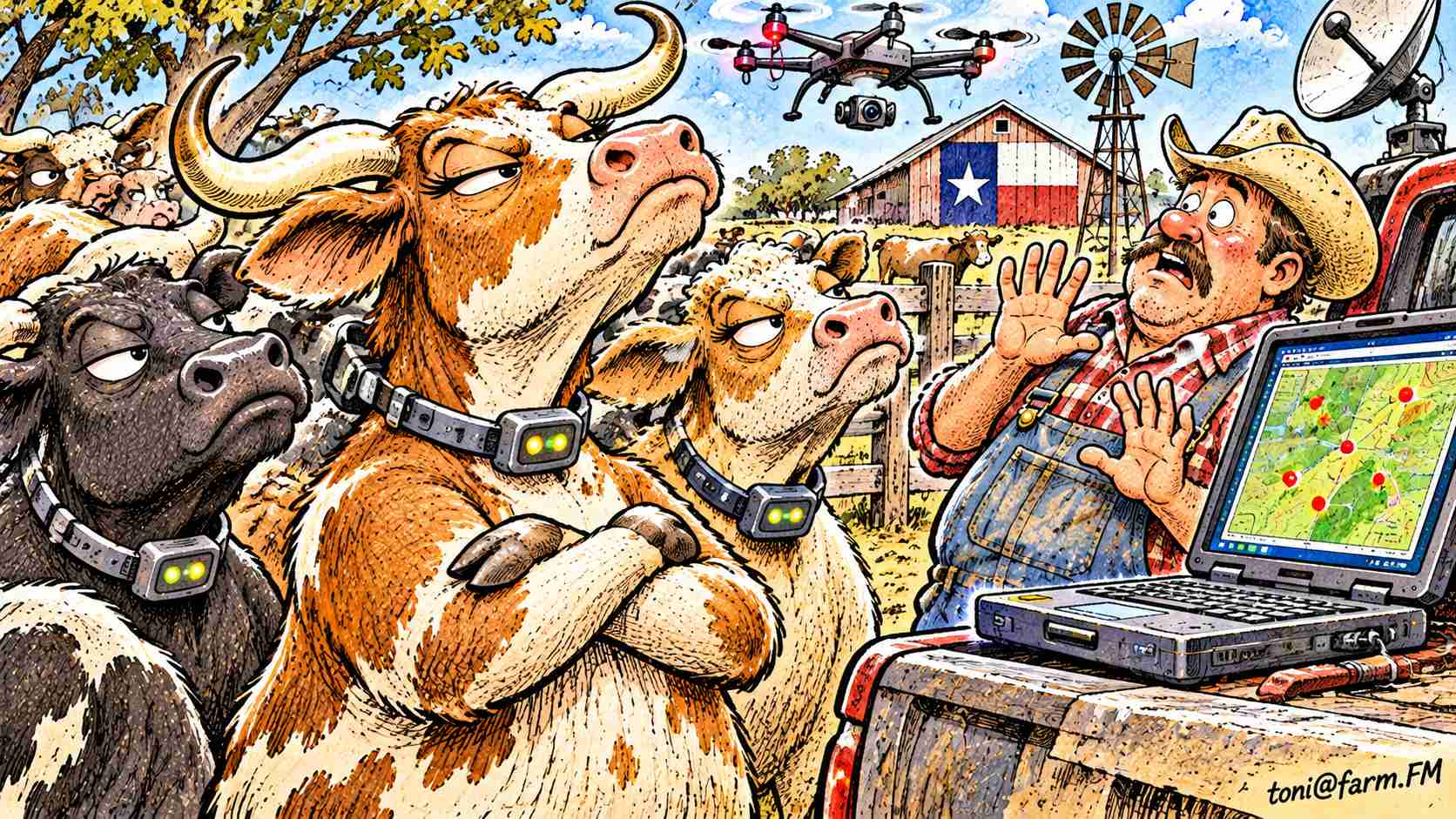
Wichita County Ranchers Put GPS Trackers on Cows; Cattle Immediately Demand Privacy Rights
Local Herds Form Civil Liberties Committee After Discovering Owners Can Monitor Unauthorized Trips to Neighboring Pastures
WICHITA FALLS, Texas – Wichita County cattle have launched an unprecedented livestock privacy campaign after ranchers began discussing electronic identification, GPS monitoring and other technologies designed to help locate missing animals and discourage theft.
The cattle say the new systems represent an unacceptable invasion of their personal lives.
“We understand the need for ranch security,” explained Hereford activist Daisy McMoo. “But there’s a difference between preventing theft and knowing every time I visit the water trough.”
Daisy represents the newly organized Wichita County Bovine Civil Liberties Association, whose membership consists of 47 cows, three suspicious-looking bulls and a heifer who joined primarily because somebody promised refreshments.
Ranchers Say Technology Helps Protect Valuable Livestock
Livestock identification is a serious ownership and traceability issue.
The Texas & Southwestern Cattle Raisers Association explains that cattle brands are recorded at the county level, and owners must periodically renew their registrations.
Electronic identification and GPS tracking are different technologies, and not every identification device provides location information.
That distinction has apparently been lost on the cows.
“They put something in your ear, and pretty soon the government knows what grass you’re eating,” Daisy warned.
Her statement was immediately challenged by a rancher, who explained that an electronic identification tag does not automatically track an animal’s every movement.
Daisy rejected the clarification.
“That’s exactly what somebody with a spreadsheet would say.”
The Neighbor’s Bull Becomes a National Security Issue
Iowa Park rancher Walter Hensley began considering GPS monitoring after repeatedly finding cattle outside their assigned pasture.
The first tracking report showed that his prize Hereford had visited the neighboring property’s bull four times in one afternoon.
“Four times,” Hensley repeated. “I thought she was checking the fence.”
His wife reviewed the location data.
“Honey, nobody checks a fence that thoroughly.”
The cow demanded that the information be deleted.
She also requested an injunction preventing the rancher from sharing the report with the other heifers.
The bull declined comment, citing an ongoing relationship.
Cattle Demand the Right to Disappear
The cattle association has proposed several amendments to ranch management practices.
Its first demand is that cows be allowed to leave their assigned pasture for up to two hours without generating a notification.
Its second demand is that GPS location data never be used in arguments about overeating.
Its third demand is that a bull’s location history be protected under the same confidentiality rules applicable to human dating applications.
Hensley rejected all three proposals.
“These animals can squeeze through a fence worth $8,000, walk onto a highway and cause a wreck,” he said. “I’m entitled to know where they went.”
Daisy responded that ranchers should focus on their own behavior.
“How about tracking the man who leaves every gate open?”
This argument produced an uncomfortable silence.
The Data Gets Out
The controversy deepened when Hensley’s tracking app accidentally sent the herd’s weekly location summary to everyone in his phone, including the feed store, his pastor and a cousin in Amarillo.
The report showed one cow spending eleven hours a day beside the water trough, another making nightly visits to the neighbor’s hay pile and a steer that had apparently spent most of October staring at a mailbox.
“My pastor called to ask if everything was all right at home,” Hensley said.
Daisy McMoo called a press conference beside the stock tank. “This is precisely the surveillance state we warned about,” she said. “Today it’s the hay pile. Tomorrow they’ll know who’s been eating the good mineral.”
The bulls released a joint statement denying any knowledge of the hay pile, the mailbox or the neighbor’s heifers.
The statement was signed with a hoofprint, which Hensley noted was a perfect match for the ones all over the hay pile.
The steer has offered no explanation for the mailbox. Hensley suspects he is waiting on a letter.
The Real Purpose of Livestock Identification
Real-world livestock identification helps establish ownership, support animal-health tracing and assist investigations involving missing or stolen animals.
The TSCRA’s livestock-brand FAQ explains how registered brands can be used by law enforcement, lending institutions and animal-health agencies.
Ranchers using electronic monitoring should also select devices appropriate to their purpose, since identification tags and active GPS trackers serve different functions.
Hensley ultimately agreed to provide his cattle with a written privacy statement.
The agreement explains that location data will be used for livestock management, theft prevention and recovery of wandering animals.
Daisy refused to sign.
Her attorney, a particularly argumentative Angus bull, objected to the clause permitting tracking during breeding season.
The meeting ended when the entire negotiating committee escaped through an open gate.
Fortunately, Hensley knew exactly where they went.
Disclaimer: Bovine satire from Farm.FM. TSCRA brand registration is real, and so is the difference between an ID tag and a GPS tracker; Daisy McMoo, the Wichita County Bovine Civil Liberties Association and the bull’s confidential location history are not. Rural areas need satire because new ranch technology arrives with big promises and fine print, and laughing at it is a good way to read the fine print twice.