
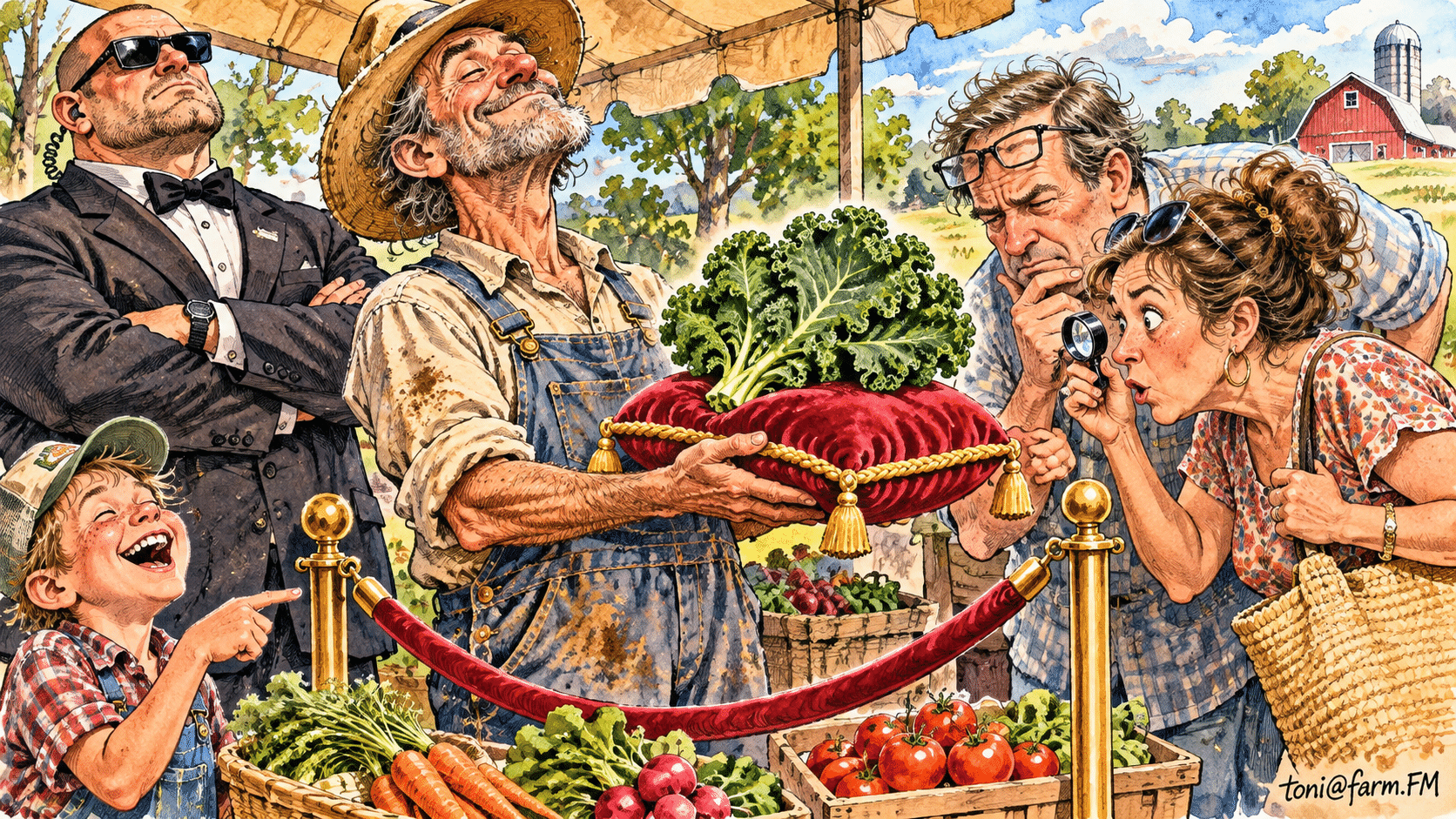
WICHITA FALLS, TEXAS. A local organic grower has unveiled a fourteen-dollar head of kale, forcing customers to decide whether they are buying a vegetable, a luxury handbag or partial ownership in a small agricultural corporation. The leaves are crisp, the stalk is sturdy, and the price requires a moment alone with your financial adviser.
Grower Eleanor Sprout insists the price is completely reasonable. “This kale was raised with patience, sunshine and seventeen different forms of paperwork,” she said. “One leaf heard classical music. Another has a college savings account. You cannot compare that with supermarket produce that never learned its own name.”
Why a $14 Head of Kale Costs More Than Lunch
Sprout’s handwritten cost analysis assigns $1.20 to seed and soil, $2.80 to labor, $3.10 to certification and compliance overhead, $1.90 to market travel, and $5 to “explaining the other nine dollars.” Her accountant refused to certify these numbers, partly because the farm’s accounting system consists of receipts stored under a sleeping cat.
At Saturday’s market, an astonished customer asked whether the kale included dressing. “It includes a profound relationship with the earth,” Sprout replied. “The dressing is six dollars.” A second shopper requested a payment plan. A third offered to trade a used lawnmower and two unopened cans of beans.
Organic Rules Are Real; The Kale’s Life Coach Is Optional
Under the USDA organic certification process, farms seeking certification must meet organic production requirements, submit documentation and undergo inspection. Certification fees vary by operation, and annual reviews matter. That explains genuine costs. It does not explain why Sprout hired a motivational speaker to encourage the kale through a difficult afternoon of photosynthesis.
The motivational speaker was paid $85 and reportedly told the vegetables to embrace their authentic roots. The carrots took it literally. The lettuce requested better lighting. One cabbage announced it was going into consulting.

USDA Finds Real Buyers; Local Farmer Finds a Branding Consultant
The 2022 Census of Agriculture counted 116,617 farms selling directly to consumers, generating $3.3 billion in sales. USDA economists also report that direct food marketing remains a significant channel for producers. Sprout has interpreted this evidence as a mandate to develop a premium kale loyalty program.
Her first customer survey contained three questions: Is the kale delicious? Is the kale worth fourteen dollars? Would you prefer to answer after we explain how hard farming is? The only completed response said, “I just wanted a tomato.”
The Practical Guide to Pricing Produce Without Frightening the Neighbors
A sensible vegetable price considers inputs, labor, transport, waste, certification where applicable and a fair margin. The customer deserves a clear explanation, and the farmer deserves a business that can survive past the next market day. Neither requires a velvet rope around the salad ingredients.
By closing time, Sprout had sold four heads, received eleven compliments and attracted one tourist who asked whether the kale was an exhibit. She celebrated by discounting the final head to $13.95, a humanitarian gesture her accountant described as financially reckless.
Disclaimer: This report is a human collaboration between two sentient beings: the world’s oldest tenured professor and a philosophy major turned dairy farmer. Neither recommends taking out a second mortgage for coleslaw.