
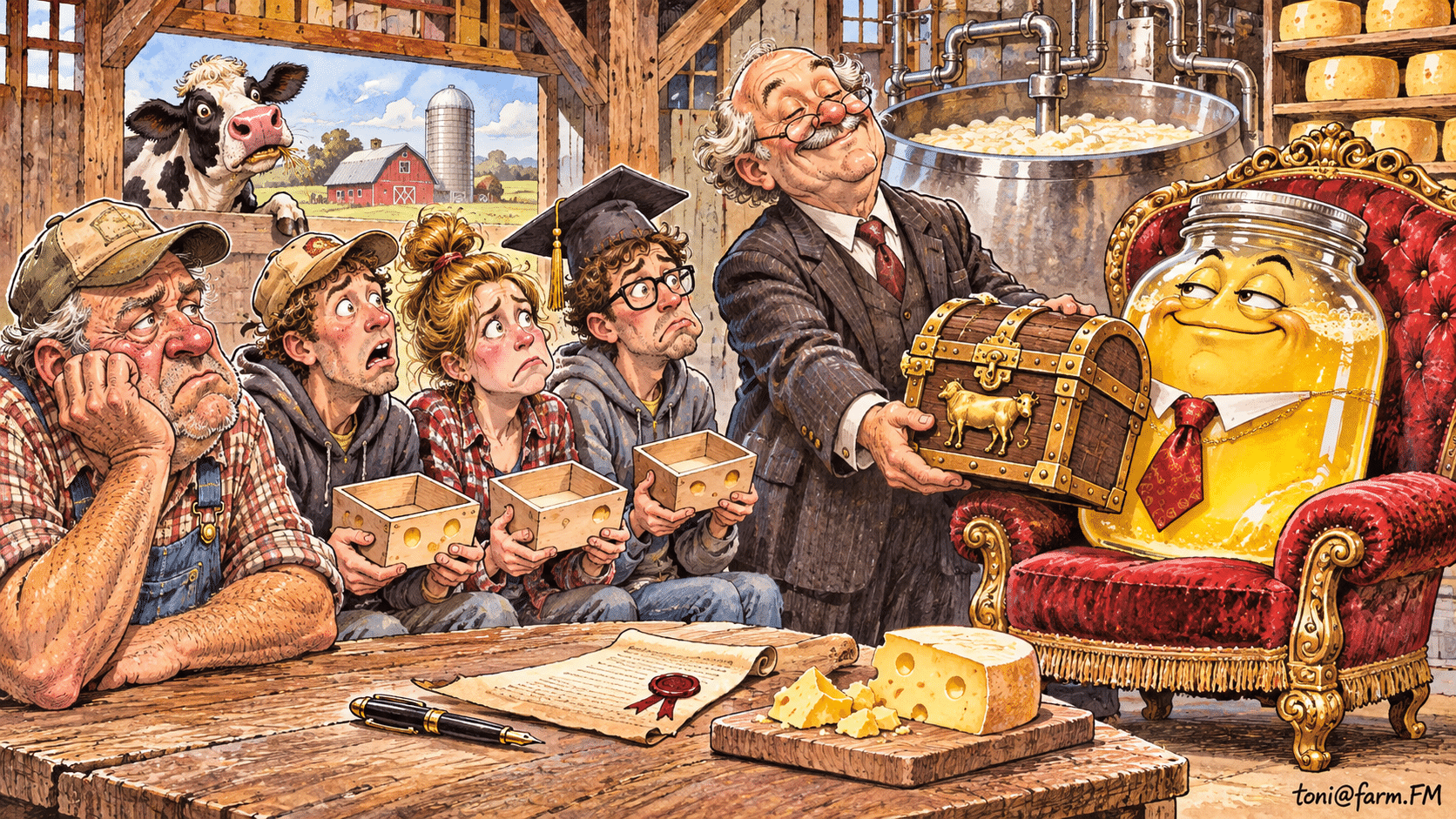
MADISON, Wisconsin. In America’s latest economic miracle, the liquid left over from making cheese has apparently developed a stronger investment portfolio than the average American family. RFD-TV reports U.S. dry whey prices set records in October as overseas appetite for dairy protein pushed this unglamorous byproduct into the executive lounge.
Whey once spent its days watching cheese get all the attention. Now it reportedly wears sunglasses indoors, asks for reserved parking and calls itself a ‘high-value nutritional asset.’ Cheese, which invented the grilled cheese sandwich, is furious.
Dairy Families Reconsider Their Inheritance Plans
At one Wisconsin farm, the family gathered around the kitchen table to discuss who would inherit the operation. The eldest son requested the equipment. The daughter asked about the land. The youngest wanted the pickup. Their father announced that the whey tank would receive the retirement account, while the children could divide the old calving shed.
The son complained that his college degree should count for something. His father explained that whey had never attended college, never financed a sports car and was now worth more than the household’s combined ambitions.
A lawyer consulted by Farm.FM’s barnyard economics department proposed a new estate-planning term: ‘liquid legacy.’ It refers to the rare occasion when liquid makes someone money rather than disappearing into a tractor repair.
Whey Protein Prices Are Almost Unreasonably Athletic
According to the National Milk Producers Federation report cited by RFD-TV, CME dry whey quotations reached their highest levels since trading began in 2018. August dry whey exports also set a record. Southeast Asian buyers purchased 94% more than a year earlier, Canadian purchases nearly quadrupled, and 68% of U.S. production was exported, versus 49% a year before.
Americans spent decades telling children to drink their milk, only to discover the world’s best customers wanted what was left after cheesemakers finished their shift. The future belongs to leftovers, and nobody has apologized to Thanksgiving turkey.
Not every dollar from higher whey prices goes to dairy farmers. Processors, manufacturing contracts, component pricing and product mix determine who pockets the gain. Simply owning a cow does not make you the owner of the global protein market.

Cheese Requests a Meeting With Management
A cheese factory has reportedly installed a velvet rope around its whey collection tank. Security officers usher protein concentrates past blocks of cheddar, which must wait near the loading dock with mozzarella.
At an imaginary shareholder meeting, a wedge of Swiss cheese demanded to know why everyone was investing in the holes. An accountant replied that holes generated no revenue, but at least required no refrigeration. Swiss cheese announced a strategic review.
Meanwhile, a farm wife suggested bottling the tears shed over fertilizer invoices and marketing them as electrolyte supplements. The idea was rejected because existing whey protein products have better promotional agencies.
What Dairy Producers Should Watch
The real questions concern protein premiums, processor pricing, export demand and whether greater value for dairy ingredients eventually reaches milk checks. Producers should review component tests and contracts rather than assume every record commodity quotation automatically improves their balance sheets.
The family compromised. The children kept the farm, the banker kept the mortgage, and whey received a seat on the board of directors. It was the first board member to arrive in a bucket.
The linked whey-price statistics are real; the inheritance hearing is agricultural satire, entirely a human collaboration between the world’s oldest tenured professor and a philosophy major turned dairy farmer.
Last Updated on November 10, 2026 by Alan Nafzger