
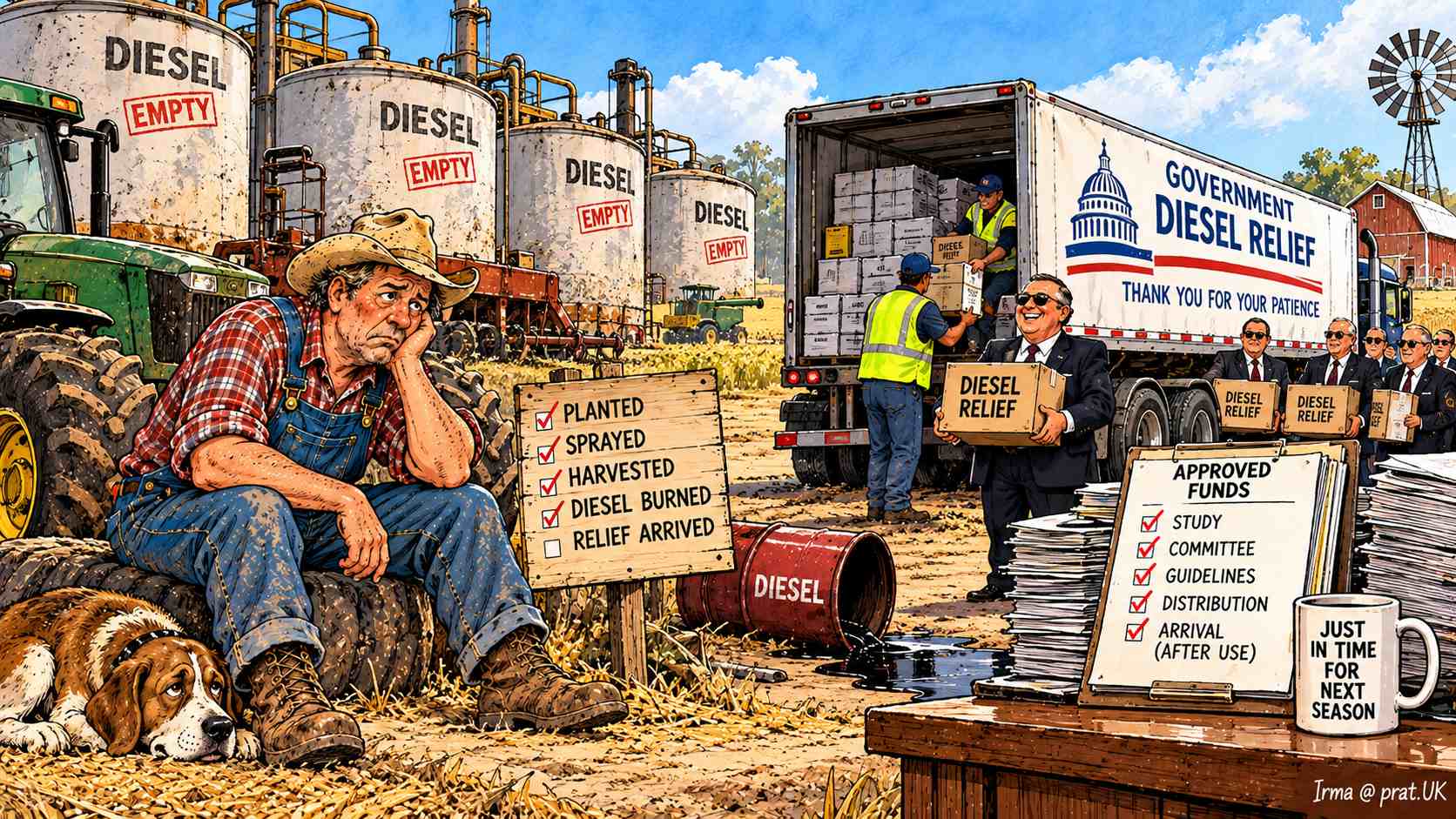
Washington times $8 billion for the day after the bill is due
WASHINGTON, D.C. – The federal government has announced an $8 billion solution to America’s farm diesel crisis, carefully scheduling the assistance for a period when much of the fuel has already been burned, the crops harvested and farmers have developed personal relationships with their overdraft departments.
The Harvest Fuel Relief program follows a fundamental principle of modern government administration: Never provide a solution while somebody can still use it immediately.
USDA official Richard Fordyce indicated that payments would come after the November 3 election, potentially near the end of the year. This remarkable timetable has been welcomed by agricultural economists who previously believed December came after October for purely astronomical reasons. Washington has now established it as fiscal policy.
A Fifth Season Called Retroactive Financial Assistance
Traditionally, American farmers recognize four seasons: planting, growing, harvesting and explaining themselves to the bank. Washington proposes a fifth season called Retroactive Financial Assistance.
During this exciting period, farmers receive government support for expenses they somehow managed to survive without receiving government support. The arrangement resembles a fire department arriving three months after your barn burns down, announcing a $50,000 firefighting initiative and asking whether the ashes are still smoking.
In a Senate hearing, an agriculture official defended the timetable.
“Farmers should recognize that eight billion dollars is an extraordinary amount of money.”
A senator asked whether the fuel companies would wait for payment.
“That’s outside the scope of our models.”
“Will the banks wait?”
“We have not modeled impatience.”
“Will the combines run?”
“That depends on whether they appreciate the magnitude of our commitment.”
Diesel Pumps Reject Government Creditworthiness
Farmers have reportedly begun experimenting with alternative payment methods. One Iowa producer handed a fuel attendant an economic-impact assessment. A Nebraska farmer offered a campaign photograph. A Texas rancher attempted to purchase 200 gallons with a bipartisan expression of gratitude. None proved as effective as an ordinary credit card.
A national poll by the Institute of Extremely Obvious Agricultural Research asked farmers when they would prefer to receive assistance for October expenses. Ninety-eight percent answered October. The remaining 2% requested September, apparently having experienced agriculture before.
The findings surprised nobody except the committee responsible for distributing the funds.
Why Harvest Fuel Relief Timing Hurts Farm Cash Flow
USDA estimates cited in recent reporting indicate that higher fuel prices could add nearly $5 billion to farmers’ annual expenses. The $8 billion package is substantial assistance, but assistance delivered after the expense creates an entirely different financial problem.
Economists call this cash flow. Farmers call it Tuesday. Banks call it another opportunity to discuss collateral.
A farmer borrowing money to purchase fuel must pay interest while waiting for assistance intended to reduce the cost of purchasing fuel. The system therefore creates a magnificent economic circle: Washington helps farmers afford fuel, farmers borrow money while waiting for Washington, and lenders collect interest for helping everyone appreciate Washington’s generosity.
In future, officials may simplify the process by sending agricultural relief payments directly to the banking industry. The farmer could receive a commemorative certificate.
Farmers Offer Washington a Counterproposal
Farmers have suggested that assistance for planting arrive before planting and harvest fuel assistance arrive during harvest. Federal administrators are reportedly studying this radical proposal, which could fundamentally disrupt decades of procedural tradition.
Meanwhile, the October harvest continues. The fuel bills are real. The repayment dates are real. The government assistance is also real, although currently enjoying the recreational luxury of being somewhere else.
America’s farmers remain optimistic. After all, spring planting is only months away. With luck, they’ll receive their harvest assistance just in time to discover fertilizer has become expensive.
The Evidence File
Cost-Benefit Analysis
A farmer who finances $20,000 of harvest diesel at 8% interest for the sixty days between pump and payment owes roughly $263 in interest for the privilege of waiting on a program designed to lower his fuel costs. That figure is calculated here on the back of an envelope, the same tool the program’s acreage models are rumored to use. The bank, notably, did not wait for the election results either.
The Obvious Question Nobody Asks
If the money is for harvest fuel, why does it arrive once harvest is over? Nobody on the platform has answered. The podium, to its credit, has been very good at calling on the next reporter.
Historical Irony
Farmers have been told for generations to plan ahead. The government’s own calendar, meanwhile, plans behind. It is the only organization in America that can be early to a deadline and late to a harvest on the same page of the same press release.
Sources and Further Reading
Program coverage is at RFD-TV, and the department’s announcements are collected at USDA.gov. For diesel price history, see the U.S. Energy Information Administration. For farm credit and lending conditions, see USDA ERS farm finance data.
Source: USDA program details and Reuters reporting published October 23, 2026.
Humorous Observations
- “We have not modeled impatience.” Sir, you work in government. Impatience is the one thing the rest of us have modeled with great success.
- A fire department arriving three months after the barn burns down to ask if the ashes are still smoking. In my county that’s called the fire department.
- Someone tried to buy 200 gallons with “a bipartisan expression of gratitude.” I can’t even get that at a church potluck, let alone a truck stop.
- Two percent said September. I know those guys. They’re the ones who show up to the barbecue with their own folding chair and a spreadsheet.
- The relief arrives just in time to find out fertilizer got expensive. That’s not timing. That’s a subscription.
Last Updated on September 19, 2021 by Alan Nafzger