
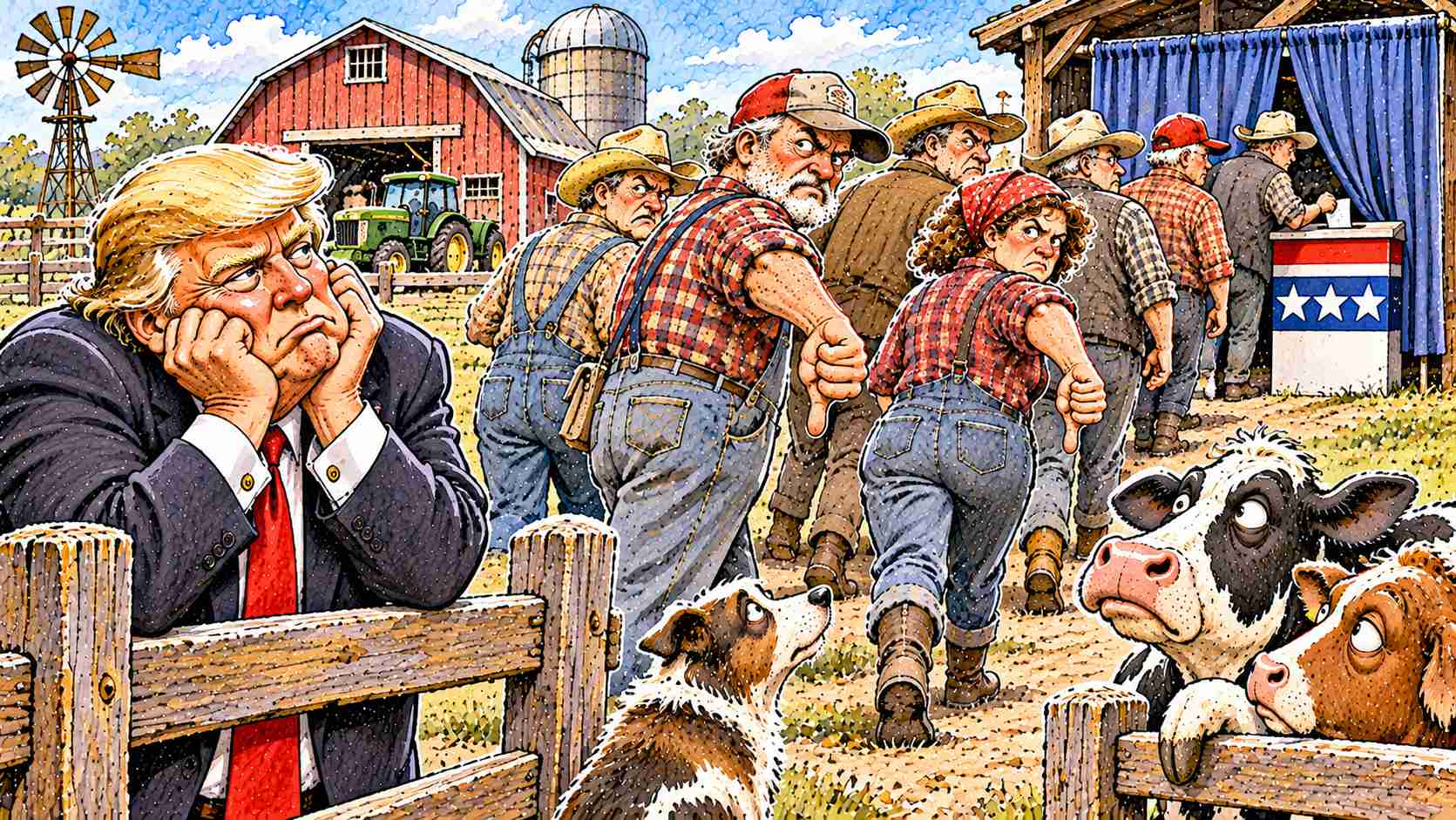
Rural Kansans Count What Loyalty Bought Them
GARDEN CITY, Kansas — American farmers are reconsidering their political relationship with Washington after discovering that the nation’s most profitable agricultural enterprise may actually be the harvesting of rural voters.
Unlike conventional agriculture, political farming requires almost no fertilizer, relatively little equipment and no concern whatsoever about whether the crop produces a financial return. The process begins with planting promises in rural communities.
These promises are watered with campaign advertisements, fertilized with patriotic speeches and harvested every fall. The resulting crop consists of votes. Farmers receive thank-you letters. Political consultants receive invoices marked paid.
A Kansas producer described the arrangement as the most remarkable agricultural business model he had ever encountered.
“I spend thousands of dollars growing wheat,” he explained. “These people spend millions telling me how important I am, and somehow they’re the ones getting rich.”
Political Farming Produces Excellent Yields

Republican consultants have spent years perfecting the art of cultivating rural support.
Their techniques include attending county fairs, purchasing expensive cowboy boots and occasionally posing beside agricultural equipment they cannot identify. One consultant referred to a combine as an unusually large tractor. A farmer politely corrected him. The consultant asked whether the combine was electric. The farmer requested that somebody remove him from the property.
Political agricultural operations also benefit from an unusual exemption.
Actual farmers must pay for seeds, chemicals, machinery and labor before selling their crops.
Political consultants can raise campaign contributions before producing any measurable improvement in rural life. A farmer suggested that agricultural producers adopt the same arrangement.
Instead of selling wheat, they could distribute photographs of wheat and request donations. The idea attracted immediate interest from Washington.
One consultant offered to manage the farmer’s fundraising campaign for 30% of the proceeds.
The farmer realized he had accidentally created another political consultant.
Democrats, meanwhile, established competing rural voter harvesting operations.
Their approach involved emphasizing affordable health care, corporate accountability and agricultural assistance. Republicans accused Democrats of cultivating the wrong crop. Democrats accused Republicans of exhausting the soil.
Farmers wondered why nobody had offered to help repair the irrigation system.
One agricultural political scientist observed that voters often judge parties through a combination of cultural identity, economic interests and personal experience.
This made the farm vote more complicated than simply distributing campaign hats. The consultant asked whether the scientist could simplify the findings.
“Farmers want results.”
The consultant nodded.
“Excellent. We’ll print that on a hat.”
Early Voting Shows Rural Georgia Lagging as Suburbs Surge
The sense that rural turnout is soft is not confined to the Plains. An Atlanta Journal-Constitution analysis of Georgia early voting found that in the 132 counties Trump carried in the last presidential race, early turnout was essentially flat compared with the same point in the previous midterm. In the 27 counties that voted for Kamala Harris, ballots cast were up 9%. Early turnout was down by double digits in Coffee, Colquitt and Laurens counties. The paper cautioned that Republicans traditionally vote later, so the picture could change.
From a Consultant’s Invoice
A copy of an invoice from a Washington consulting firm to a Kansas campaign, obtained by this publication, lists “rural authenticity” at $14,000 and “boot sourcing” at $2,600. A line item marked “farm visit (one)” is billed at $5,000. The final line reads: “Hat.” The farmer who saw the invoice said he had a hat. He said it was in the truck.
Transcript From a County Fair Forum
Moderator: Next question. How will you support Kansas farmers?
Candidate: By listening.
Moderator: To what?
Candidate: To farmers.
Moderator: And then?
Candidate: I’ll listen some more.
Audience member: Can you listen to my combine? It’s making a noise.
The Last Time This Happened
Rural politics has been reshaped by a farm downturn before. The Reagan-era farm crisis sent foreclosures and bank failures across the Plains and rearranged loyalties in county after county for a decade. Old-timers in Garden City remember the auctions, the neighbors who came to bid low as a kindness, and the signs that went up when the credit dried up. “Nobody asked who you voted for,” said one retired rancher. “They asked if you had a trailer.”
By election season, rural communities were being visited by so many campaign representatives that one cattle producer considered installing a gate requiring political visitors to pay admission. Republicans would pay by the hour. Democrats would pay by the committee. Television reporters would pay double. At harvest, the farmer watched his combine move steadily across the field.
He wondered why politicians could collect votes with such extraordinary efficiency while farmers struggled to collect profits. Then the answer occurred to him. Politicians had discovered something farmers could only dream about. A crop that never required them to deliver the product.
Five Humorous Observations About Being Farmed
- Political farming is the best racket. You plant a promise, harvest a vote, and never pay for the seed.
- A consultant called my combine an unusually large tractor. Sir, that’s not a tractor. That’s what a tractor has nightmares about.
- A fundraising campaign for wheat. Send a photo of wheat, get a donation. Honestly the best idea I’ve heard all month.
- Admission to the farm: Republicans pay by the hour, Democrats by the committee, TV reporters double. Finally, some honest pricing.
- A crop you never have to deliver. I’d trade the whole place for that.