
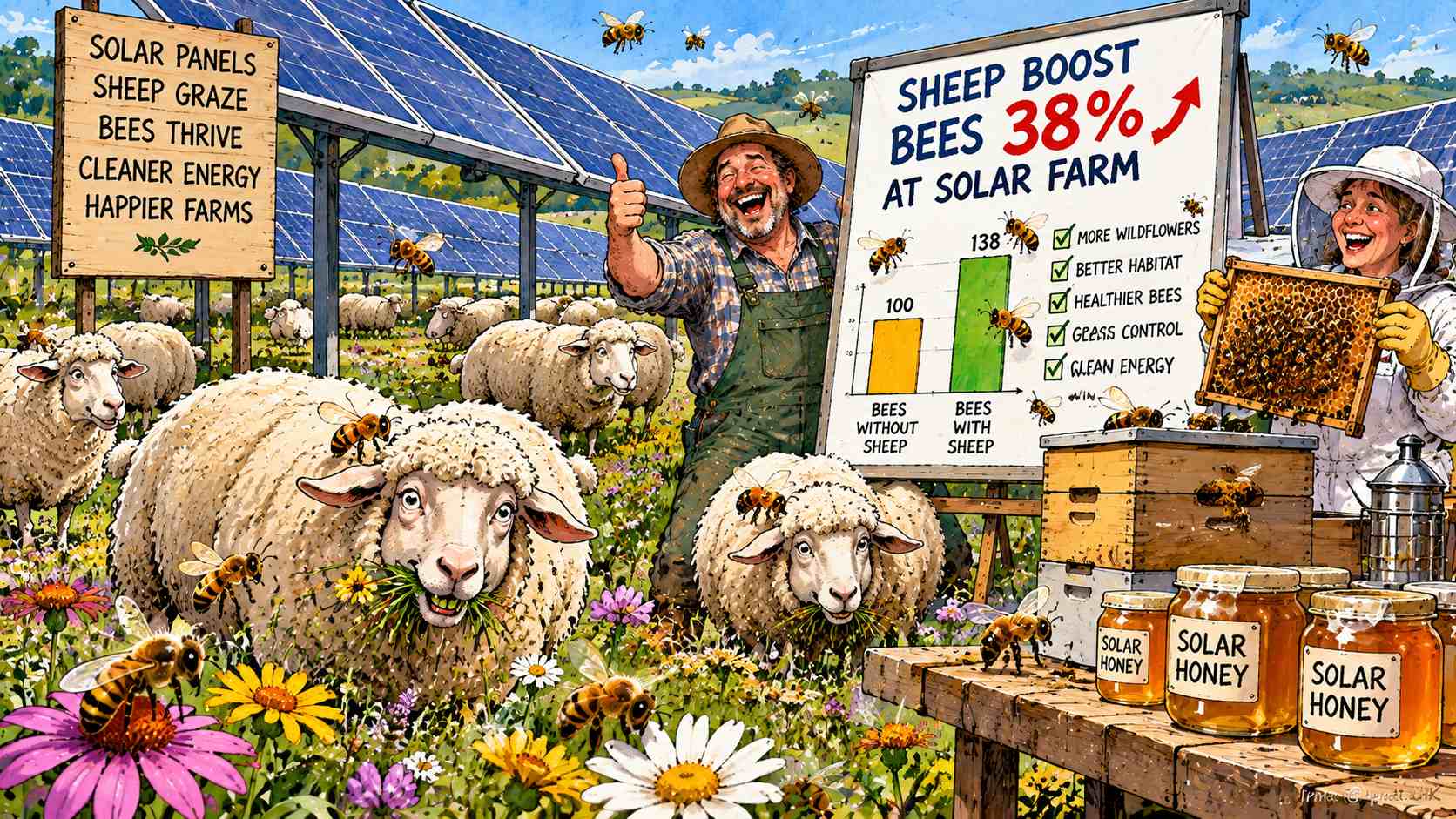
Cornell shows nature works without a consultant
DRYDEN, NEW YORK – Scientists at Cornell University have made an important discovery about solar farms, grazing livestock and beneficial insects: under the right conditions, sheep can improve an agricultural ecosystem simply by eating grass.
The Cornell research announced October 14 found that grazing two sheep per hectare around solar panels increased the combined abundance of certain beneficial insects by 38% compared with mowing. Honey bee abundance rose 83% in the study’s low-density grazing treatment. Washington responded by investigating why the sheep had achieved these results without submitting a grant application.
The Sheep Accidentally Become Environmental Scientists
For generations, farmers have understood that livestock grazing can change vegetation. The Cornell research added scientific detail by examining how different sheep stocking densities affect the insects living around solar installations, in a paper published in Environmental Research Letters. At two sheep per hectare, beneficial insect abundance increased. At four, it was similar to the mowed control. At eight, vegetation management was strongest, but honey bee abundance fell 45%.
The results suggest that stocking rates matter. Too few sheep may leave vegetation unmanaged, and too many may reduce important flowering resources.
Professor Clifford Wool, an environmental consultant, described the implications.
“We’ve discovered that ecological systems respond differently depending on how many animals are present.”
A sheep farmer responded that cattlemen had been explaining stocking rates since before universities invented research departments.
Washington Announces the National Grass Committee
Under a federal proposal, a new agency would regulate the relationship between sheep, grass and bees. Every sheep would receive an Individual Grazing Authorization. Every bee would register its preferred flowers. Grass would submit annual growth forecasts.
A farmer questioned whether this was necessary.
“The sheep eat the grass. The flowers support insects. The solar panels generate electricity.”
The committee chairman nodded.
“Exactly. We need at least three departments.”
The farmer suggested that a healthy pasture might not require additional federal administration. The chairman requested that the comment be removed from the minutes.
The Great Bee Satisfaction Poll
A survey asked 500 honey bees whether they preferred solar farms managed with appropriate sheep grazing or conventional mowing. Seventy-two percent requested more flowers. Twenty percent requested fewer agricultural consultants. Eight percent asked whether their honey would qualify for renewable energy credits.
The insect abundance measurements, unlike the bees’ opinions, came from actual field research.
What the Solar Grazing Study Teaches About Conservation
The genuine research demonstrates that conservation benefits depend on management choices. Sheep grazing is not automatically superior in every location. The number of animals, vegetation conditions, available forage and farm economics all matter. That is exactly why field studies are useful: rather than imposing one universal solution, researchers can identify the conditions under which particular practices work best.
The same principle applies to agricultural policy. A practice that helps a small sheep operation in New York may need modification before it works on a large ranch in Texas. Farmers understand that land is not interchangeable. Neither are livestock.
Congress Considers Hiring More Sheep
A congressional committee proposed replacing traditional landscaping crews around federal buildings with sheep. Supporters argued that sheep could cut mowing costs. Opponents worried about manure. One senator asked whether sheep could also reduce the federal deficit. An agricultural economist explained that the animals would need considerably more grass. A Texas rancher proposed grazing them directly on congressional expense reports.
The World’s Most Productive Lunch Break
The Cornell findings offer a practical opportunity for farmers and solar operators to cooperate. Sheep provide vegetation management. Solar facilities provide grazing. Beneficial insects may benefit when grazing intensity is right. And farmers may gain additional income from services they can provide.
A shepherd watched his flock grazing beneath solar panels.
“The sheep are eating. The solar panels are producing electricity. The bees are doing their thing.”
A federal consultant asked whether the arrangement required additional oversight.
The shepherd shook his head.
“Not unless you can find something useful for the consultant to eat.”
The sheep continued grazing. The bees continued visiting flowers. The consultant requested a feasibility study.
The Evidence File
The Real Study Design
According to coverage in FingerLakes1, the work ran three years at Cornell’s Cascadilla Community Solar Farm in Dryden, comparing grazed plots with one kept by mowing. Three summers of sheep, three stocking rates and a lot of counting insects. No consultant counted a single bee.
Logical Contradiction in the Comic Plot
The committee insists it needs three departments to oversee something that works with none. That’s the same government that says it wants efficiency and then appoints a subcommittee to study the word. The sheep, for the record, have not filed for a department.
Reductio ad Absurdum
If two sheep help bees by 38% and eight sheep cut bees by 45%, then somewhere around five sheep a bee is simultaneously thriving and applying for asylum. Science calls this a trade-off. A bee calls it a Tuesday.
Sources and Further Reading
The research is covered at Cornell Chronicle, and the project’s history is at Cornell CALS. Federal context is available from NREL.
Source: Cornell University, October 14, 2026, summarizing research published October 7 in Environmental Research Letters.
Humorous Observations
- Two sheep, bees go up 38%. Eight sheep, bees go down 45%. So the bee is the only animal in America with a perfect understanding of how crowded a party gets.
- “Cattlemen have been explaining stocking rates since before universities invented research departments.” Yes, and they did it at a feed store, without a grant, using a pickup tailgate as a whiteboard.
- Grazing sheep on congressional expense reports. Finally, a government document someone would actually finish.
- Honey bees asked about renewable energy credits. Of course they did. That’s the first insect in history to read the fine print.
- The consultant requested a feasibility study. The sheep, meanwhile, requested lunch. One of them is getting results.
Last Updated on June 1, 2024 by Alan Nafzger