
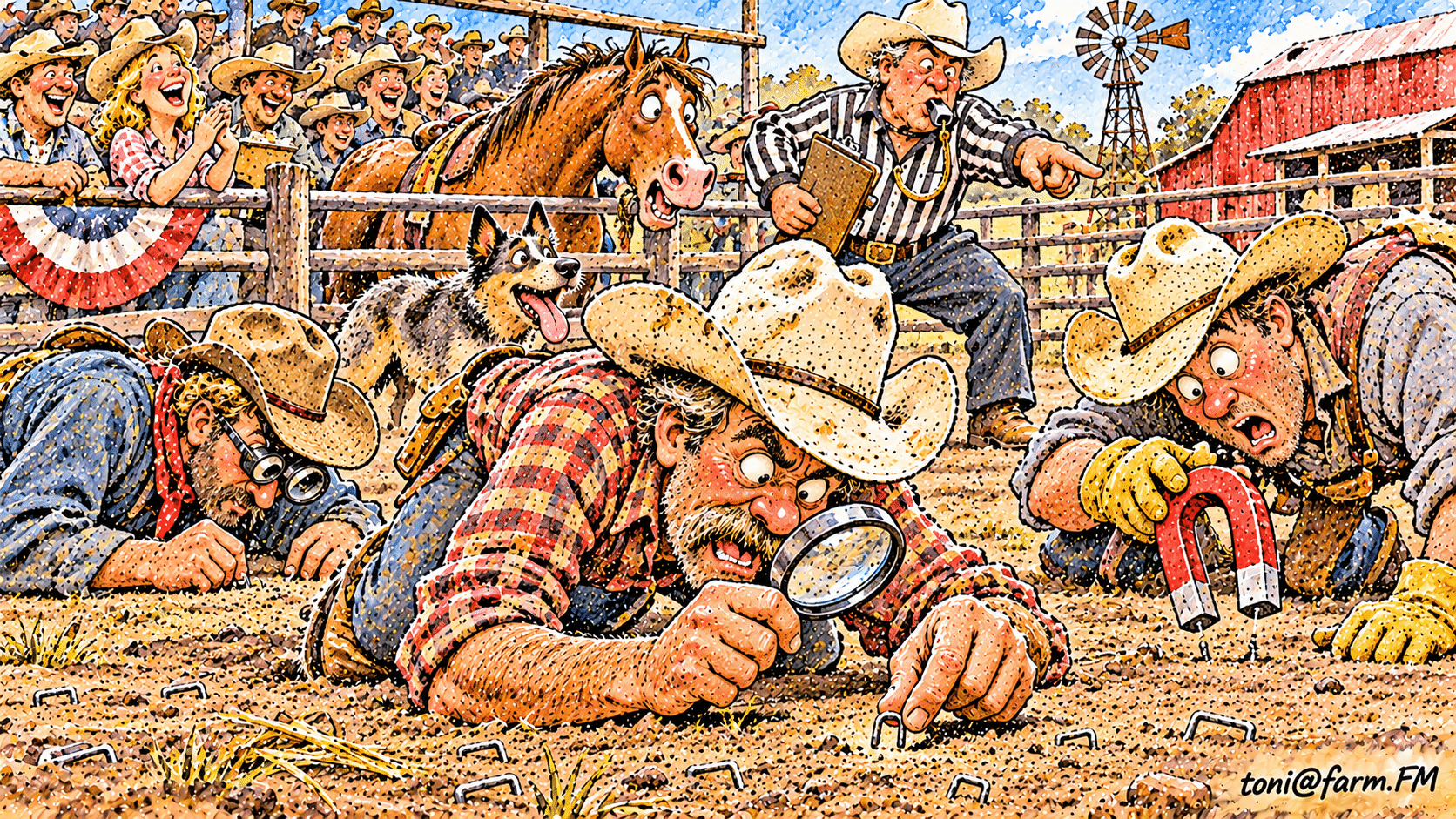
Ranch Rodeo Cowboys Compete to Find the Missing Fence Staple
AMARILLO, Texas (Farm.FM) — A ranch rodeo committee has introduced what organizers call the ultimate test of cowboy ability: locating a missing fence staple somewhere along forty acres of pasture before the cattle notice the gate is loose.
The contest attracts cowboys who have spent their lives searching for things that were in their pockets ten seconds earlier.
“Roping a steer is hard,” said competitor Wade Rucker. “Finding one rusty staple in a pasture while your uncle explains how he would’ve done it in 1978 is a spiritual ordeal.”
Each team receives a hammer, a bucket of replacement staples, and a supervisor who repeatedly asks why the job isn’t finished.
Ranch Rodeo Recognizes the Everyday Cowboy Olympics
Working ranch rodeos already showcase practical skills. The real Working Ranch Cowboys Association promotes ranching traditions and lists events such as stray gathering, team penning, and wild cow milking in its annual championship.
The staple contest rewards every rancher’s natural talent for losing things within arm’s reach.
Judges award points for speed, technique, and how convincingly a contestant claims, “It was right here.” Penalties apply for throwing the hammer, blaming children who are nowhere nearby, or buying a new fence because the old one has become emotionally exhausting.
Rucker’s partner, Boots Mendez, has trained for the championship by walking a perimeter fence at daybreak and returning with a broken glove, a pocketknife, and seven new problems. His veterinarian calls this cross-training.
A marketing executive proposed a tourist challenge: open a gate, drive through, and close it before the cattle escape.
The contestants rejected the idea as an extreme sport requiring professional insurance.
Corporate Sponsors Discover Cattle Don’t Follow Schedules
A sponsor requested that every competition conclude within ninety minutes to accommodate streaming advertisements. Rucker replied that nobody had successfully communicated a ninety-minute deadline to a cow, a thunderstorm, or a borrowed tractor.
One new event, Find the Matching Socket, requires participants to repair a hydraulic leak with only the contents of an old toolbox. Judges consider it cheating to open a second toolbox, although all contestants insist that is how the first one normally works.
The livestock remain unimpressed. A steer wandered into rehearsal, stepped on the prize ribbon, and refused to acknowledge the organizing committee.
The association’s real mission is to preserve working-ranch skills, not turn every inconvenience into television programming. That distinction was lost on the executive, who suggested a reality series called America’s Next Top Fence Post.
The financial context is real enough: USDA forecasts farm-sector debt at $605.1 billion in 2026. No cowboy needs a luxury prize that comes with a payment plan.
Rucker proposed a championship reward that every rancher could appreciate: a fully stocked toolbox in which the tools remain exactly where they were left.
Judges called it unrealistic.
First prize will instead be a new hammer and the chance to look for the old one.
Disclaimer: The new contest, organizers, participants, and quotations are satirical. The WRCA mission and USDA financial statistics are real. This story is entirely a human collaboration between two sentient beings: the world’s oldest tenured professor and a philosophy major turned dairy farmer.