
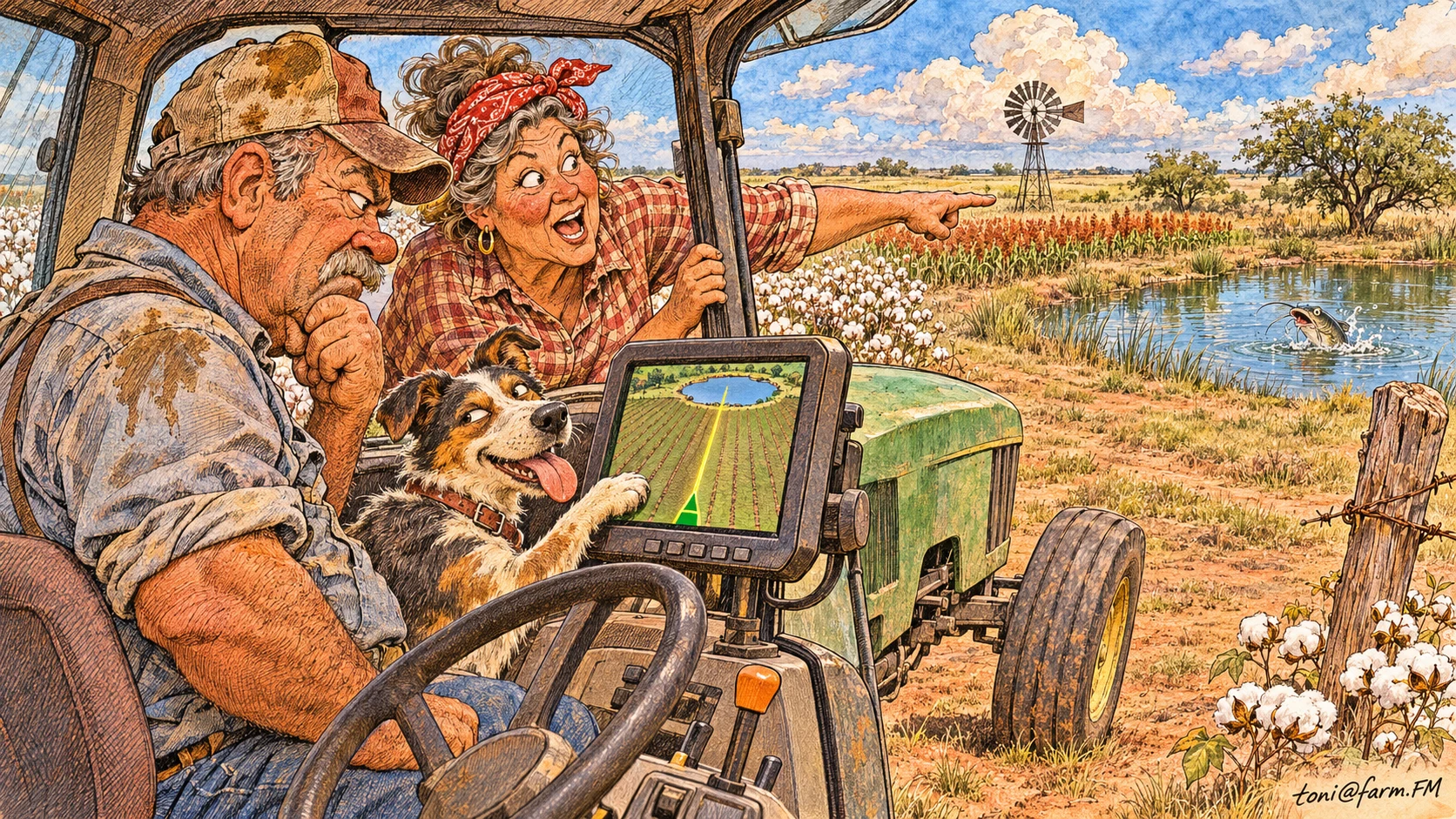
LEVELLAND, Texas — Precision agriculture has drawn a perfectly straight guidance line through Clyde “Straight Row” Mercer’s stock tank, producing the first farm map in Hockley County accurate enough to prove that water is not row crop.
Clyde installed a guidance display because he was tired of overlapping fertilizer, missing strips and hearing his wife say, “You already covered that,” in the calm voice she reserves for expensive mistakes.
The salesman promised repeatable passes, reduced fatigue and better use of seed, fuel and inputs.
Clyde asked whether the system could also repeat last year’s wheat price.
The salesman said it controlled the tractor, not Congress.
Precision Agriculture Meets the Old Fence Post
Clyde consulted the PrecisionAgDirectory for GPS guidance, RTK correction, equipment compatibility, yield monitors, soil sampling, sensors, software and setup worksheets. The directory recommended starting with a goal, checking compatibility, recording settings and testing before treating a forty-year-old tractor like it attended college.
Clyde’s goal was simple: fewer overlaps.
His first plan was also simple: turn everything on.
His wife, Marlene, asked which correction signal, implement width, antenna offset and field boundary he had entered.
“Texas,” Clyde said.
Marlene explained that Texas was a state, not an implement measurement.
The USDA Economic Research Service report on precision agriculture notes that automated guidance can reduce skips and overlaps, lower input costs and lessen operator fatigue. Benefits depend on the technology, farm and correct configuration instead of pressing every green button.
Clyde considered the last condition unnecessarily personal.
The AB Line Acquires Waterfront Property
To create an AB line, Clyde marked one point near the north gate and another at the far end of the field. Unfortunately, the second point was selected while he was wiping barbecue sauce from the display.
The resulting line ran directly through the stock tank.
The tractor engaged and began steering with the confidence of a man who had never personally paid for a radiator. Clyde watched the hood settle onto the line.
“That is impressive,” he said.
“That is water,” Marlene said.
Clyde disengaged long before the bank. The display continued suggesting that the shortest route to agricultural efficiency involved catfish.
They corrected the points, entered the actual implement width and measured offsets. Then they drove a short test pass with the equipment raised, checked the return path and compared the tire tracks with the screen.
The line was straight.
The fence remained employed.

The tractor found the line; Clyde found the pond.
A Six-Inch Overlap Receives an Invoice
With the system properly set, Clyde planted a test field and watched the guidance display keep passes consistent. The precision was good enough that he began treating every saved inch as a financial recovery.
Marlene used the directory’s overlap calculator to estimate how extra width accumulates across repeated passes. Clyde had always considered six inches too small to discuss unless it concerned rainfall. Now six inches of redundant field operation became fuel, seed, fertilizer, wear and time.
He issued the old overlap an invoice.
The overlap did not pay.
At the headland, Clyde remained responsible for turns, obstacles, people and livestock. Autosteer reduced steering effort; it did not grant the tractor judgment or a working relationship with the irrigation riser.
Clyde’s dog rode in the cab and monitored the operation from the passenger seat. Its principal contribution was placing one paw on the display and opening a menu for a crop that had not been planted in Texas since Reconstruction.
Marlene added “lock screen around dog” to the setup record.
Yield Maps Discover the Family Argument
At harvest, the yield monitor produced a colorful map showing strong and weak areas. Clyde immediately described the green zones as evidence of skill and the red zones as foreign interference.
Marlene asked whether the monitor had been calibrated.
They checked harvested weight against a reliable scale, reviewed moisture readings and removed obvious bad data from stops, turns and partial header widths. After cleaning the map, one mysterious low-yield streak disappeared. It had been created while Clyde stopped to retrieve a dropped sandwich.
“That sandwich cost eighteen bushels on the first map,” Marlene said.
“It had bacon,” Clyde replied.
They compared the patterns with soil tests, drainage, field history and scouting notes instead of treating one bright map as divine instruction. One low area aligned with poor drainage. Another followed compaction. A third held a bargain seed lot advertised by a man whose office was a bass boat.
The map did not recommend a purchase. It recommended another question.
The Straight Row Requires a Human
By season’s end, Clyde used guidance lines, saved setup records and backed up field data. He also kept a paper notebook because no satellite had ever survived fifty years in the pickup door.
The system reduced overlap and fatigue. It did not replace calibration, observation, maintenance or Marlene standing beside the tractor asking why the implement width was entered in centimeters.
Clyde now defines precision agriculture as “making the mistake exactly enough to find it.”
He still calls himself Straight Row Mercer.
The stock tank has requested a no-drive zone and waterfront assessment.
Farm.FM Disclaimer
This report is entirely a human collaboration between two sentient beings — the world’s oldest tenured professor and a philosophy major turned dairy farmer. Neither recommends testing autosteer on livestock, relatives, public roads or water deep enough to contain a disappointed catfish.
Last Updated on November 17, 2026 by Alan Nafzger
A perfect guidance line through the stock tank is how you learn the catfish did not sign up for sorghum, and GPS guidance and precision-ag dealers can usually move that line off the water cheaper than filling the pond.