
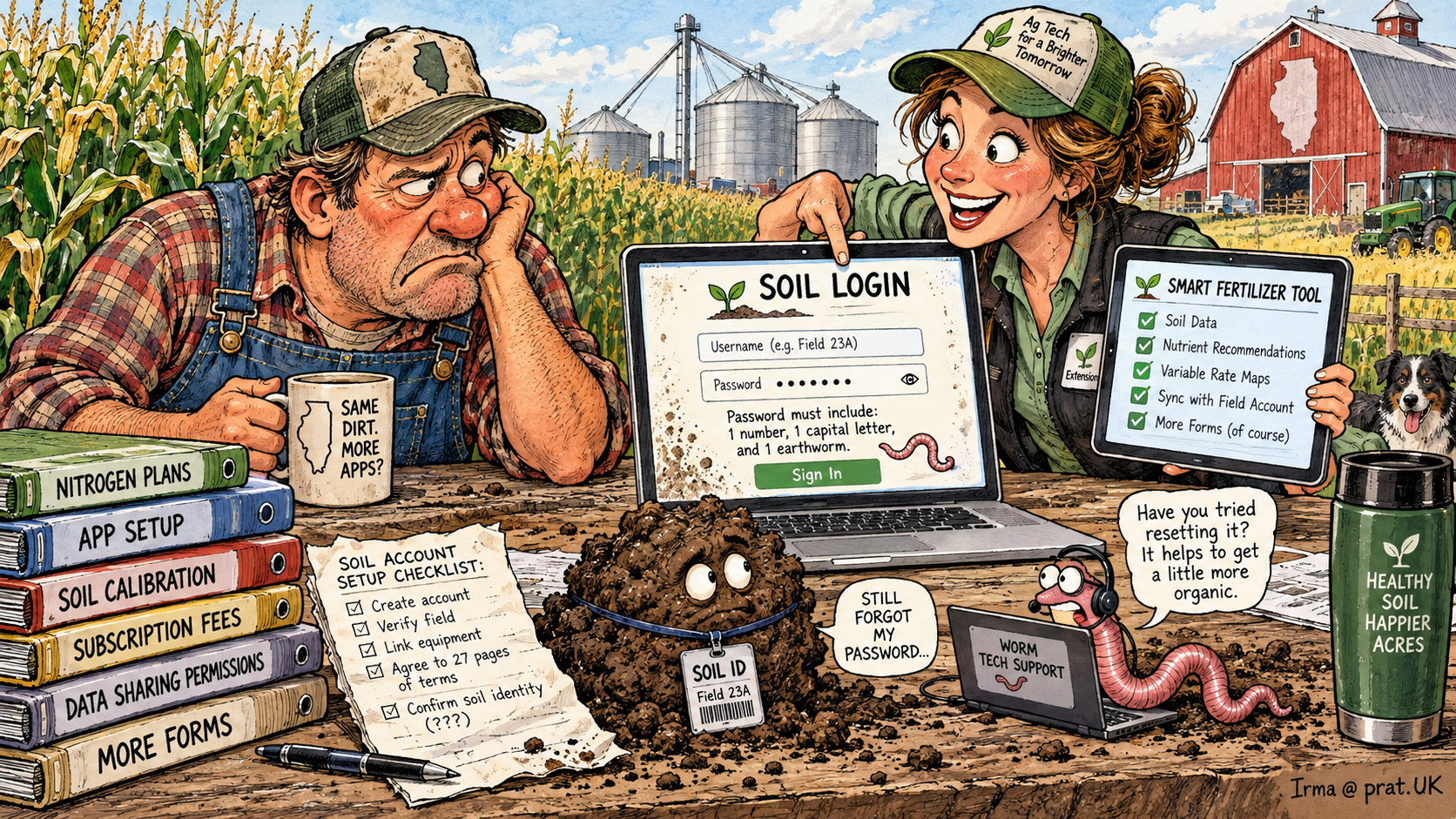
USDA funds a smart fertilizer tool and farmers ask if dirt needs an app
CHAMPAIGN, ILLINOIS – American farmers are preparing for a revolutionary future in which even ordinary agricultural soil may require a password, software updates and a customer service department.
The USDA announced $65 million for 34 Conservation Innovation Grants on October 23, including an Illinois project developing a data-driven decision tool to help producers decide where and when to apply nitrogen fertilizer. The project combines field experiments, sensors, weather information and other agricultural data, with the aim of improving fertilizer efficiency, supporting farm profitability and reducing waste, per the NRCS grant program. Farmers welcomed the scientific progress while asking whether the software could also explain why fertilizer costs so much.
America’s First Intelligent Dirt
For centuries, farmers have studied soil using experience, testing and agricultural research. Modern technology promises increasingly precise decisions based on information gathered all season. Professor Carlton Spreadsheet, director of the Institute for Digitally Enhanced Dirt, believes this is a historic milestone.
“We’ve finally discovered that soil contains information.”
An Illinois farmer responded that his grandfather had identified this phenomenon by observing whether anything grew.
“Yes,” Spreadsheet replied, “but your grandfather didn’t generate a downloadable dashboard.”
The professor recommended building an agricultural technology platform where farmers could monitor nitrogen, weather, moisture and the psychological well-being of their topsoil.
Washington Announces the National Soil Login Program
Under a proposal, every farm would receive a unique digital soil identification number. Farmers wishing to apply fertilizer would first log into the Agricultural Nitrogen Management Portal, which would ask whether they were human. After successful verification, users would be prompted to identify every photograph containing a tractor. The system would then request a password containing eight characters, two numbers, one special symbol and a small amount of organic matter.
A farmer attempting to apply nitrogen before an approaching rainstorm would receive the message:
“Your session has expired.”
The rainfall would continue without authentication.
Why Nitrogen Management Is Serious Business
Nitrogen management is a real financial and environmental challenge. Applying too little can limit yields, and applying too much wastes money and can contribute to water-quality problems. Weather and field conditions affect how much nitrogen is available, which makes timing and placement important. Decision tools that combine credible research with field-level data can help producers choose better, and the USDA’s Illinois project is meant to explore exactly that.
A survey of 600 corn farmers found that 91% favored reducing fertilizer costs without reducing yields. Seven percent requested improved nitrogen application timing. Two percent wanted a phone app that could persuade fertilizer suppliers to offer discounts. Scientists suggested the third objective would require substantial additional research.
The Farmer’s Digital Revolution
Agricultural innovation is most valuable when it solves problems without creating new administrative burdens. Farmers routinely operate complex machinery, use precision agriculture and analyze financial information. They don’t object to technology. They object to technology that requires three subscriptions, fourteen updates and a password reset before breakfast.
An Illinois farmer tested the proposed concept.
“So this app tells me when to apply nitrogen?”
“Correct.”
“And where?”
“Correct.”
“Will it save me money?”
“That’s the goal.”
“Will it work without an internet connection?”
The software consultant became quiet.
The World’s Most Experienced Soil Consultant
The farmer finally walked outside, picked up a handful of soil and examined the field. His grandfather would have recognized the gesture. The difference was that today’s grower could also use weather forecasts, soil tests and scientific models to sharpen the decision. That is genuine progress.
The farmer returned to the computer. The app displayed its first recommendation.
“Check field conditions.”
He looked out the window.
“It’s raining.”
The program requested $49.99 to unlock the premium agricultural weather package.
The Evidence File
Real Research Behind the Joke
Nitrogen decision tools are a real research area, and earlier grant rounds funded work like Purdue’s hyperspectral leaf-scanning project for assessing corn nitrogen status with a field robot. The idea of reading a plant to guide fertilizer is old. Putting a login in front of it is the part Washington contributed.
Unintended Consequences
If the app works, farmers apply less nitrogen, fertilizer dealers sell less nitrogen, and the dealer’s own app starts sending the farmer “We miss you” emails. Efficiency is a wonderful thing until it is somebody’s revenue line.
Comic Eyewitness Testimony
Gil Bassett, a crop adviser from Piatt County, says the best soil sensor he ever used was a boot. “You step on it, it sinks, and you say, ‘Wet.’ It never once asked for my email.”
Sources and Further Reading
For the research side, see the USDA Agricultural Research Service, university work from Illinois ACES, and the NRCS grants page.
Source: USDA Conservation Innovation Grants announcement and 2026 awards information.
Humorous Observations
- A password for dirt. Eight characters, one symbol, and one worm. The worm is the real two-factor authentication.
- “We’ve finally discovered that soil contains information.” Yeah, buddy, it’s called “a field.” We’ve been doing the reading.
- The app says “Check field conditions.” That’s a $49.99 way to say “look out the window,” and I’m told some people paid.
- Prove you’re human by picking the pictures with a tractor. You know who can’t do that? A guy who’s been on a tractor eleven hours. All he sees is the sun.
- The rain doesn’t need to log in. That’s why rain has outperformed every software company in agriculture since the Bronze Age.
Last Updated on July 11, 2022 by Alan Nafzger