
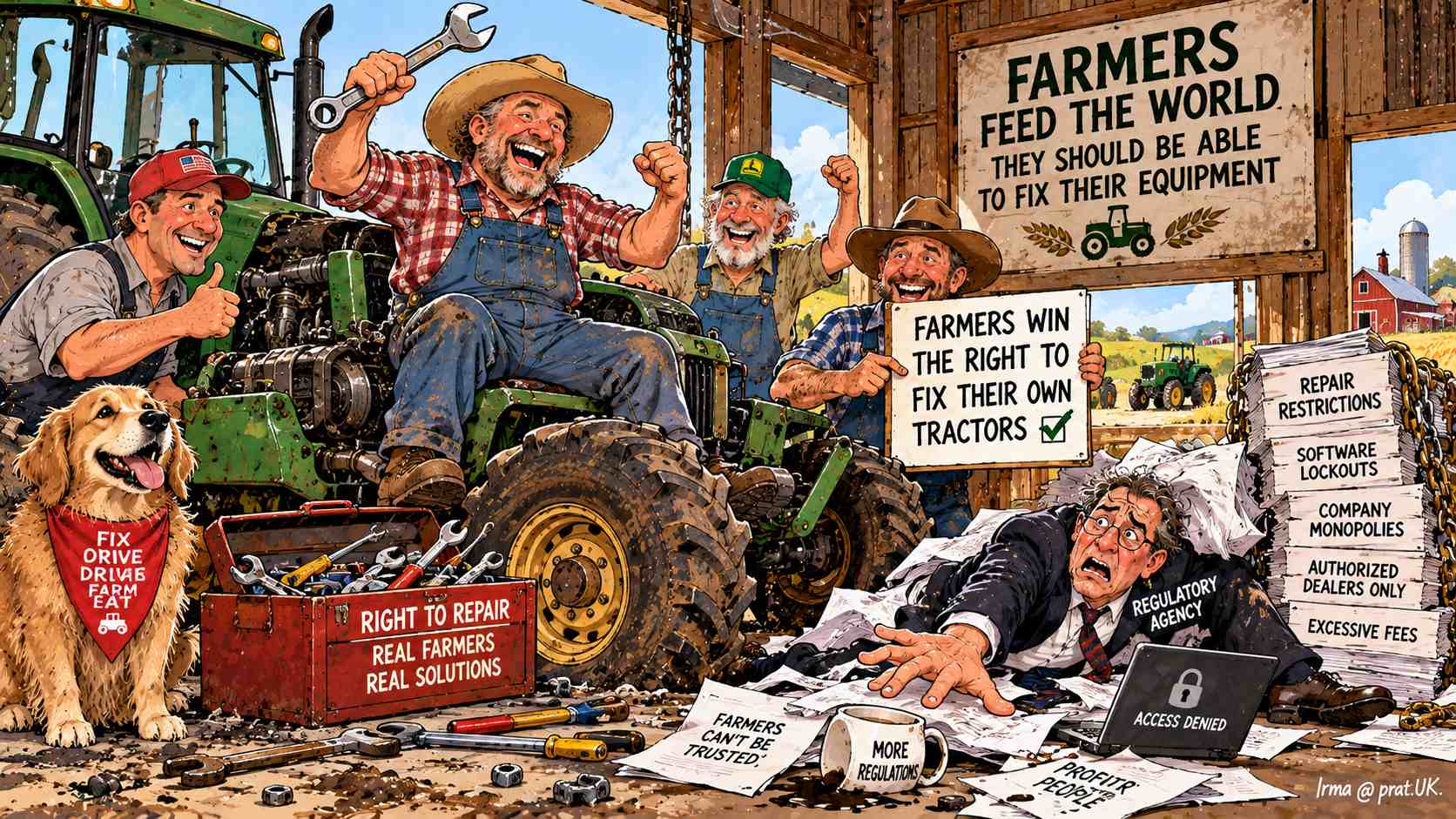
FTC Settlement Proposal Recognizes Radical Property Rights Theory That Buying a Tractor Might Include Permission to Repair It
MOLINE, ILLINOIS – American farmers are celebrating a historic breakthrough in private property rights after federal regulators advanced the shocking legal theory that purchasing an expensive tractor might entitle its owner to repair the machine.
The Federal Trade Commission announced a proposed settlement with Deere & Company in July, following allegations that repair restrictions harmed farmers and independent mechanics.
The proposed 10-year order would require Deere to make important diagnostic tools, software capabilities and repair information available to equipment owners and independent providers on fair and reasonable terms.
The stipulated order still requires court approval to acquire the force of law.
Farmers expressed appreciation that the government was finally considering whether a man who purchased a tractor should be allowed to open its hood.
The Great American Wrench Liberation
For generations, American farmers repaired their own machinery.
When something broke, they found the problem.
They grabbed a wrench.
They fixed it.
Modern electronic equipment introduced a more sophisticated approach.
When something broke, the computer identified the problem.
The farmer grabbed a wrench.
The computer explained that further assistance might require specialized software.
A satirical Nebraska farmer described the experience.
“My grandfather rebuilt an engine beside a cornfield with two wrenches and a cigarette.”
He looked at his modern tractor.
“This one needs a software update to recognize that I replaced a perfectly good sensor.”
His grandfather reportedly rotated several times in his grave.
Property Rights Receive a Software Update
The FTC’s lawsuit alleged that restricted access to certain repair tools forced farmers toward authorized Deere dealers, contributing to higher costs and delays.
Deere has disputed the allegations and has expanded owner-facing repair resources.
The proposed settlement addresses electronic fault codes, component reprogramming, technical information and restarting machines after certain emissions-related shutdowns.
These capabilities matter because a broken tractor during harvest is not the agricultural equivalent of a malfunctioning office printer.
Crops are waiting.
Weather is changing.
Every hour can matter.
One satirical rural economist calculated that a tractor sitting idle during a perfect harvest afternoon produces exactly zero bushels.
His research was published under the title “Things Farmers Already Know.”
It became the university’s most widely understood economics paper.
Farmers Organize the First Wrench Independence Day
An openly satirical survey of 500 farmers found that 97% supported the ability to repair their own machinery.
Two percent were uncertain.
One percent was an authorized dealership manager experiencing an unusually stressful afternoon.
A fictional celebration outside an Illinois equipment dealership featured speeches, fireworks and a ceremonial opening of a tractor’s hood.
The crowd became emotional.
One farmer wept.
Another kissed his socket wrench.
A third discovered that he had misplaced the 10-millimeter socket, restoring normal workshop conditions.
Congress Discovers a Dangerous Precedent
The right-to-repair debate has potentially alarming implications for other industries.
If farmers can repair tractors they own, homeowners may demand permission to repair refrigerators.
Drivers could insist on maintaining cars.
Consumers might begin believing that ownership includes practical control over their possessions.
A satirical corporate consultant warned that the trend could undermine the entire business model of charging customers for problems they might otherwise solve themselves.
Congress ordered a study into whether Americans should be permitted to sharpen their own pencils.
The Farmer’s Final Verdict
Manufacturers have legitimate interests in safety, intellectual property and equipment reliability.
But those interests must be weighed against competition and owners’ ability to maintain essential machinery.
The right to repair is ultimately about making ownership mean something.
A Kansas farmer offered the simplest interpretation.
“I bought the tractor. I bought the replacement part. I own the tools.”
He picked up his wrench.
“Now somebody explain why I need permission.”
Washington reportedly requested a 90-day public comment period.
The farmer fixed the tractor before lunch.