
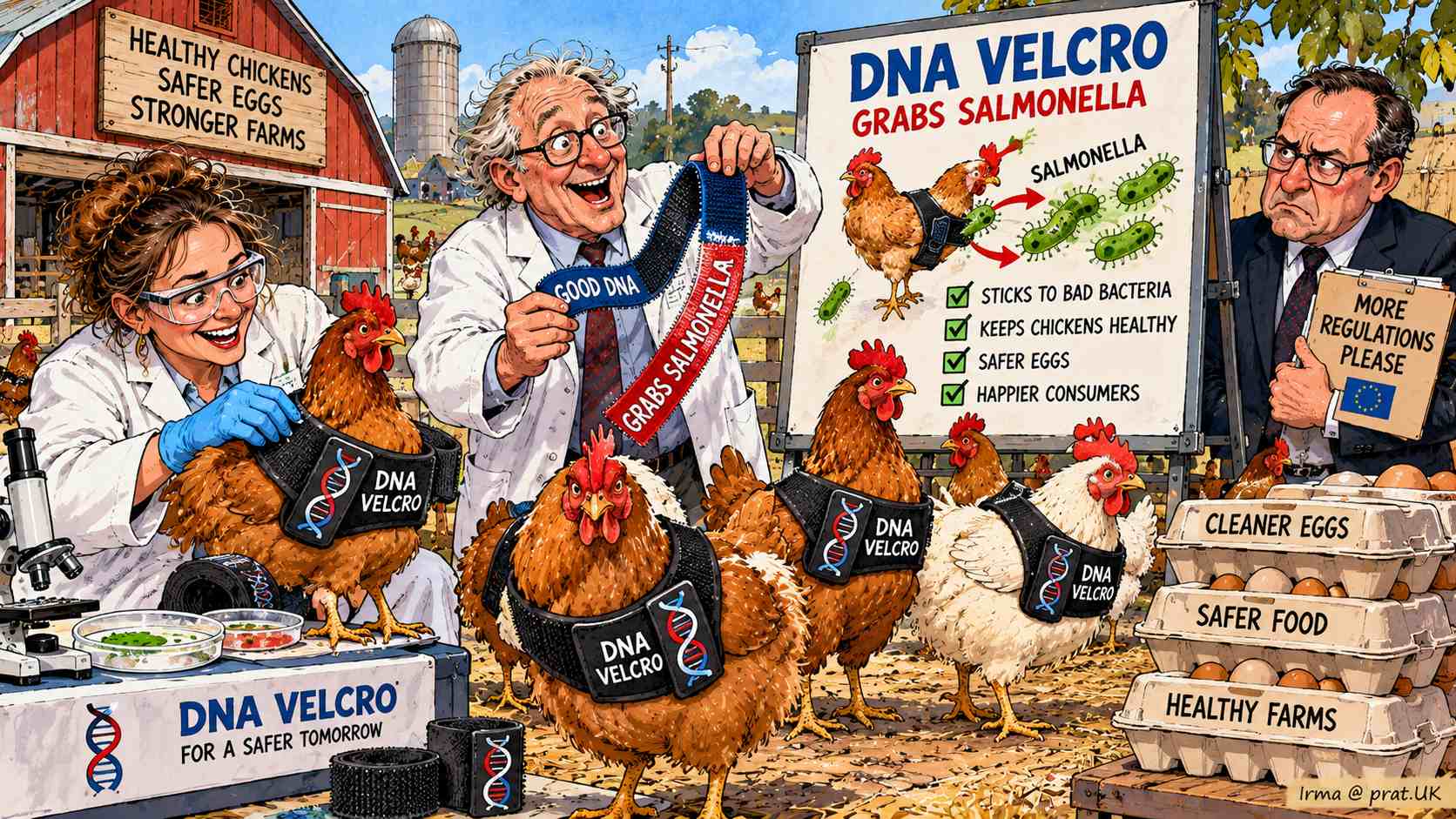
Arkansas researchers strengthen poultry immunity and the bacteria want a seat at the table
FAYETTEVILLE, ARKANSAS – Scientists at the University of Arkansas have developed a promising new approach to fighting salmonella in poultry using DNA-based technology that operates somewhat like microscopic Velcro.
The University of Arkansas Division of Agriculture announced the research on October 21, explaining that researchers had strengthened immune responses by attaching specialized DNA structures to vaccine antigens. The breakthrough has generated excitement among agricultural scientists and concern within the nation’s salmonella community, whose representatives say they were never consulted about the proposed improvements to chicken immunity.
The Bacteria Demand Equal Representation
Salmonella has enjoyed a historically uncomplicated business model. Enter a suitable host, multiply, cause problems, repeat. Modern poultry research threatens this arrangement by helping the chicken’s immune system recognize and respond to the bacteria more effectively.
Professor Stanley Germsworth, a microbiologist and unpaid spokesman for the National Association of Disappointed Pathogens, condemned the development.
“For generations, bacteria have relied on the reasonable expectation that chickens would not receive advanced molecular assistance.”
He accused researchers of technological discrimination.
“First antibiotics. Then sanitation. Now DNA Velcro. Where does it end?”
Scientists declined to negotiate with salmonella.
How the DNA Aptamer Salmonella Vaccine Works
Research led by poultry science professor Young Min Kwon builds on earlier work involving CD40, a molecule found on immune cells. The Arkansas team developed specialized DNA aptamers that bind to biological targets. Using a technique called rolling circle amplification, researchers created long DNA structures displaying many binding sites, and Kwon compared the principle to Velcro. The mechanism helps deliver vaccine components in ways that encourage stronger immune-cell responses. The group’s earlier work is described in published research on aptamer-based adjuvants.
Tests involving chicken immune cells showed encouraging results, and later experiments in chickens indicated improved protection against salmonella colonization. These findings are promising research, not proof that a new commercial vaccine is ready for widespread use.
A chicken named Margaret expressed cautious optimism.
“I don’t understand DNA, CD40 or molecular binding.”
She paused.
“But if it means fewer bacteria bothering me, I’m prepared to support science.”
The National Salmonella Satisfaction Survey
A survey asked 500 salmonella bacteria whether they approved of the new research. Ninety-nine percent opposed it. The remaining 1% had already been neutralized by the immune response.
A separate survey of 300 poultry farmers found universal enthusiasm for practical improvements in flock health and food safety. However, respondents requested that successful scientific innovations also become economically affordable. One Arkansas grower summarized the requirement.
“If the vaccine costs more than the chicken, we may have a problem.”
Why Poultry Food Safety Is Serious Business
The CDC estimates that salmonella causes approximately 1.35 million infections annually in the United States. Improving poultry health and reducing contamination risks can benefit producers, processors and consumers. But commercial adoption requires successful testing, regulatory review and financially practical production.
The Arkansas researchers acknowledge the economic challenge. A vaccine costing close to $1 per dose would be difficult to justify in many poultry operations where the acceptable added cost may be only pennies. That creates a familiar agricultural dilemma. Science develops something useful. Economics asks who will pay.
Salmonella Announces Its Retirement Plans
Researchers are continuing work to improve the technology and investigate its broader applications. The molecular strategy could eventually prove useful beyond poultry, but future applications require additional evidence.
Meanwhile, bacteria representatives have begun exploring alternative careers. One applied for a position in congressional budget analysis. Another considered becoming a social media consultant. A third decided the safest location was a government committee, where nothing had been eliminated in decades.
Arkansas poultry scientists continued their research. The chickens continued laying eggs. And salmonella discovered that its most dangerous opponent might be a tiny strip of molecular Velcro.
The Evidence File
Seven Years of Science, Stated Plainly
The research is not a weekend project. A USDA NIFA project record lists the work running from 2022 through 2026 under a food-safety program, with the stated aim of a novel, scalable vaccination strategy in broilers. The chickens, it should be noted, were not asked to attend the grant meeting.
Historical Irony
Humans spent centuries inventing locks, then spent the 20th century inventing bacteria that pick them. The latest move is to give the chicken a better lock made of DNA, which is the first time a chicken has had better security than a bank.
False Authority
Dr. Beaufort Cluck, a self-appointed Poultry Immunity Influencer with 14 followers, insists that “the chicken already knows,” and has declined to specify what.
Sources and Further Reading
See the University of Arkansas Division of Agriculture for the announcement, the CDC’s salmonella pages for the public-health numbers, and USDA’s Food Safety and Inspection Service for poultry regulation. Related work on this platform appears in Veterinary World.
Research basis: University of Arkansas Agricultural Experiment Station, October 21, 2026; research discussed in Frontiers in Veterinary Science.
Humorous Observations
- “Disappointed Pathogens.” I’d attend that meeting. Free snacks, and everybody’s got a grudge against hand soap.
- The chicken doesn’t understand DNA, CD40 or molecular binding. Which makes her about as informed as every other juror I’ve ever met, and she’s got better instincts.
- One percent of the bacteria had already been neutralized and still showed up to the survey. That’s more civic engagement than my block.
- “If the vaccine costs more than the chicken.” Ladies and gentlemen, the first time in history anyone has done math on a chicken and the chicken lost.
- Salmonella wants a seat at the table. Pal, you already have one. It’s at the church potluck, and everybody’s looking at you.