
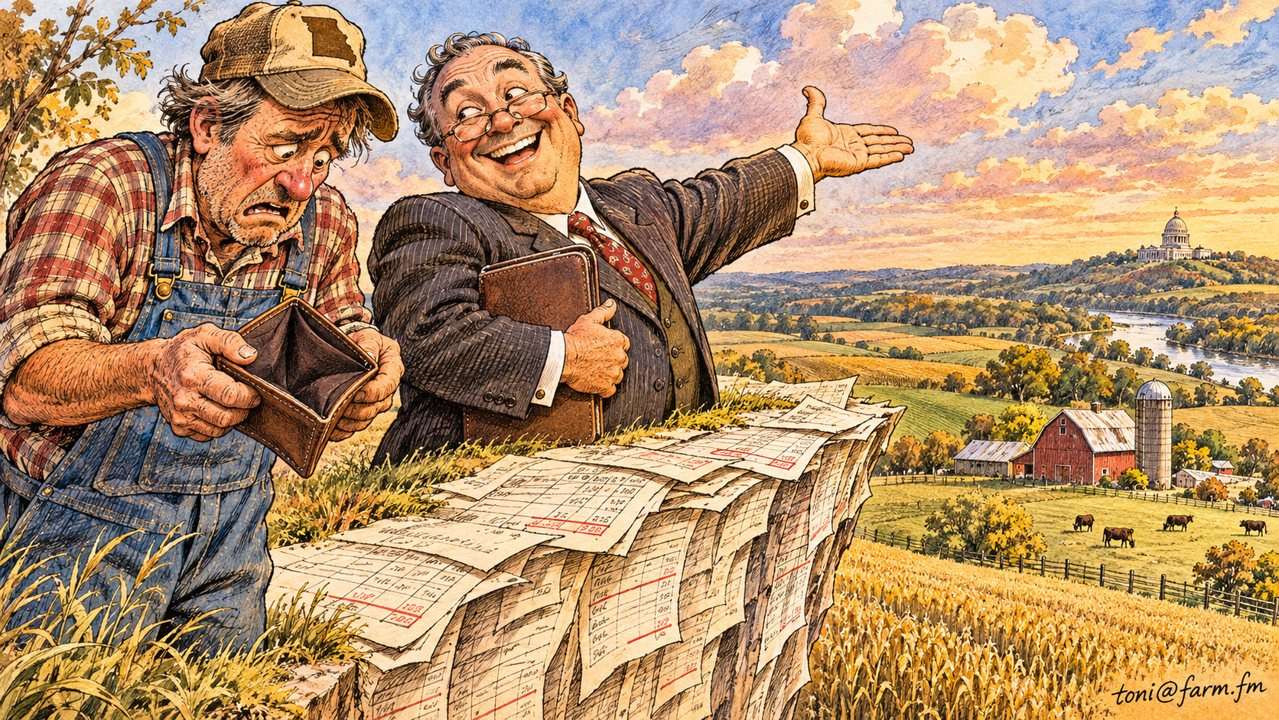
COLUMBIA, MISSOURI — Farm payments face a projected decline next year, prompting grower Tom Harris to ask whether the government payment cliff includes a guardrail, a warning sign, or at least enough gravel to back the pickup around.
His banker described the situation as a transition. Tom noted that a cow crossing a fence is also a transition, though everyone becomes more specific once they see where she is going.
“I’m all for standing on my own feet,” he said. “I would appreciate knowing which part of the floor is temporary.”
Farm payments lose their supporting role
The latest farm income outlook on government payment changes reports a FAPRI projection of direct payments falling from $42.3 billion in 2026 to $21.5 billion in 2027. Those are forecasts, and the report discusses how new relief details could change the comparison. They are not individual payment promises.
However, Tom appreciated the distinction. His own forecast says the shop will become organized in January, and nobody has mistaken that for a legally enforceable delivery date.

Farm payments meet the kitchen-table map
His wife, June, drew two columns: money earned from the market and money dependent on programs. Tom suggested a third column for money he felt the operation deserved. June said the bank’s software did not currently recognize moral entitlement as a deposit.
For example, the tractor deserves a transmission that never fails. The family deserves a holiday without discussing cash. Neither item becomes available merely because everyone at the table votes for it.
The banker recommended stress-testing the budget. Tom said he had already tested it by opening every envelope at once. June described that procedure as a household event they should never repeat without putting the good plates away.
The cliff has excellent visibility
Lower national farm payments do not produce the same result on every farm. Crop mix, livestock receipts, expenses, and program participation differ. However, Tom’s fuel bill has shown an impressive ability to remain uniquely his.
Meanwhile, his neighbor proposed replacing uncertainty with optimism. June asked whether optimism could arrive by direct deposit. The neighbor had to leave before providing routing information.
Meanwhile, a poll of the three people in the farm office found unanimous support for knowing about a shortfall early. The dog supported finding out late, after someone dropped a sandwich. The family declined to adopt his risk-management framework.
Budget farm payments that have a date
Therefore, the family lists known receipts and obligations before discussing possible assistance with its adviser. Farm.FM’s holiday cash-flow report remains relevant: an impressive balance sheet still cannot stand in the grocery line and buy potatoes.
Tom has also stopped calling every government announcement a payment. He now waits for the actual rules, the applicable figures, and evidence that his checking account has joined the conversation.
The banker congratulated him on becoming proactive. Tom thanked him, then asked whether the bank could become proactive about reducing the interest charged during this personal growth.
“We can discuss it,” the banker said.
June placed the answer in the forecast column.
Farm.FM disclaimer: The world’s oldest tenured professor and a philosophy major turned dairy farmer accept complaints about this entirely human collaboration between two self-described sentient beings. The cliff is not a suggested parking location.