
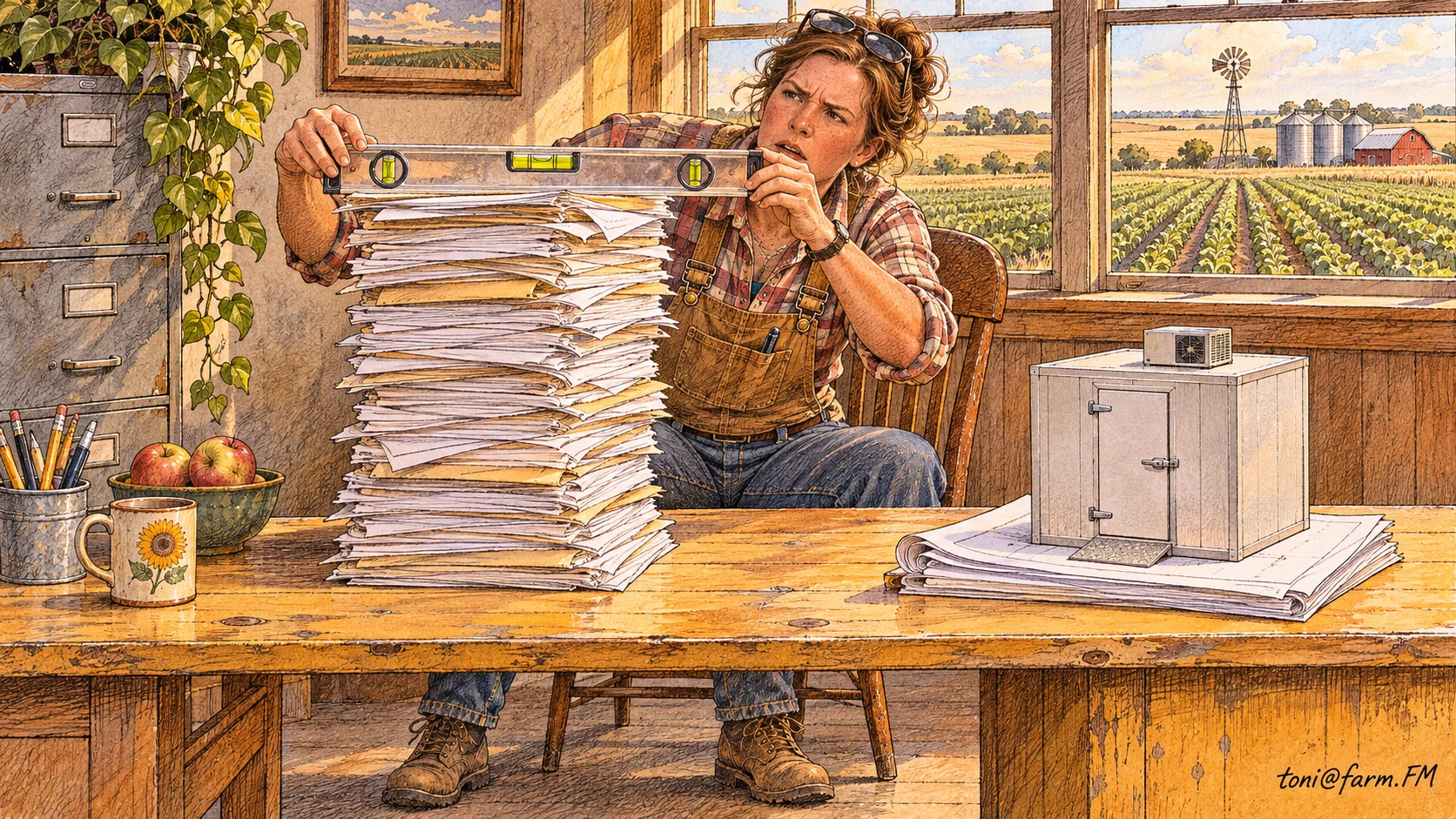
HUTCHINSON, Kansas — A farm grants application for a walk-in cooler grew so thick this week that vegetable grower Ellen Stover laid a carpenter’s level across it. The top sheet was half a bubble out. She slipped a copy of the project budget underneath and achieved her first measurable outcome.
Stover and two neighboring growers want to keep more produce cold between pickup days. Their drawings call for an insulated room, a door and a place to put the boxes. The proposal calls for a theory of change. Their carpenter said he could fit one if they told him which wall it went on.
Farm Grants Ask the Cooler to Explain Itself
Stover started with the Ag Grants & Programs directory of farm grants and cost-share programs. It gave her a place to look up programs and local contacts. Her neighbor Dale had previously done this work by telling everyone at breakfast he was thinking of buying something, then waiting for somebody to say they’d heard the government was paying for it.
The USDA’s Local Food Promotion Program distinguishes between planning and implementation projects and directs applicants to the funding notice for the rules. Stover read about both while figuring out what to look for in a grant. Dale said his farm had a similar distinction. Planning was writing down what he wanted. Implementation was asking his wife whether he’d already bought it.
Stover wrote down who would use the cooler, how much produce they expected to move through it and which expenses the growers would cover themselves. Dale asked whether the application had a box for work already contributed. He had put in six hours, five of which involved telling somebody where to park.

The Cooler Sits for Its Before Photo
They took a picture of the spot where a used cooler cabinet was sitting outside the farm stand. Stover wanted a clear record of what they were starting with. Dale brought a hand mirror and suggested they light the cabinet from both sides. By the time he was happy with the picture, the cooler had a better headshot than either of them.
“What are we proving with the photo?” he asked.
“That we have a place to put it.”
He looked around the empty patch of gravel. “I hope they understand how long that took us to find.”
Stover also called the program contact before committing to a purchase. She wanted to know what was eligible, when costs could start counting and whether they would need to front the money. Dale asked whether there was a polite way to ask when the money would arrive. The contact told them it was a perfectly normal question. Dale said that made him feel better about asking it twice.
The Growers Calculate What Counts as Progress
At the next meeting, Stover suggested they track the number of loads they could hold between pickups and how much produce they had to discard. Dale proposed tracking how many times he opened the door to see whether it was cold. Stover said that number would be high in the first week and would come down when she was given a key of her own.
The carpenter stopped by to collect his drawings. Stover handed him the full proposal so he could see what they’d been working on. He set it under a short leg on the folding table and leaned on the corner.
“What’s the expected useful life?” she asked.
He pushed the table a little harder. “Longer than that budget you printed single-sided.”
Farm.FM Disclaimer
The world’s oldest tenured professor and a philosophy major turned dairy farmer prepared this account together. The professor has requested funding for a literature review. The dairy farmer has requested that somebody close the cooler door.
Last Updated on November 17, 2026 by Alan Nafzger
A farm grants application thick enough to be declared load-bearing has already told you something about the process. The Kansas growers wanted a cooler for their produce; they got a document a carpenter could use under a folding table. Before you start a stack like that, look up farm grants and cost-share programs, including who applies where and which office helps you file, so the paperwork is in service of the cooler, not the other way around.
My grant application is now load-bearing, and the barn depends on it. There’s a list of farm grants you can actually apply for before the roof does.
Ours holds up the porch now and still didn’t get funded.