
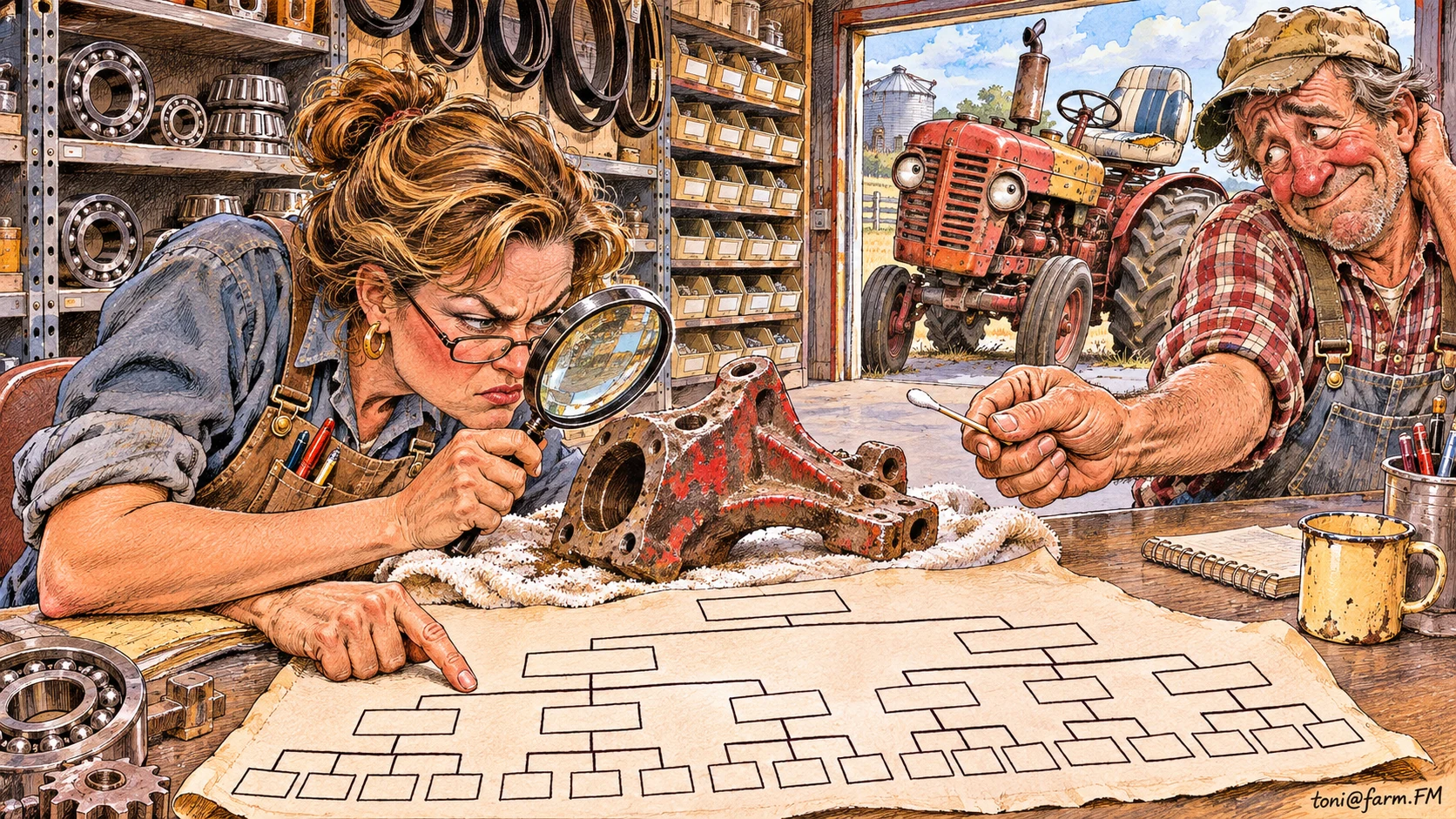
SALINA, Kansas — A farm equipment parts counter has requested a DNA sample from a 1974 tractor after the owner arrived with a broken casting and described it as “the piece that lives behind the other piece.”
Parts manager Lorna Pike placed the casting on a clean towel and asked farmer Wes Brackett for the tractor model, serial number and original part number.
Wes said the tractor was red, except where it was yellow, and had belonged to his uncle before the family stopped speaking about the transmission.
Lorna turned the casting over. It had no tag, no number and three layers of paint.
“This part has entered witness protection,” she said.
Farm Equipment Parts Need a Family History
Wes had consulted the Parts and Salvage Directory for guidance on new, rebuilt, aftermarket, used and salvage components. Its checklist recommends recording the machine model, serial number and original part number, checking serial-range compatibility, requesting inspection photos and comparing freight, labor, cores and downtime.
Wes had recorded “tractor” on the back of an envelope.
The Penn State Extension farm equipment maintenance resources emphasize inspection, maintenance and the true costs of owning new or used machinery. Lorna said this supported her professional opinion that the cheapest part is often the one a farmer purchases twice and installs during weather that could kill a mailbox.
She asked whether the tractor’s hour meter worked.
“It has hours,” Wes said.
“Does it count them?”
“It judges them.”
Lorna found the serial plate beneath grease, paint and a metal bracket added during the Carter administration. The number showed that Wes’s tractor had been assembled during a production change. The front half matched the early series. The rear half matched the late series. The seat appeared to match a fishing boat.

The Salvage Part Provides References
The salvage yard sent photos of a possible replacement. Lorna enlarged the wear surfaces, casting marks and bolt pattern. Wes enlarged a shadow behind the part and announced that the donor tractor had probably been parked indoors.
Lorna said the shadow was a tire.
The used casting came with a thirty-day warranty and a core charge. Wes asked what the core was.
“The broken part you brought in.”
Wes placed a protective hand over it. After forty-seven years together, the casting had become family.
Lorna explained that returning it reduced waste and helped rebuild another component. Wes agreed, provided the part received a respectful service and no one mentioned the transmission.
The freight estimate arrived next. The part cost less than shipping because it was dense, awkward and located in a state that had apparently moved farther away overnight. Wes asked whether the yard could email it. Lorna said that option was available for the invoice.
The Tractor Meets Its Compatible Donor
Back at the farm, Wes cleaned the mounting surface, compared bolt holes and checked the service manual Lorna had printed. He disconnected power, blocked the machine securely and waited for everything to stop moving. This was difficult because his neighbor, Dale, continued offering advice.
The casting fit. Four bolts aligned immediately. The fifth aligned after Wes loosened the other four, lifted the component slightly and stopped accusing the manufacturer of personal hostility.
Dale asked whether the replacement was original equipment.
Wes said it was original to some equipment.
After installation, the tractor started and ran without leaking from the repaired area. It began leaking two feet away, which Wes described as proof that pressure had returned.
Lorna called the next morning to ask how the job went. Wes said the farm equipment parts research had saved him from ordering the wrong casting.
“And the DNA test?” she asked.
Wes looked at the tractor, the boat seat and the borrowed hydraulic hose.
“Inconclusive,” he said. “But we are keeping it in the family.”
Farm.FM Disclaimer
This report is entirely a human collaboration between two sentient beings — the world’s oldest tenured professor and a philosophy major turned dairy farmer. Both verified the serial number. Neither accepts responsibility for the boat seat.