
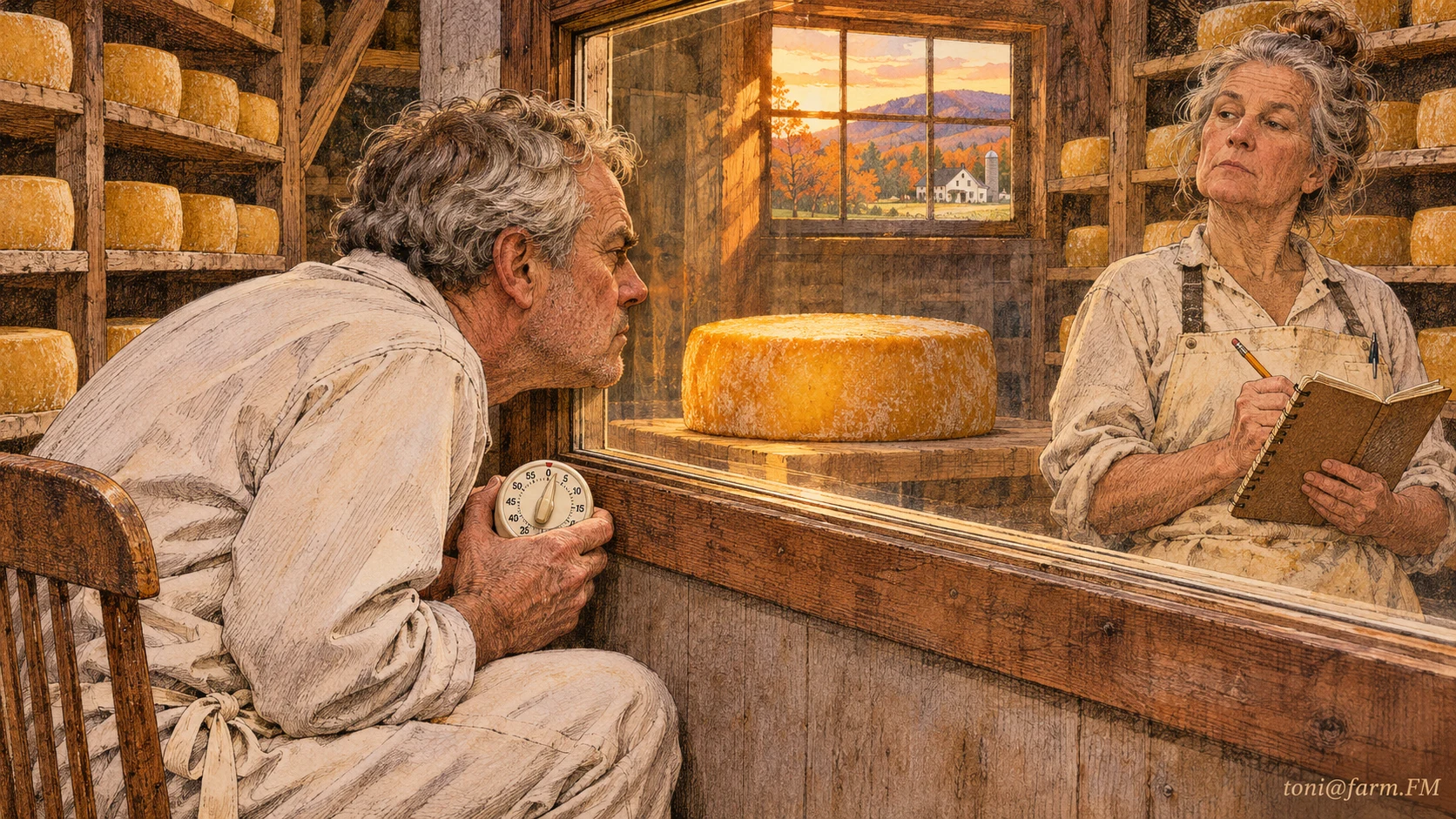
CABOT, Vermont — Cheese aging slowed to a standstill Tuesday after a creamery owner’s brother began checking a wheel every time he walked past the window. Neil Abbott said he knew it would take months. He only wanted to see whether the first three days had shown any initiative.
His sister Ruth asked him what he expected to see. He said he’d be encouraged by a change in color. She moved him two feet to the left, where there was less glare. He said the wheel looked better already.
Cheese Aging Begins Without a Countdown Clock
Ruth had been using CheeseMakersResource’s cheese-making guides and batch records to tighten up the creamery’s paperwork. Neil asked whether there was a sheet for counting down the days until a batch was ready. Ruth said there was a calendar. Neil said he was looking for something that made the days feel shorter.
The Penn State Extension Cheese Tracking System helps small-scale producers track parts of the process and compare the resulting quality. Ruth kept notes on the batch, the work it had been through and what she observed over time. Neil kept notes on lunch. He thought that gave them a fuller picture of how the cheese would be used.
Ruth pointed out the wheel they planned to evaluate later and told him it would be there when he came back from town. He set a kitchen timer on his side of the window anyway. It rang after thirty minutes. He went to find Ruth, who asked which material change he was calling her to see. Neil said it was nearly eleven, and he was finding it easier to imagine a sandwich.

The Creamery Holds Its First Empty Tasting
At lunch he sliced the bread and told Ruth she could set the cheese down whenever she was ready. She set a clean empty plate beside him. Neil asked what stage they were at.
“Waiting,” she said. “Go ahead and note the finish.”
Neil tried a slice of bread. He said he thought it would do well with something on top. Ruth said she’d reached the same conclusion in 1988. There was butter in the refrigerator.
He asked why she kept a record if nobody was going to read it at lunch. Ruth showed him two entries from comparable batches. They gave her a way to trace when a difference had turned up and look for a reason. Neil said his records could do much the same thing. On days when he had written down two sandwiches, he was generally able to account for both of them.
A Cheese Aging Record Finally Has Good News for Neil
Ruth scheduled a time to assess the wheel according to the creamery’s usual process and went back to work. Neil asked whether he could do anything useful while he waited. She handed him yesterday’s notes and asked him to enter the batch details. He read the notes twice and spotted a date she wanted to confirm. She checked the original record and thanked him. He asked whether this meant he had seniority at the window.
Weeks later, when Ruth assessed an older wheel from a different batch, she brought Neil a piece. He tasted it quietly, then asked whether there was more. Ruth said there would be after she finished her notes.
Neil set his timer down without winding it. Then he went to slice a loaf of bread. He knew exactly how long that part took.
Farm.FM Disclaimer
The world’s oldest tenured professor and a philosophy major turned dairy farmer prepared this account together. The professor has entered an empty plate as an interim finding. The dairy farmer wants the plate back before supper.