
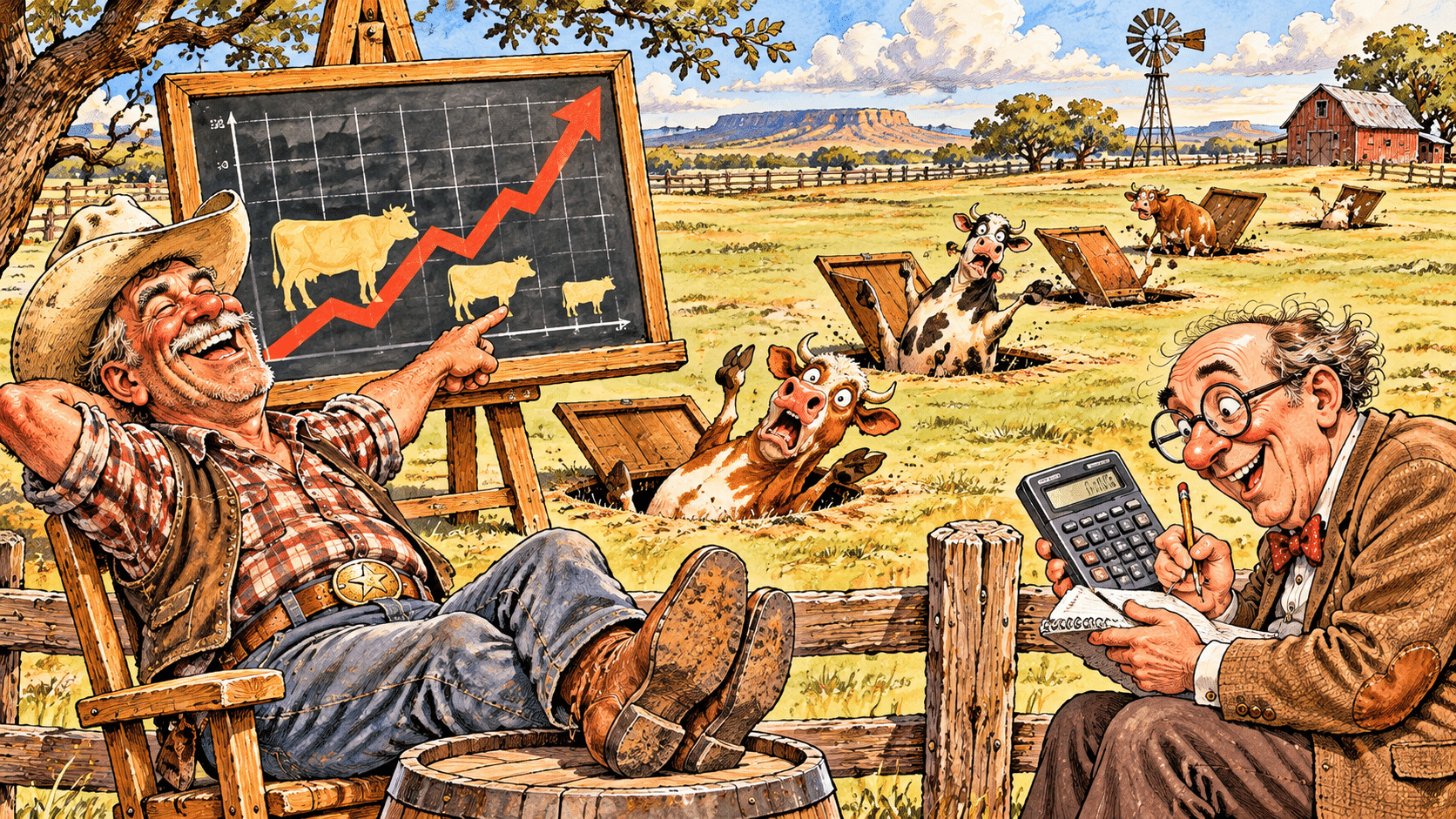
FORT WORTH, Texas | Texas A&M agricultural economists reported that Southern Plains cull-cow prices declined from about $187 per hundredweight in spring to about $154 at the end of September, roughly 18 percent. Ranchers examined their checks, shoppers examined meat cases, and both groups asked the oldest question in beef economics: where did the money go?
Cull Cow Prices Fall; Supermarket Beef Refuses to Notice
Rancher Wade Kincaid hauled an older cow to market and received a smaller check than he’d expected. At the supermarket the next afternoon, he found ground beef still demanding the sort of financial commitment once associated with buying a used pickup. “If I get less and my neighbor pays more, somebody in the middle must be feeding a very expensive cow,” he said.
The cow in question, Mabel, had already retired from the herd for the final time and was unavailable for comment. A ranch employee described her as dependable, stubborn, and better at negotiating a feed bunk than most elected officials.
Beef Supply Chain Introduces the Invisible Discount
A fictional meat-market consultant explained that lower producer prices do not automatically become lower shelf prices because processing, transportation, labor, retail margins, and timing matter. He then suggested consumers might enjoy paying full price simply for the emotional experience of supporting commerce. Wade asked whether emotional support could be deposited at the bank.
The economist’s seasonal explanation was legitimate: cull-cow prices normally retreat in late summer and fall as more cows move to market. Wade accepted this and pointed out that ranchers also experience a seasonal event called paying the same bills regardless. His feed dealer does not provide an autumn discount because the calves are feeling reflective.
For evidence, Farm.FM interviewed two shoppers, one rancher, and a man who claimed to be a retail-price adjustment specialist but turned out to be the butcher’s cousin. All five agreed the savings were difficult to locate. The cousin said that was because they had been consolidated into a spreadsheet located in an air-conditioned office.

Ranchers Launch Search for the Missing 18 Percent
Wade’s wife, Bonnie, arranged a search party. The ranch hands checked the auction barn, the meat-counter manager checked the warehouse, and a curious child checked under the supermarket cash register. They discovered receipts, coupons, and one stale breath mint, but not the missing share of the cow’s value.
A finance professor suggested the spread between livestock prices and retail meat prices can change for many reasons and should never be treated as a simple one-for-one comparison. Bonnie agreed and replied that nobody was requesting a simplistic comparison. “We’d just like a complex one in which the people raising the cattle get to keep enough to buy groceries.”
Consumers and Ranchers Find Common Ground
The Kincaids are now keeping sharper records on marketing expenses and considering direct sales where feasible, while emphasizing that every processing route has its own real costs. Their supermarket neighbor is comparing unit prices rather than assuming a producer-price headline promises a checkout bargain.
The only person entirely pleased with the episode was Wade’s banker, who noted that the money was still circulating somewhere. Wade replied that circulating money was wonderful, but he’d like it to pass through his account once in a while.
Satirical editorial note: Price changes and market-seasonality context are factual; Mabel and the missing-discount investigation are comic storytelling. A human collaboration between the world’s oldest tenured professor and a philosophy major turned dairy farmer.
Wade hauled Mabel to town for $154 and then found ground beef still priced like a used pickup. If the savings went to somebody in the middle, that fellow is feeding a very expensive cow. I dog-eared the cull-cow section of this beef cattle ranching guide so I can at least pretend I knew where the money was supposed to land.