
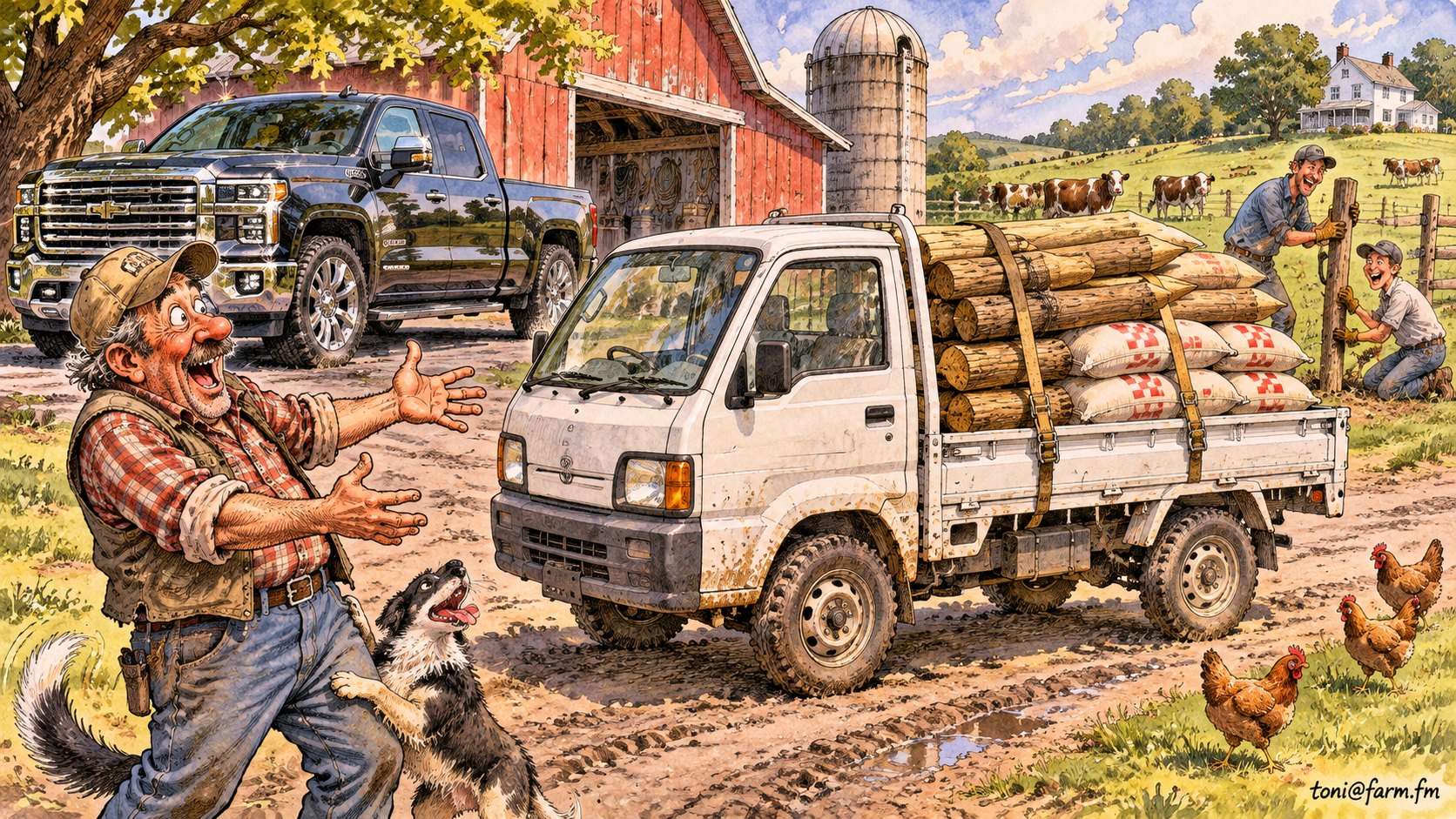
ABILENE, TEXAS — An affordable work truck proposal has unsettled local ranchers by suggesting that a pickup might be designed primarily to pick things up.
At a coffee-shop discussion, rancher Clyde Morrow examined the planned flatbed configuration and asked where the outdoor kitchen, ambient lighting, and monthly relationship with a software provider were supposed to go.
Then he noticed the loading space.
“Well,” he said. “They’ve left room for the reason you bought it.”
Affordable work truck revives a forgotten feature
Successful Farming’s report on REO’s planned work trucks describes a proposed lineup emphasizing simplicity, mechanical four-wheel drive, and expected starting pricing of $21,500. Planned pricing and specifications are not the same as a vehicle sitting ready for delivery at the local dealer.
Clyde respects that qualification. He has personally planned to repair his stock trailer for three years, so he understands the distance between an announcement and an object that moves.
Still, the concept stirred memories of trucks whose interiors could be cleaned without consulting a screen.

The bed has not been converted into a lifestyle
His neighbor Brent said a modern truck needed to make a statement. Clyde said his truck made several: it needed tires, it had carried mineral tubs, and somebody should remove the fence staples before sitting down.
Brent’s pickup has leather seats, a polished dashboard, and a bed so carefully protected that feed sacks require an appointment. He explained that this maintained resale value.
Clyde asked whether using the vehicle to earn money might also contribute.
A dealer acquaintance warned that customers wanted comfort. Clyde agreed. He finds it extremely comforting when a part can be identified without opening an account.
The coffee-shop survey found five men interested in practical trucks and six opinions about transmissions. One man declined to participate because he was waiting for a remote update to finish explaining why his current truck would not start.
An affordable work truck still needs practical scrutiny
None of this means a proposed vehicle should escape ordinary scrutiny. Buyers still need to examine availability, safety compliance, warranty support, payload, parts, service access, and the price of the configuration they actually need.
Clyde has written that list down. He says hope is a fine emotion but an unreliable towing specification.
At Farm.FM’s rural-life desk, the discussion has revived an older distinction: owning a working vehicle and maintaining a rolling demonstration of purchasing power.
Brent suggested that the plain truck might lack prestige. Clyde asked whether prestige could unload wire.
The conversation ended when Clyde’s wife, Nora, arrived and asked whether the men had compared actual requirements or merely formed another transmission support group.
Clyde showed her the loading bed.
She approved. Their current truck still contained enough fencing supplies to establish a modest international boundary.
He said a simpler replacement might finally allow him to organize everything.
Nora said that feature was not included in any manufacturer’s announcement.
Truck-lot notice
This is not a vehicle endorsement or a delivery promise. Check current manufacturer information and actual specifications. A clean truck bed is circumstantial evidence that someone owns a second truck.