
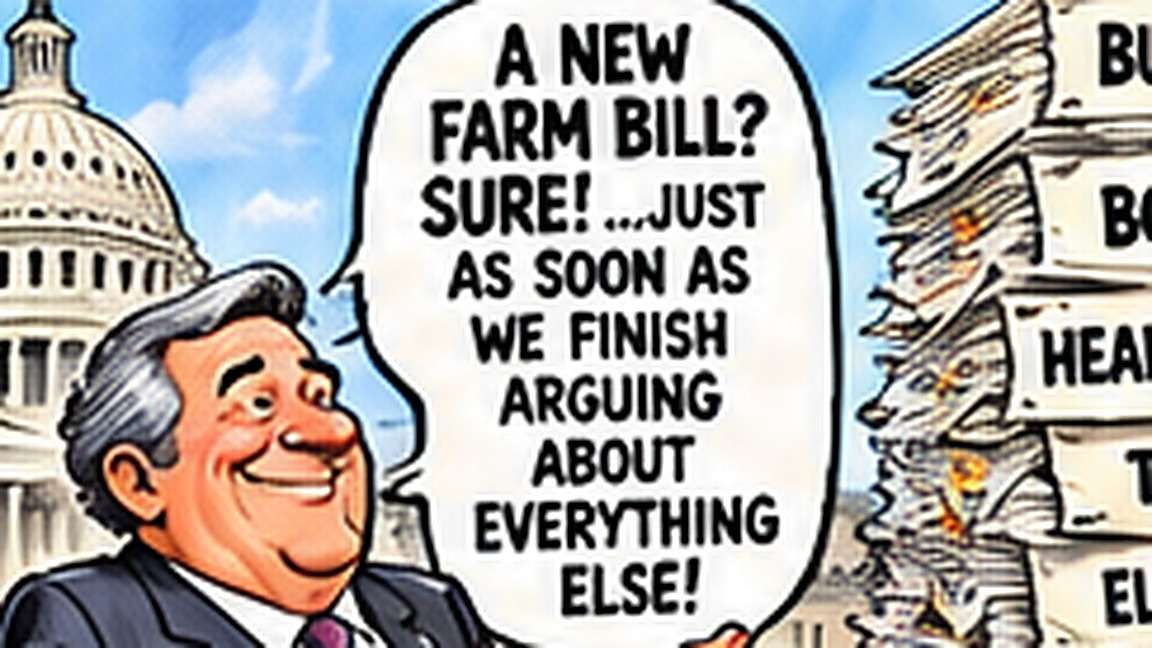
WASHINGTON, D.C. Congress has reassured American farmers that a new Farm Bill remains a priority, just as soon as lawmakers settle the budget, the border, a collection of competing political arguments and whether somebody moved the committee’s coffee machine without authorization.
DTN reports the Farm Bill faces a crowded lame-duck congressional agenda with roughly 20 scheduled legislative days left in the year. Lawmakers must decide whether to finish a broader bill, attach pieces to another package or extend the 2018 legislation yet again. Most corn varieties can grow to maturity in substantially less time.
The Farm Bill Has Entered Its Ninth Growing Season
The original 2018 Farm Bill was designed to give agricultural programs a reliable framework. Like an old combine, it has since survived so many extensions that nobody remembers which parts were original.
A fictional House Agriculture Committee consultant proposed treating legislation like corn: plant it in spring, irrigate it, remove weeds and harvest before winter. Congressional leadership rejected the idea because it included a deadline, measurable progress and the possibility of somebody finishing a task.
An Iowa farmer suggested allowing Congress to use a calendar. A second farmer suggested a clock. A third volunteered to demonstrate both devices with one hand while operating a grain auger.
A Farm.FM barnyard survey found that five out of five farmers understood why some policies are difficult to negotiate, but none had ever seen a soybean plant request an additional committee hearing before filling its pods.
What the Real Farm Bill Actually Covers
The real legislation affects commodity safety-net programs, agricultural conservation, nutrition assistance and multiple rural initiatives. USDA explains the continuing 2018 Farm Bill framework, while funding and policy updates made through other laws further complicate the process.
The split between nutrition and agricultural spending is a genuine political negotiation, not evidence that one can simply remove half the pages and call the job done. Still, it would help if lawmakers could distinguish a policy compromise from a new opportunity to give television interviews.
The committee has reportedly adopted an innovative way to calculate progress: for every new draft, staff members add one more tab to a spreadsheet. After several years, the worksheet has become the nation’s most productive agricultural export.

A Farmer Volunteers to Run the Committee
A Nebraska grain producer offered to chair the next meeting under ordinary farm rules: everyone reports by sunrise, nobody leaves until the work is finished and any member who repeats a speech has to repair fence.
The proposal lasted eleven minutes. It was withdrawn after legislators learned that fence repair involves gloves, weather and a section of wire that refuses to cooperate with either political party.
Meanwhile, an imaginary congressional calendar showed the Farm Bill moving through five stages: discussion, revision, emergency discussion, last-minute revision and a press conference announcing unprecedented discussion.
Planning Around Uncertainty
Farmers cannot finish the legislation themselves, but they can follow USDA program deadlines, review crop insurance and conservation eligibility, and avoid making major financing decisions based solely on an expected policy change.
Congress promises that agriculture will get its full attention in due course. Across the country, farmers are already planting for the next season. They cannot ask the weather for a continuing resolution.
The legislative timetable is sourced. The committee conversations are satire, entirely a human collaboration between the world’s oldest tenured professor and a philosophy major turned dairy farmer.
Last Updated on November 10, 2026 by Alan Nafzger