

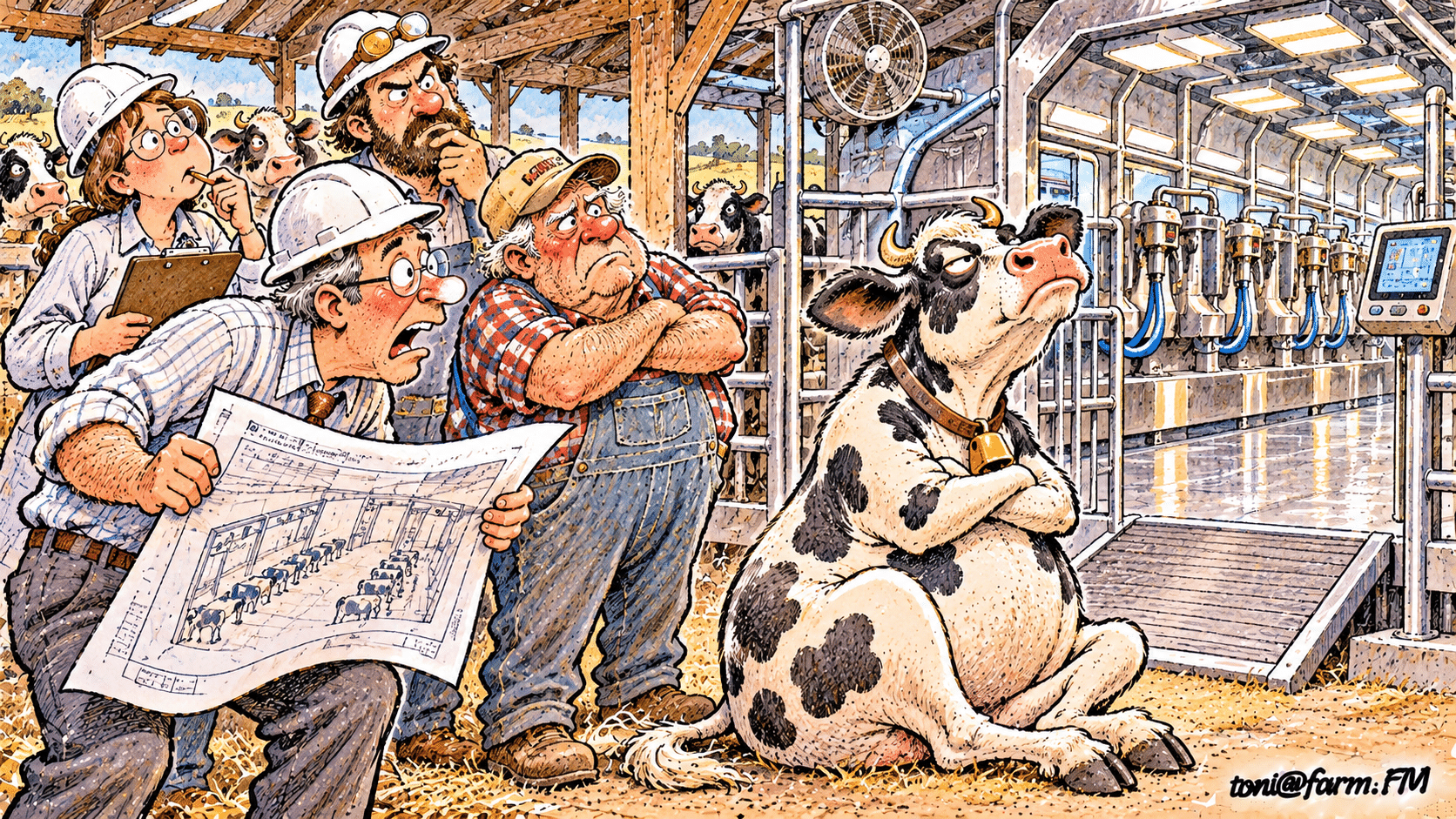
The Blueprint Was Perfect Until One Cow Objected
ROCHESTER, Minnesota (Farm.FM) — A dairy engineering firm has declared its new milking parlor mathematically perfect after spending eighteen months designing a cow entrance that no cow appears willing to use.
The building features streamlined traffic lanes, computerized gates, biometric sensors and a five-page explanation of why animals should appreciate modern geometry.
At the ribbon cutting, project director Nolan Price pressed the button marked Optimized Cow Flow. A gate opened, a gentle chime sounded and the first cow, Marge, stopped to examine a shadow on the floor.
The entire line stopped behind her.
“That’s not a defect,” Price said. “That’s an unplanned stakeholder intervention.”
Dairy Engineering Team Forgot to Ask the Cow
Marge had objections to the polished floor, the unfamiliar doorway and a yellow raincoat hanging from a hook. She expressed them with the ancient bovine negotiating technique of standing perfectly still while seventeen people developed theories.
The dairy engineering team demonstrated that the new route was twelve percent shorter on paper. Marge demonstrated that a shorter route still takes forever when nobody is moving.
One designer suggested installing another screen to provide reassuring graphics. The farmer suggested removing the raincoat.
The screen proposal generated a three-week feasibility study. The raincoat was moved in six seconds. Marge took two steps forward, then stopped to look at a reflection in the stainless steel.
The architects ordered an emergency review of the reflection.
A consultant argued that the cows would eventually adapt once they understood the building’s brand promise. The farmer replied that cows are generally more concerned about their feet, their neighbors and where breakfast went.
Research Supports Calm Cow Flow, Not PowerPoint Flow
The University of Wisconsin dairy extension’s cow-handling research explains that cattle can hesitate around unfamiliar objects, shadows, hoses and other visual distractions. Predictable routes and low-stress handling help animals move calmly.
Good dairy engineering must therefore work with actual animal behavior. A beautiful blueprint is not useful if the cow at the doorway has already concluded that the blueprint is none of her business.
Penn State Extension’s milking equipment guidance similarly emphasizes the real work of calm cow movement, sound milking routines and functioning equipment. None can be replaced by an architectural award.
The farmer walked through the entrance himself. The design consultants applauded his demonstration, then discovered he was not authorized to substitute for a cow in the performance calculations.
Perfect Blueprint Receives First Bovine Amendment
Marge finally walked through after the crew improved the lighting, cleared the distracting items and gave the animals a familiar, unhurried route. The solution cost less than the consultants’ lunch.
The engineers updated their report to describe the intervention as “adaptive livestock-centered circulation recalibration.” The farmer called it “moving the coat.”
At the ceremony’s conclusion, Price announced that the redesigned parlor had exceeded every operational target. Marge then backed into the camera tripod, sending the presentation screen into a water trough.
“Does she always do that?” Price asked.
“No,” said the farmer. “She usually ignores PowerPoint.”
Disclaimer: The parlor launch, named participants and quotations are satirical. The linked extension publications provide the factual basis for low-stress dairy handling and equipment care. This story is entirely a human collaboration between two sentient beings: the world’s oldest tenured professor and a philosophy major turned dairy farmer.