
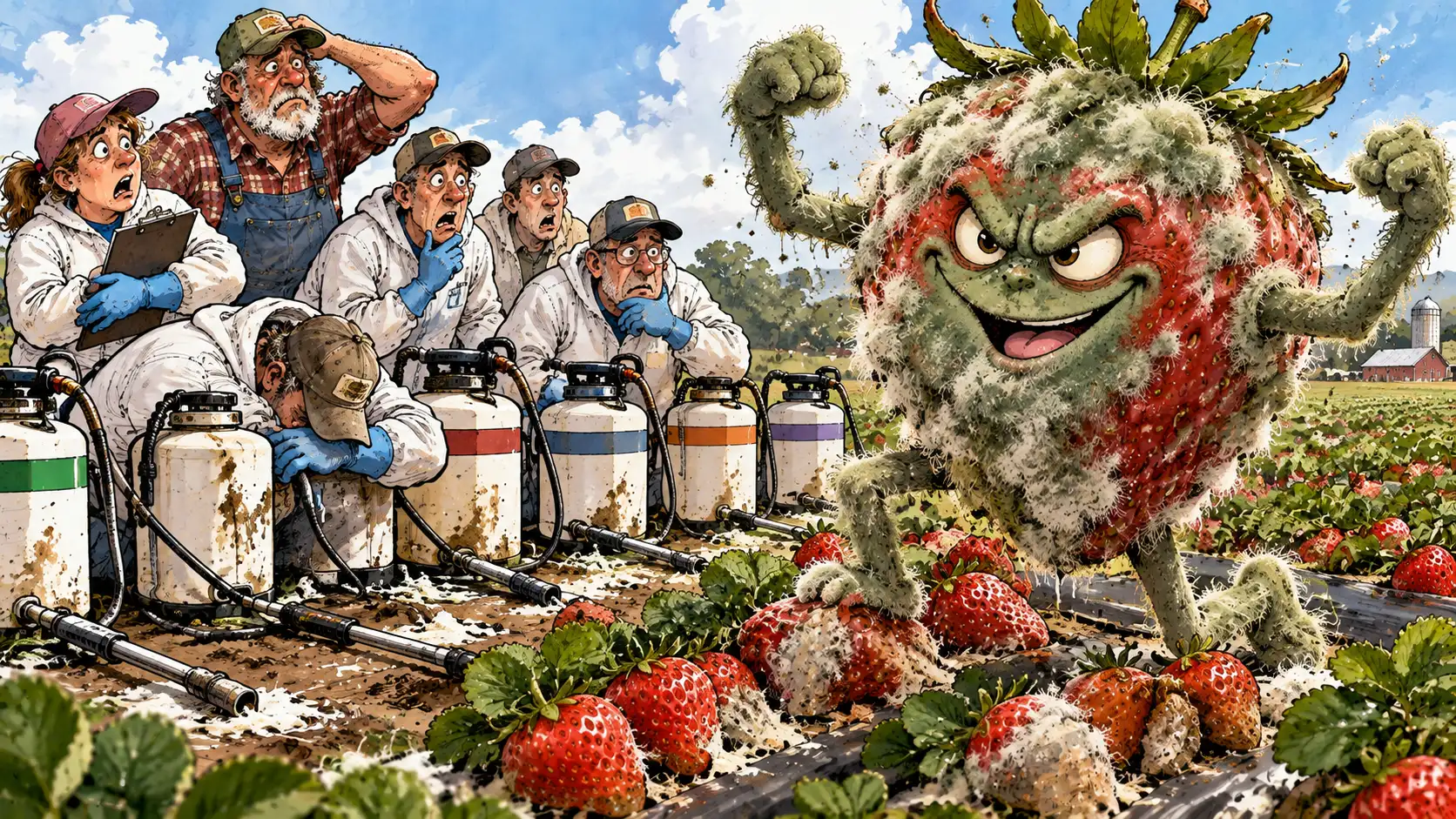
The Fungus With an Advanced Degree
ATHENS, Georgia. Strawberry growers in Georgia are facing a formidable opponent: gray mold with enough chemical resistance to qualify for an advanced degree in agricultural survival. The fungus has apparently studied the pesticides, read the warning labels and decided to continue its career in fruit destruction.
University of Georgia Extension fruit disease specialist Phil Brannen recently described Botrytis isolates in Georgia showing resistance to five or more fungicide classes, as Specialty Crop Grower reported. That doesn’t mean every strain resists every treatment. It means resistance can accumulate, reducing the effectiveness of valuable disease-control tools. For a grower, it’s rather like discovering the burglar has memorized five different locks.
Botrytis causes gray mold, a disease that can damage strawberries before and after harvest. It particularly enjoys the fact that fruit must eventually leave the field, enter the supply chain and reach a customer while still looking appetizing. The fungus has no interest in that business plan.
Botrytis Fungicide Resistance: How Gray Mold Learned the Routine
Farm.FM’s Agricultural Medical Board has offered the organism a scholarship. Its academic achievements include advanced chemistry, resistance management, refrigerated storage survival and an apparent commitment to ruining Mother’s Day desserts.
A berry grower said he’d tried managing diseases, labor, weather and market prices, only to discover his fungus had stronger professional development opportunities than his employees. “My strawberry plants need sunshine and attention,” he explained. “The mold needs one afternoon of bad weather and apparently becomes a professor.”
The comparison gets funnier until the grower opens his records. A failed fungicide application isn’t merely a wasted chemical purchase. It can mean lost marketable fruit, extra labor, reduced shelf life and angry buyers. A strawberry has an absurdly narrow window between premium produce and the beginning of a science experiment.
Resistance also explains why spraying repeatedly with the same type of product may become counterproductive. The Fungicide Resistance Action Committee classifies fungicides by mode of action precisely so growers can rotate them. Selection pressure favors organisms that survive. Over time, the survivors can become a larger proportion of the population. That’s natural selection, although farmers generally prefer it when the winners are their cattle instead of their diseases.
Rotating Fungicide Modes of Action: The Old Chemicals Return
Brannen noted that older products, including captan and thiram, remain important tools because of their different resistance characteristics. The broader management lesson is to rotate fungicide modes of action as appropriate, follow labels, monitor conditions and combine chemical controls with sanitation and other integrated disease practices. UGA Extension publishes the current recommendations. More product isn’t always better, particularly when the pathogen has already learned the routine.
Farm.FM recommends that Congress study Botrytis closely. The organism accomplishes something Washington has struggled with for years: it adapts promptly when conditions change. Unfortunately, its primary policy platform is destroying strawberries, so a cabinet appointment would be premature.
This is also a reminder of why agricultural research matters. A grower can’t negotiate with a microscopic organism or ask it to honor a campaign promise. Extension recommendations, resistance testing and practical field observations help protect the tools that remain useful. The USDA and land-grant universities have been funding that kind of unglamorous work for generations.
For consumers, the most helpful action is far less dramatic: handle strawberries carefully, refrigerate them appropriately and use them promptly. A berry is delicate, even if the fungus pursuing it is tough enough to survive several chemical confrontations.
Farm.FM’s final recommendation is to stop asking the mold whether it intends to cooperate. The evidence suggests it will request tenure, hire a lawyer and continue growing on the berries while the paperwork is processed.
Documents From the Berry Patch
Exhibit A: Fine Print on the Fungicide Label
This product is effective against gray mold except where it is not. Results depend on the weather, the grower, the berry and the mood of the fungus. Do not apply more than the label allows, and do not apply less than the label allows, and do not apply the same product again and again and expect a different result. Resistance is not covered by the manufacturer’s warranty and is not covered by any warranty known to man.
Exhibit B: One-Star Review of a Pint of Strawberries
★☆☆☆☆ “Bought a pint Tuesday. Looked perfect Tuesday. Wednesday morning the top layer had developed a gray coat and what appeared to be opinions. Refrigerated promptly as instructed. Mold was unimpressed. Would buy again, but not on a Tuesday.” Posted by a customer in Atlanta.
Exhibit C: Spray Records, Block Four
| Date | Product Class | Result |
|---|---|---|
| Feb. 2 | Class A | Mold unmoved |
| Feb. 9 | Class B | Mold slightly amused |
| Feb. 16 | Class C | Mold took notes |
| Feb. 23 | Captan | Mold flinched |
| Mar. 2 | Thiram | Mold requested a meeting |
Reporting foundation:Specialty Crop Grower, University of Georgia research on fungicide resistance.
Five Observations About a Fungus With a Degree
- The mold is resistant to five fungicides. Five! You know how long it took me to become resistant to my mother-in-law? Eleven years and a divorce attorney.
- The grower says the mold has better professional development than his employees. That’s a real thing. The mold gets a conference, a seminar and tenure. My guys get a Thursday off if somebody dies.
- A strawberry has about a four-minute window between “premium produce” and “science experiment.” I’ve got leftovers in my refrigerator that are in the experiment phase. They’ve got their own ecosystem.
- They say try the old chemicals, captan, thiram. That’s the farming version of calling your ex. It worked once. Nobody feels great about it. But it works.
- Congress should study this mold because it adapts when conditions change. Folks, that’s the one thing Congress has never done. They’ve been in the same room since 1789 and the room still has the same furniture.
Last Updated on October 29, 2026 by Alan Nafzger