
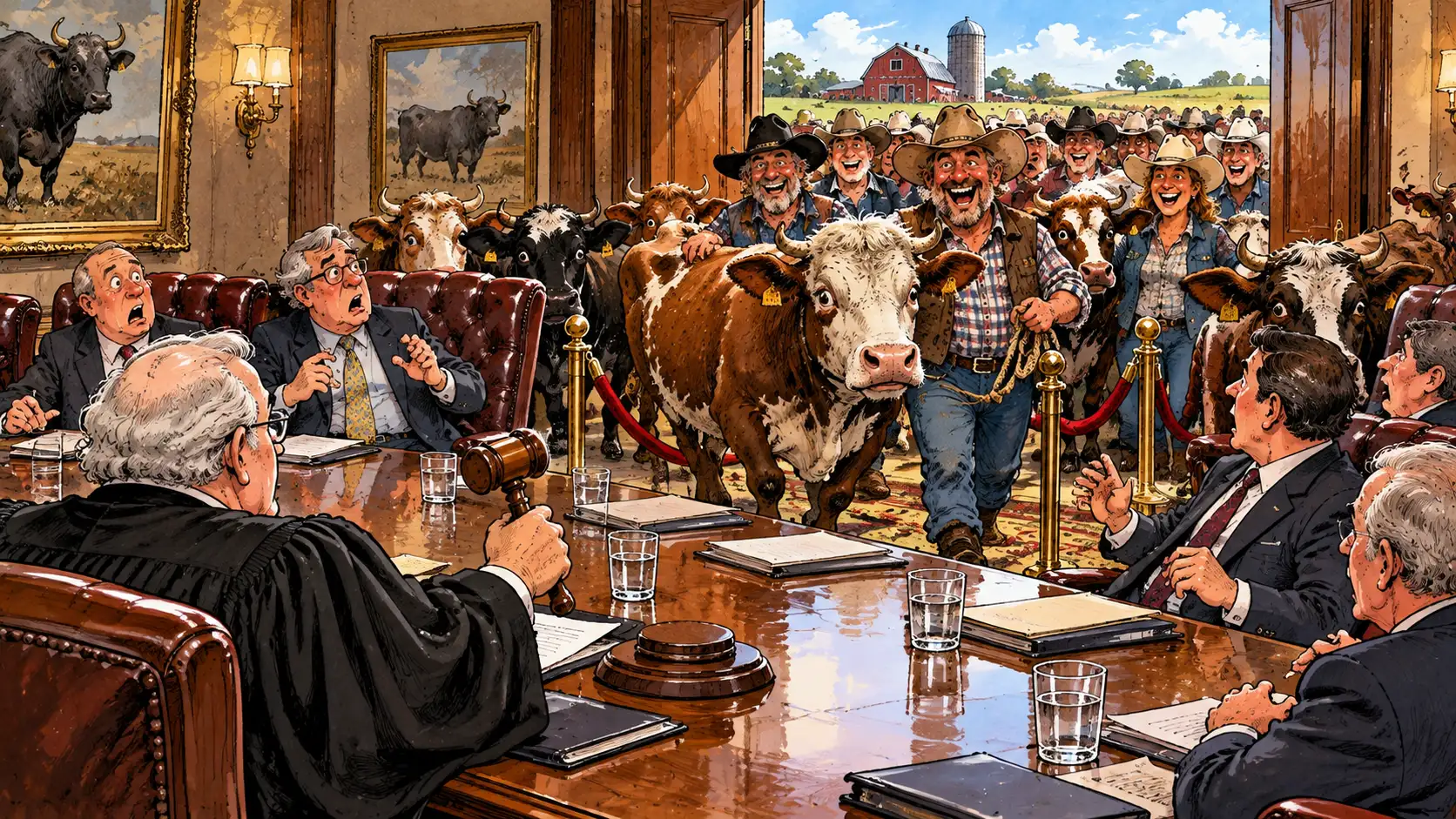
A Judge Looks at the Guest List
BISMARCK, North Dakota. The state has discovered a strange new principle of representative government: when ranchers help pay for an institution, they may reasonably expect a chance to participate in it. Agricultural officials are reportedly reviewing this radical notion before somebody applies it to the federal budget.
A North Dakota district judge ruled that provisions governing nominations to the nine-member North Dakota Beef Commission improperly favored four named industry organizations. Six seats were tied to nominations from those groups. The ruling concerned the selection process, not the continued existence of the beef checkoff program. It has introduced something unfamiliar into agricultural politics: an open door. The North Dakota Monitor covered the October 27 decision.
For decades, the average rancher has approached agricultural representation the way he approaches a locked gate: assume somebody else has the key, climb over the fence and hope the bull is elsewhere. Now a court has pointed out that choosing representatives from a predetermined list resembles an election where the winners are picked before anybody arrives.
The Beef Checkoff Meets the Cows That Fund It
Picture a rancher arriving at a commission meeting with a folding chair and a question: “I paid into this deal. Who represents me?” A receptionist hands him a brochure celebrating beef, which is a fine product but a poor answer to a constitutional question.
The USDA Agricultural Marketing Service oversees research and promotion programs, and the Cattlemen’s Beef Board administers the national checkoff, a per-head assessment intended to support promotion and research. That makes the public-relations challenge unusually delicious. The program exists to convince Americans to buy beef. Convincing ranchers they deserve a voice ought to be the easy assignment, right after convincing a hungry Texan that brisket is worth eating.
Farm.FM’s governance calculator found that the old nomination arrangement achieved a 100 percent success rate at selecting nominees through the organizations authorized to nominate them. The math is airtight and about as enlightening as reporting that every winning bull came from the winning pen.
One rancher suggested a modest reform: put a feed bucket by the door, let everybody who raises cattle submit a name, and count the votes before the cattle eat the ballots. A second demanded term limits for anyone whose boots had never touched manure. A third asked whether committee meetings could end before the afternoon feeding, which disqualified him from Washington employment on the spot.
The Constitutional Beef Behind the Ruling
The legal question isn’t whether trade organizations have knowledge. They certainly do. It’s whether lawmakers can give specified private groups exclusive access to nominate people for public positions. Knowing plenty about cattle doesn’t entitle anybody to own the corral, the gate and the county road leading to it.
There’s an economics lesson in here too. When a rancher buys fencing, he receives fencing. When he pays an assessment supporting promotion, he receives a collective program whose governance can feel several pastures removed. The farther money travels from the producer, the more transparency matters. Anybody who has chased a heifer through three neighboring properties understands the problem.
The judge did not order cattle onto the board, although several have better attendance records than professional committee members. The North Dakota Department of Agriculture now has a nomination system to rework, which is less dramatic than a stampede, but constitutional repair seldom comes with a rodeo announcer.
For ranchers, the practical demand is modest: transparent rules, broader participation and clear accounting. If an organization promotes beef on their dime, the people raising the beef shouldn’t need a secret handshake to approach the table.
The cows have announced no position. Their attorneys advise remaining outstanding in their field.
Exhibits From the Commission Files
Exhibit A: Fine Print on the Old Nomination Form
Nominees must be nominated. Nominations must be made by an approved nominator. Approved nominators are those who have previously been approved. Applicants who believe they qualify as approved nominators should consult an approved nominator. Void where prohibited, which is increasingly everywhere. Folding chairs are not provided and should not be brought.
Exhibit B: One-Star Review of the Public Comment Period
★☆☆☆☆ “Drove four hours. Brought my own chair. Was told the meeting was open to the public but the public meant four organizations. Offered a pamphlet and a mint. The mint was good. Would not attend again unless the cows are allowed to vote.” Posted by a rancher from the southwest part of the state.
Exhibit C: Receptionist Brochure Distribution Log
| Time | Visitor | Question Asked | Item Provided |
|---|---|---|---|
| 9:02 a.m. | Rancher, one chair | Who represents me? | Beef brochure |
| 9:14 a.m. | Rancher, no chair | Who picks the nominees? | Beef brochure, laminated |
| 10:40 a.m. | Rancher’s wife | Is there a form? | Form, plus brochure |
| 11:55 a.m. | Judge | Nothing, just looking | None requested |
Reporting foundation:North Dakota Monitor, October 27 court ruling.
Five Observations About a Guest List With Cows on It
- You ever notice the only group that gets to pick the nominees is the group that already picked the nominees? That’s not a process. That’s a family reunion with a budget.
- A rancher drives four hours with his own folding chair and they hand him a brochure. A brochure! I came to talk about representation and I’m leaving with a picture of a steak.
- The cow pays in, the cow gets nothing, and the cow doesn’t even get a mint. And the mint was the best part of the meeting. Everybody says so.
- They say the commission meets at nine. Nine in the morning, to a cattleman, is the middle of the day. He’s been up since four arguing with a gate.
- The judge said open the door and the whole state went, “Wait, there was a door?” Forty years of climbing over the fence and the gate was right there. Unlocked. With a sign.