
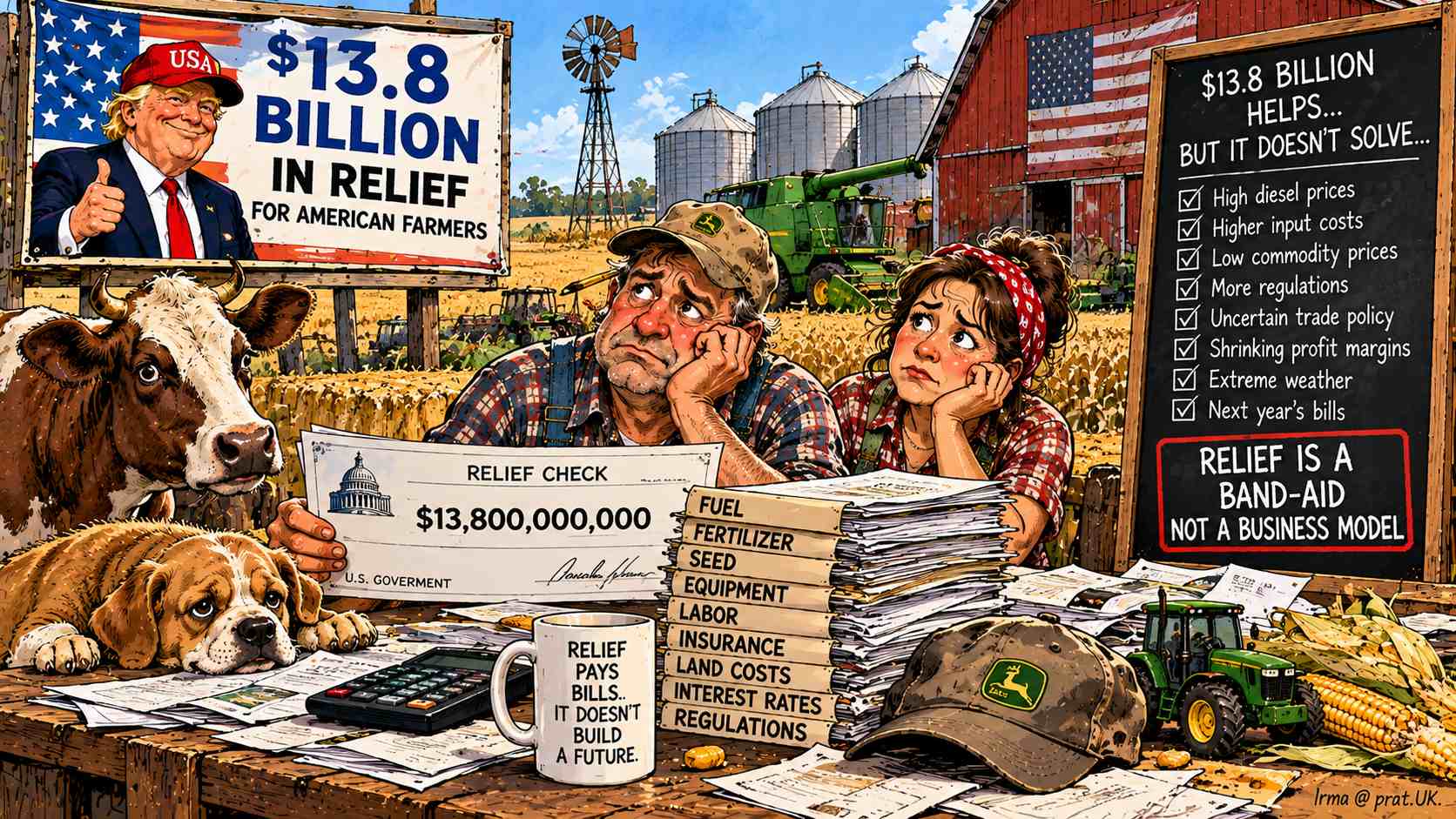
Accountants ask why a record payout needs to exist
WASHINGTON, D.C. – The USDA has announced approximately $13.8 billion in gross Agriculture Risk Coverage and Price Loss Coverage payments for the 2025 crop year, celebrating the largest payout since the programs were established under the 2014 Farm Bill.
American farmers welcomed the assistance. Their accountants immediately began asking why a business responsible for feeding the nation requires record government support to remain financially viable.
Washington called the payments a historic achievement. Farmers called them helpful. Accountants called them evidence that somebody needed to examine the income statement.
America’s New Agricultural Business Plan
Under a business model proposed by the National Association of Financially Exhausted Accountants, American farmers would operate according to five principles.
First, borrow money to buy expensive inputs. Second, grow an enormous quantity of commodities. Third, discover market prices have declined. Fourth, apply for government assistance. Fifth, repeat until the accountant requests a career change.
Dr. Benjamin Bottomline, an agricultural financial adviser, praised the program.
“This is the only industry where receiving emergency financial support can be described as a record-breaking achievement.”
He suggested replacing farm profit-and-loss statements with a single question.
“Did the government send anything?”
The $13.8 Billion Agricultural Accounting Experiment
USDA reports that 16 crops triggered Price Loss Coverage payments for the 2025 crop year, including corn, soybeans, wheat, rice and peanuts. Payments are calculated using program rules and eligibility requirements rather than divided equally among farmers.
The announced $13.8 billion is also a gross figure, subject to payment limits and statutory reductions, including sequestration. These details matter because a national announcement is not the same as an individual farmer receiving an identical share, as Feedstuffs explained.
An Iowa accountant attempted to explain this distinction to a senator.
“Thirteen billion dollars sounds impressive.”
“It is impressive.”
“But what if farmers lost money growing the crops?”
“The assistance helps.”
“Wouldn’t higher profitability be better?”
The senator requested that the accountant stop introducing unrelated questions.
Washington Discovers Profit Is Not a Four-Letter Word
Agricultural economics distinguishes between revenue, expenses and income. Revenue is money received. Expenses are money spent. Profit is what remains when the first exceeds the second.
Washington reportedly considers this definition unnecessarily restrictive. A congressional adviser proposed calculating agricultural prosperity by adding subsidies directly to the number of favorable press releases. Under this innovative accounting method, every USDA announcement increases rural prosperity, even if no farm earns another dollar.
A poll of 700 producers found that 81% preferred earning money from crop sales to receiving government assistance after prices fell. Twelve percent preferred both. Seven percent requested a tax deduction for the emotional damage caused by agricultural accounting.
Who Actually Benefits From ARC and PLC Payments?
Government payments provide meaningful support for producers facing low commodity prices and financial stress. They can also help farmers meet operating expenses and prepare for another crop year.
But a support program is not a replacement for competitive markets, manageable input prices and profitable production. If a farmer receives financial assistance only to transfer most of it to lenders, suppliers and accumulated obligations, the program may preserve the farm without fundamentally improving its economics.
That is not necessarily failure. It is certainly not the same as prosperity.
A Nebraska accountant illustrated the distinction with a household analogy.
“If your wife gives you $500 because you lost $1,000 at poker, you haven’t discovered a new retirement strategy.”
The Accountants Issue Their Final Verdict
America’s farmers produce crops, raise livestock and take substantial financial risks. They deserve functioning markets and a reasonable opportunity to earn returns on their investments. The $13.8 billion safety net can help stabilize farms during difficult economic conditions.
But the real measure of agricultural success should not be how much rescue money Washington distributes. It should be whether farmers can operate without needing rescue money every year.
One accountant delivered the final verdict.
“Congratulations on receiving the payment.”
He examined the farm’s books.
“Now let’s discuss why you needed it.”
The farmer requested another payment. The accountant requested a drink.
The Evidence File
Follow the Money
Of the $13.8 billion, the amount actually reaching a given farm is reduced by payment limits and sequestration, then reduced again by the lender, the landlord and the implement dealer. By the time it arrives, the check has done more traveling than a rodeo clown and has less to show for it. The University of Illinois farmdoc daily analysis lays out the mechanics in far less amusing detail.
Logical Contradiction
Washington calls the record payout a historic success. Farmers call it a response to low prices. Both cannot be a victory. If low prices trigger the record, then the more successful the program, the worse the farm economy. It is the only scoreboard where the winning team is the one losing.
Definitions of Key Terms
“Gross payment” means the number on the press release. “Net payment” means what’s left after the bank, the dealer and the sequester finish dinner. “Record” means the old mark was lower, which is only worth celebrating if you were hoping for the second one. Coverage is also at RFD-TV.
Sources and Further Reading
See the USDA Farm Service Agency, Feedstuffs, RFD-TV and the University of Illinois farmdoc daily for the analysis.
Source: USDA Farm Service Agency, October 7, 2026, announcement of $13.8 billion in gross ARC/PLC payments for the 2025 crop year, including eligibility and statutory reductions.
Humorous Observations
- “Did the government send anything?” That’s the whole farm audit. That’s also my entire relationship with the IRS.
- Seven percent wanted a tax deduction for the emotional damage caused by agricultural accounting. Tell ’em the form is 14 pages. There’s a box for sobbing.
- “If your wife gives you $500 because you lost $1,000 at poker, you haven’t discovered a retirement strategy.” Buddy, in my house that’s called a Tuesday.
- The farmer asked for another payment. The accountant asked for a drink. Both of them got what they could afford, and the accountant got more.
- Adding subsidies to the number of press releases. That’s the first time I’ve seen math where the answer is a podium.
Last Updated on October 26, 2026 by Alan Nafzger