
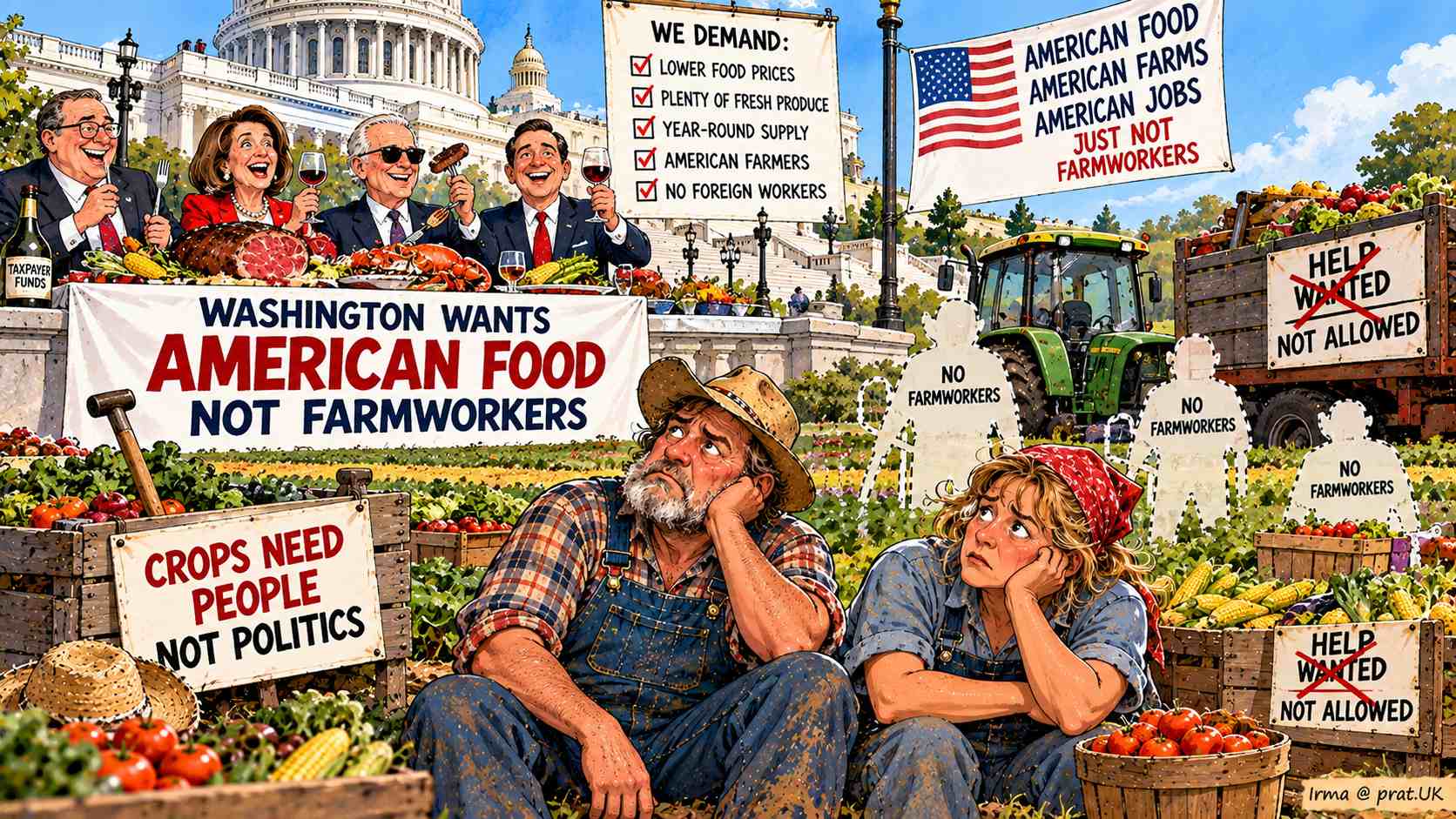
Congress Announces Plans to Protect American Agriculture From Foreign Competition, Foreign Workers and Apparently the Agricultural Industry Itself
WASHINGTON, D.C. – American agriculture has encountered an extraordinary political contradiction after Washington demanded greater domestic food production while pursuing immigration policies that agricultural employers say are disrupting the workers needed to produce it.
More than 40 agricultural organizations have warned federal officials that immigration enforcement is creating labor disruptions across the food supply chain, according to The Washington Post’s October 23 investigation.
The affected industries include meatpacking, dairy farming and produce agriculture.
Congress responded by promising Americans more domestic food, lower grocery prices and fewer problems, preferably without anyone explaining how food gets from the field to the supermarket.
The Great American Agricultural Labor Discovery
For decades, politicians have celebrated American farmers as the backbone of the nation.
Unfortunately, somebody forgot to mention that backbones ordinarily require arms.
The USDA reports that approximately 68% of hired crop farmworkers performing manual labor were foreign-born in its 2020-2022 survey data.
This does not mean those workers all lack legal immigration status. Foreign-born workers include people with different immigration and employment authorizations.
Nevertheless, the statistics suggest that American agriculture has developed a considerable reliance on workers whom many politicians rarely meet outside campaign photographs.
Dr. Harold Turnip, director of the entirely satirical Institute for Economically Convenient Contradictions, explained Washington’s strategy.
“We demand American-grown strawberries, American-grown tomatoes and American-grown lettuce.”
“Who harvests them?”
“We prefer not to discuss operational details.”
Congress Introduces the Self-Harvesting Farm Act
Under a satirical congressional proposal, American fruits and vegetables would be required to harvest themselves.
Strawberries would voluntarily detach from plants.
Lettuce would assemble into supermarket bags.
Dairy cows would operate their own milking systems, complete immigration documentation and submit weekly productivity reports.
A California farmer questioned the arrangement.
“Who picks the peaches?”
“The peaches will demonstrate individual responsibility.”
“What about my dairy cows?”
“Have you tried offering them overtime?”
“The cows don’t understand overtime.”
“Then perhaps they’re not sufficiently committed to American agriculture.”
The farmer reportedly requested that Congress spend one afternoon milking cows before developing additional recommendations.
No lawmakers volunteered.
The Grocery Store Receives a Surprise
Agricultural organizations warn that severe workforce disruptions can delay processing, reduce production and increase expenses.
These problems can eventually affect consumers.
The arithmetic is not especially complicated.
Fewer available workers can mean slower harvesting or processing.
Slower production can increase waste and reduce supplies.
Reduced supplies, other things being equal, can place upward pressure on prices.
Washington has reportedly classified this sequence as advanced economics.
An openly satirical survey of 500 shoppers found that 96% wanted lower grocery prices.
Ninety-three percent also wanted American-grown produce.
Only 4% volunteered to pick lettuce in California during August.
The remaining respondents asked whether the lettuce could be collected remotely.
Farmers Ask for a Workable Policy
Agricultural employers are calling for dependable legal workforce arrangements, including possible work authorization for established agricultural employees.
Border security, lawful employment and reliable food production are legitimate policy goals. The challenge is creating rules that address all three rather than pretending one eliminates the others.
American farmers are not asking Congress to abandon immigration law.
They are asking Congress to recognize that food production involves labor.
A Texas producer summarized the problem.
“Washington wants American food, American jobs and affordable groceries.”
He looked toward an empty field.
“Fine. Send me somebody who’ll show up at five tomorrow morning.”
Congress scheduled a hearing for noon.
The farmer had already finished half his workday.
Last Updated on May 10, 2025 by Alan Nafzger