
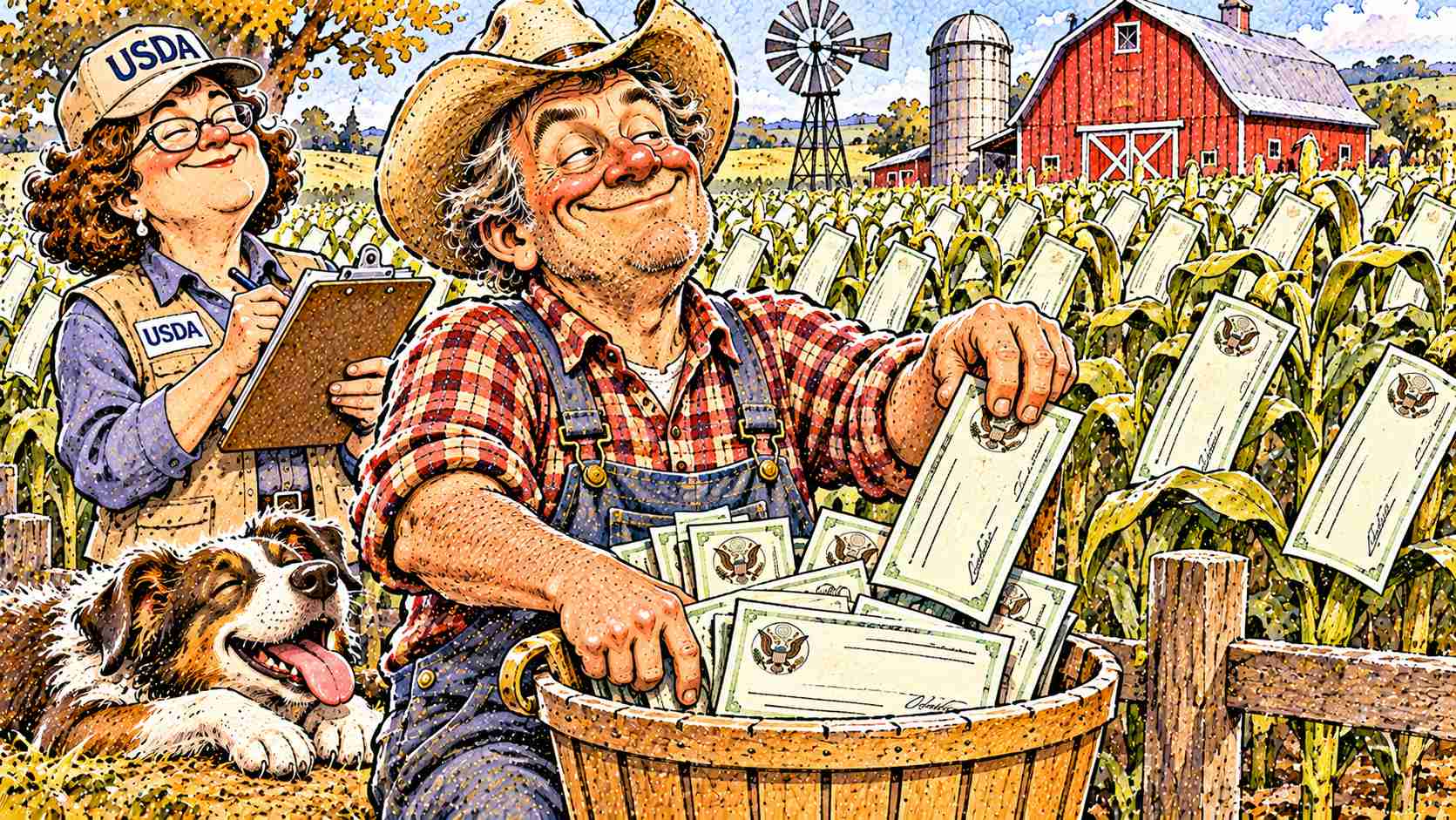
Extension agents advise planting politicians near competitive districts
WASHINGTON, D.C. — The United States Department of Agriculture has discovered an extraordinary new agricultural opportunity. American farmers may be able to improve their financial position by spending less time producing food and more time cultivating politicians.
The revelation follows the administration’s announcement of $8 billion in diesel assistance amid elevated agricultural operating costs. According to Reuters, government payments to farmers were already expected to top $47 billion this year, and the diesel aid would push the total to a record $55.4 billion.
Federal Farm Payments: The Most Reliable Crop in America
After years of struggling with unpredictable weather, weak commodity prices and expensive machinery, farmers have finally identified a crop that thrives under almost any environmental condition. Federal spending.
Unlike corn, government checks do not require nitrogen fertilizer. Unlike soybeans, they are relatively resistant to drought. And unlike wheat, they can achieve astonishing growth whenever a difficult election approaches. The USDA Economic Research Service tracks farm sector income, though it has not yet added a column for political yield per acre.
An Iowa producer enrolled in the experiment reportedly planted a row of Republican campaign signs beside a field of soybeans. The campaign signs produced more promises per acre. A neighboring farmer experimented with Democrats. Results were similar, although the paperwork came in different colors.
Agricultural researchers have therefore classified both political varieties as highly productive but extremely difficult to harvest.
The Political Cultivation Program
The USDA’s proposed Political Cultivation Program would reward farmers for maintaining suitable growing conditions for congressional representatives. Approved practices include attending campaign rallies, nodding politely during agricultural speeches and refraining from asking what happened to last year’s promises.
A new soil classification system would measure the concentration of federal dollars within each congressional district. Fields located near competitive elections would receive premium ratings. Fields located in safely held districts would be advised to improve their political fertility through strategic redistricting.
Expert Advice from the Extension Office
Gail Rasmussen, a county extension agent in western Iowa for nineteen years, said farmers should handle politicians with care. “They look hardy, but they’re a delicate crop,” she said. “Too much exposure to television cameras can cause uncontrolled growth. And without regular pruning, a single senator will produce enough speeches to cover several thousand acres while contributing almost nothing to soil productivity.”
Rasmussen said the most common mistake among new growers is overwatering with attention. “They bolt,” she said. “Right up the middle of the field. Then they flower right before the vote and you’ve got press releases everywhere.”
University Study: Rotate Parties Every Four Years
Fortunately, political manure remains plentiful. One university study recommends rotating political parties every four years to prevent the accumulation of unsustainable promises. The researchers caution against planting Republicans and Democrats in the same field because both varieties compete aggressively for attention while consuming enormous quantities of resources.
The study’s authors reported a statistical finding they described as “robust across every district sampled.” In 100 percent of test plots, promises per acre rose sharply in the final two weeks before a vote and returned to baseline by the following Tuesday.
Leaked Memo: The Department Considers a Rebrand
A draft internal memo, circulated among staff and shared with this publication, proposes renaming the department’s farm assistance line “Seasonal Support Yield.” The memo explains that the existing name, “Emergency Payments,” has been used four times in the past two years and “is beginning to suggest a pattern.” A handwritten note in the margin reads: “Do not use the word pattern.”
What Farmers Actually Want
Meanwhile, actual farmers continue raising cattle, cultivating crops and performing the work that puts food on American tables. Their preferred business model remains remarkably old-fashioned. They would like to sell what they produce for more than it costs to produce.
This proposal has reportedly confused several Washington economists. One suggested additional subsidies. Another recommended a federal commission. A third insisted the solution was creating a new office responsible for studying whether farmers should be allowed to make profits.
The farmer suggested abolishing the office and dividing its budget among people who own tractors. Washington rejected the idea because it contained insufficient administrative complexity.
For now, the most reliable agricultural forecast remains unchanged. Corn may rise or fall. Soybeans may prosper or struggle. But government spending, properly irrigated with taxpayer money, appears capable of growing forever.
Five Observations on Growing Government Checks
- Farmers have found a crop that doesn’t need fertilizer, doesn’t mind drought, and grows like crazy before an election. And we’ve been calling it a “check.” It’s a weed. It’s the only weed in America that comes with a press conference.
- One guy planted Republican signs next to his soybeans, another one planted Democrats. Same result. Just the paperwork’s a different color. That’s America. Two parties, one tractor, and nobody’s allowed to drive it.
- Don’t overwater a politician with attention, or he’ll bolt. I’ve dated that guy. You give him a little attention, he’s up the middle of the field wearing a flag as a cape.
- The department wants to rename “Emergency Payments.” Because they’ve used it four times and it’s starting to suggest a pattern. When your emergency has a pattern, it’s not an emergency. It’s a subscription.
- All the farmer wants is to sell his stuff for more than it costs. That’s it. That’s the radical idea. And Washington looks at him like he asked them to land a plane on a diner.