
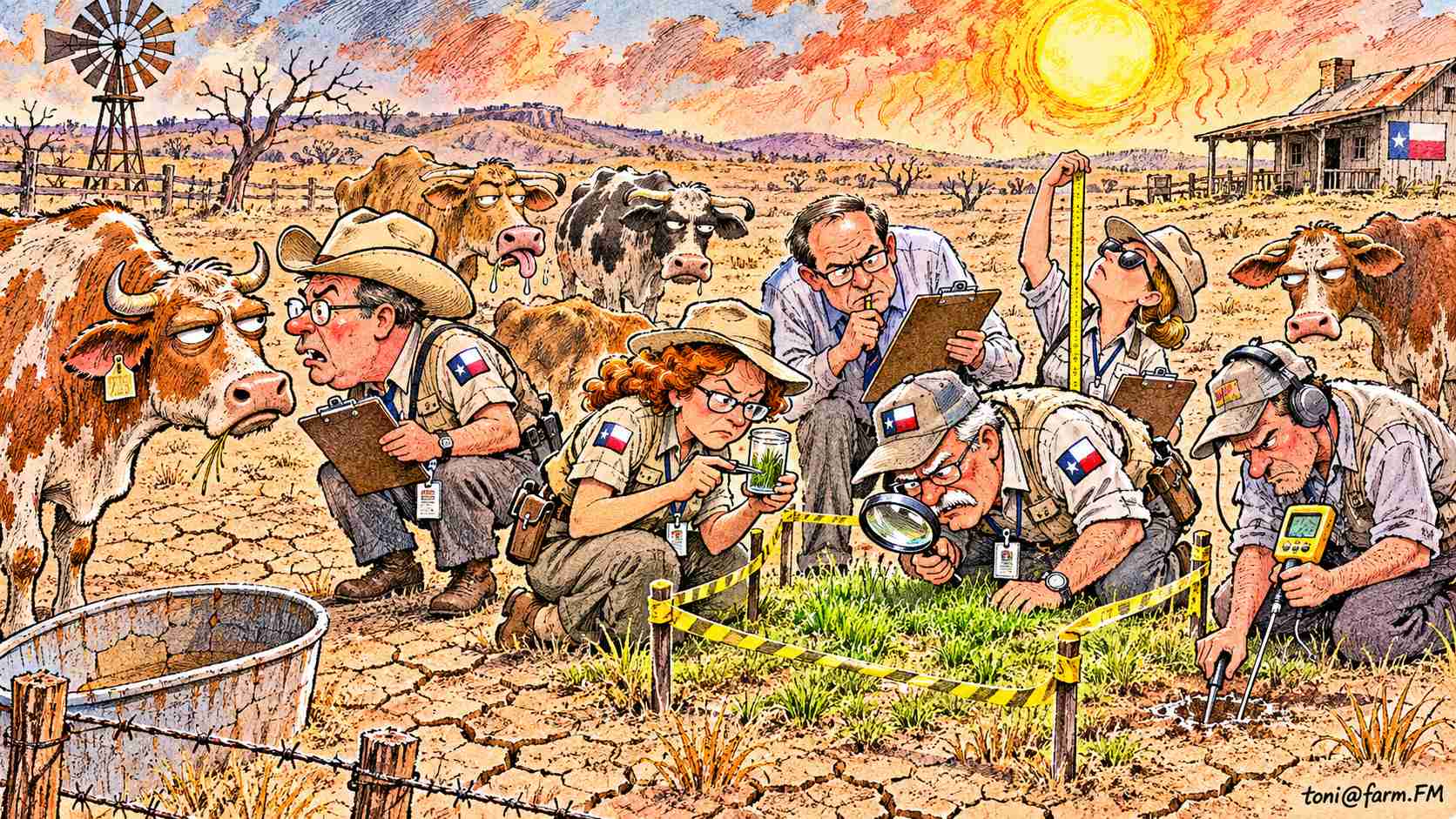
Ranchers want to know who’s hiding the water
COLLEGE STATION, Texas – Agricultural economists have reported that 77% of Texas beef cows were located in drought-affected areas in recent weeks, prompting ranchers to demand the immediate interrogation of the remaining 23%.
According to Texas A&M agricultural economist Josh Maples, more than half the nation’s beef cows were in drought-affected areas, with conditions particularly severe across Southern cattle country. The Oklahoma Farm Report carried the same analysis, and Drovers has tracked how drought stalls herd expansion.
Texas producers responded by examining their herds and asking whether any animals had been withholding important information about groundwater.

Texas Cattle Drought: Cows Suspected of Concealing Water
A rancher near Vernon, Texas, described discovering that one cow appeared unusually cheerful despite the dry conditions.
“She’s been standing behind the barn looking smug for three weeks.”
He suspects she may know where the remaining water is located.
The cow declined to cooperate with investigators.
When offered a bucket of water in exchange for information, she drank the evidence.
Another cow reportedly attempted to leave the interview by walking slowly toward a distant patch of weeds.
Authorities are considering whether the entire herd has formed a conspiracy to conceal a reliable water source from its owner.
The incident report filed with the county sheriff’s office, which this newspaper obtained, lists the suspect as “cow, brown, approximately 1,200 pounds, smug.” Under Witnesses, the deputy wrote “chickens,” and under Motive, “unknown, possibly grass.” A line at the bottom adds that the suspect “was last seen walking away at a pace described as unhurried.”
Scientists Discover Drought Is Expensive
Agricultural economists warn that persistent dryness can increase feed costs, reduce forage supplies and discourage herd rebuilding.
A rancher confirmed the findings.
“That’s remarkable scientific work. I’ve only been experiencing it every morning since spring.”
He said the researchers should next investigate whether cattle become hungry when grass disappears.
A visiting graduate student suggested that drought creates negative pasture productivity outcomes.
The rancher nodded.
“Out here we call that dirt.”
The student began taking notes.
He is now preparing a dissertation on the economic implications of cows eating something other than dirt.
A forensic examination of the tank behind the barn, conducted by a retired county agent with a flashlight, found hoofprints leading to the water trough, three mineral blocks and one hat. The hat, he determined, belonged to the rancher.
Ranchers Introduce Hay-Based Retirement Plans
With pasture conditions deteriorating, some producers must purchase additional feed or begin winter feeding earlier than usual.
One Texas rancher reported that his hay inventory had become more valuable than his pickup.
“I’ve got sixty bales in the barn, and every time I look at them I feel like a banker guarding gold.”
His wife asked why he was refusing to sell a few bales to their neighbor.
“That’s our retirement account.”
She reminded him they already possessed a retirement account.
He explained that the hay was currently performing better.
Government Considers Drought Awareness Campaign
A federal consultant suggested creating an educational program to teach ranchers how to recognize drought.
The program would feature photographs of dry grass, empty ponds and cattle looking disappointed.
A local producer objected that ranchers were already familiar with all three.
The consultant replied that public awareness was essential.
The producer invited him to visit.
“Bring a shovel. We’ve got plenty of awareness out here.”
Texas producers know that drought management requires flexible stocking rates, realistic forage budgets and careful decisions about keeping or selling breeding animals. The Texas and Southwestern Cattle Raisers Association has been explaining that to anyone who will listen, including, eventually, the cattle.
Hay has become the region’s second currency. A round bale of decent coastal Bermuda now changes hands with the ceremony of a land sale, and one producer outside Vernon has started parking his trailer in front of the barn at night so the neighbors can’t count what he has left.
“I don’t lock the house,” he said. “I lock the hay.”
His banker has asked that future loan applications list stored forage under liquid assets, since it is the only thing on the place anybody is trying to buy.
What they cannot do is manufacture rain through positive thinking.
One rancher recommended that government officials spend less time announcing drought statistics and more time avoiding policies that increase producers’ operating costs.
The consultant promised to examine the suggestion after lunch.
The drought affects 77% of Texas cattle. The other 23% are being questioned about their suspiciously favorable living arrangements.
Five Observations on the Texas Cattle Drought
- Seventy-seven percent of Texas cattle are in drought. So who are the other twenty-three? I’d like to see their water bill. Somebody’s got a pool.
- She’s been standing behind the barn looking smug for three weeks. Every family has that one cousin who’s doing great and won’t tell anybody how.
- The cow drank the evidence. That’s cow CSI. “Sir, the suspect consumed the only proof.” “Of course she did. She’s a cow. It’s the one thing she does.”
- The student calls it “negative pasture productivity.” The rancher says out here we call that dirt. That’s how you know you’ve been to grad school. You can charge seventy grand for a word that means dirt.
- “Bring a shovel. We’ve got plenty of awareness out here.” Awareness is the only crop in Texas that’s doing well.
Last Updated on November 9, 2026 by Alan Nafzger