
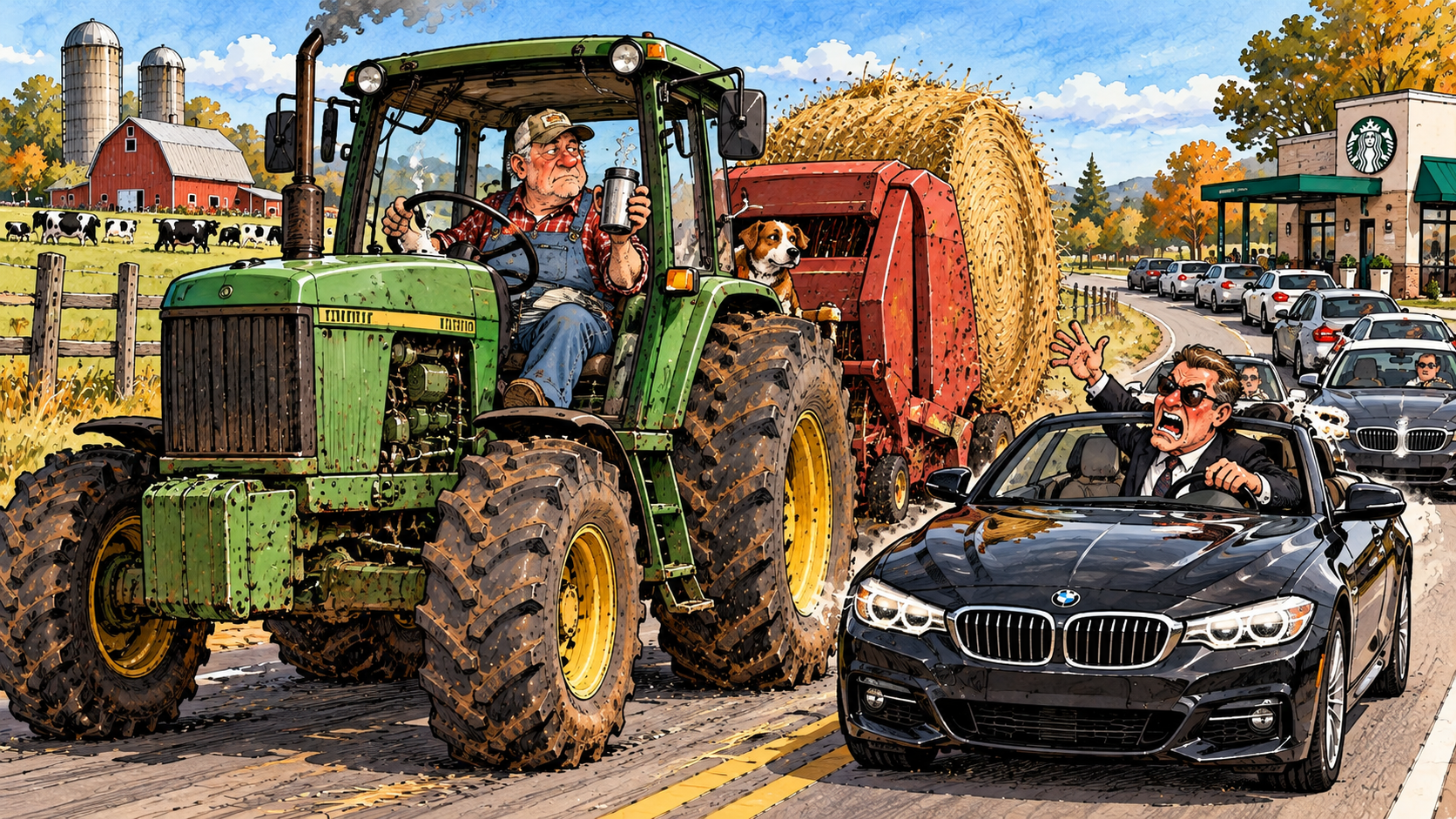
New Jersey Discovers Tractors Are Slow
Lawmakers Draft Highway Safety Bill as Motorists Demand Tractors Go Faster
TRENTON, NEW JERSEY, October 26, 2026 — New Jersey lawmakers have advanced legislation designed to protect agricultural equipment on public highways, following the extraordinary discovery that tractors move slowly, combines occupy considerable space, and farmers occasionally need to travel between fields without being treated as escaped prisoners.
New Jersey wants drivers to respect slow-moving farm equipment, suburban motorists want tractors to travel 75 mph, and farmers want somebody in Trenton to explain how Americans expect to eat without occasionally encountering the people growing their food.
According to NJ.com’s report on the proposed farm equipment highway safety legislation, lawmakers want motorists to understand the dangers of passing tractors, harvesters, and other agricultural machinery. The bipartisan proposal, Assembly Bill A2753, would require educational materials, safety videos, and additional driver instruction.
Farmers welcomed the proposal, although several expressed surprise that civilization had reached the point where Americans needed government instruction to recognize that a 12-ton machine pulling a manure spreader might not handle like a Porsche.
A tractor can’t go from 15 to 75 just because a BMW gets behind him on his way to Starbucks. That’s not how tractors work. That’s not how anything works. You think the farmer’s gonna see you in the mirror, go, “Oh, a BMW, in a hurry, for a latte,” and hit the nitrous? There’s no nitrous. There’s a hay baler. He’s pulling a hay baler. And the guy in the BMW is going to get to Starbucks twelve seconds sooner so he can sit in the drive-through behind nine other BMWs. The tractor’s coffee is in a thermos. It’s been in that thermos since 1998. It’s fine. – Alan Nafzger
New Jersey Farm Equipment Safety: Why Tractors Are Slow
New Jersey lawmakers have identified a serious transportation crisis: agricultural tractors, despite decades of technological advancement, continue refusing to travel at the speeds suburban motorists consider necessary for civilization. The problem gets especially acute when a driver runs into a tractor while six minutes late for a $7 coffee.
According to agricultural experts, tractors were designed primarily for agricultural work, an engineering oversight that has frustrated commuters since the invention of the automobile.
One particularly impatient motorist explained the suburban position: “I support American farmers. I just don’t think they should be allowed to farm anywhere that inconveniences my personal schedule.”
The philosophical contradiction is considerable. Americans demand locally produced food, sustainable agriculture, fresh vegetables, affordable groceries, and picturesque countryside. The moment they encounter an actual farmer transporting actual equipment, though, they behave as though the agricultural revolution was a terrible misunderstanding.
The state has no shortage of farmers to run into. The USDA’s 2022 Census of Agriculture for New Jersey counted 9,998 farms on just under 712,000 acres.
Assemblywoman Dawn Fantasia, one of the bill’s sponsors, has noted that agricultural equipment often travels at 25 miles per hour or less. For suburban commuters, this represents an almost medieval transportation experience.
One transportation survey conducted among three irritated motorists, a combine operator, and a roadside scarecrow found that 100% of impatient respondents believed tractors should either accelerate immediately or disappear into another dimension. The scarecrow declined comment, having already witnessed enough irrational behavior from humans.
A mathematical examination reveals the severity of the crisis. If a motorist encounters a tractor traveling 15 mph for half a mile, the journey takes two minutes. At 60 mph, the same distance takes 30 seconds. The difference is 90 seconds, approximately the time required to complain about the farmer on Facebook, insult the driver’s ancestry, and write a furious post demanding government intervention.
Agricultural economists suggest this represents the first known instance of Americans demanding legislation because somebody delayed their arrival at a pumpkin-spice latte.
The tractor driver, meanwhile, is operating machinery worth more than the complaining motorist’s automobile, transporting equipment necessary to produce food, and attempting not to become tomorrow’s highway fatality. And the person with the genuine responsibility is expected to apologize.
NJ Slow-Moving Vehicle Law: Passing Rules, Fines and Farmers
New Jersey’s effort to educate motorists has exposed an extraordinary cultural development: farmers who have transported equipment between fields for generations are now sharing roads with people who believe the centerline is a decorative suggestion.
According to the New Jersey Assembly’s explanation of Bill A2753, existing state law requires motorists approaching vehicles displaying the familiar orange and red slow-moving vehicle emblem to reduce their speed to match the slower vehicle before attempting to pass, except on roads with at least two lanes traveling in the same direction. Violations can carry fines ranging from $100 to $500. This information has reportedly stunned motorists who previously believed the orange triangle meant “pass immediately while expressing disappointment.”
The issue isn’t new in Trenton. The New Jersey Department of Agriculture has carried a farm equipment and highway safety resolution at its annual convention in 2022, 2023 and 2025. Nationally, a National Agricultural Safety Database review of agricultural equipment on public roads counted 87 fatal crashes involving farm machinery in 2006, a small share of all road deaths and the reason safety professionals keep raising it.
Sharing the Road With a Tractor: What Drivers Should Know
The average farmer approaches a rural road with an understanding of machinery width, tire placement, turning radius, uneven shoulders, and approaching traffic. The average impatient commuter approaches the same road with a Bluetooth telephone conversation, a breakfast sandwich, and absolute confidence that the laws of physics are negotiable.
Consider the familiar rural highway encounter. A farmer drives a tractor toward a field entrance. He slows, signals his intention to turn, and positions his equipment to accommodate an unusually wide implement. Behind him, a motorist interprets the entire maneuver as an invitation to demonstrate acceleration. The farmer attempts to turn left. The motorist attempts to pass left. Both discover that modern automobiles and farm machinery cannot occupy precisely the same piece of pavement, regardless of how expensive the automobile’s sound system happens to be.
Safety specialists call this a dangerous passing situation. Suburban drivers call it Tuesday.
The problem gets even more absurd during autumn, when urban families travel into rural New Jersey to experience authentic agriculture. They drive to orchards, purchase apples, admire tractors, photograph barns, and pay admission to activities their grandparents considered unpaid household chores. Then, leaving the farm, they encounter agricultural machinery on the highway and become furious. Apparently, they enjoy agriculture as long as the farmer stays inside the designated entertainment area.
One orchard visitor summarized the prevailing suburban attitude: “We drove forty miles so our children could see a real tractor. We just didn’t expect one to be using the road.”
Farmers have proposed a revolutionary alternative to additional bureaucracy: motorists could slow down, pay attention, and refrain from passing where visibility is restricted. Transportation officials have yet to determine whether Americans can absorb this information without a 40-page instructional booklet.
Assembly Bill A2753: Another Government Study of the Obvious
New Jersey’s legislative proposal requires the Department of Agriculture, working with highway safety officials and the Motor Vehicle Commission, to produce educational materials explaining how motorists should behave around farm equipment. The legislation also calls for safety information in driver education courses and materials distributed to parents of beginning drivers. Furthermore, the proposal would require an assessment of agricultural roadway risks and recommendations for additional safety measures, along with annual awareness campaigns during National Farm Safety and Health Week, according to the public tracking page for A2753.

This has raised an uncomfortable question among farmers. Why does the government require a formal study to determine whether passing a combine harvester on a blind curve might be dangerous? In the agricultural community, that discovery traditionally takes about three functioning brain cells and a passing familiarity with death.
Nevertheless, the state may eventually produce signs, reports, videos, and comprehensive recommendations. Farmers anticipate the process with the same excitement normally reserved for property tax assessments.
The proposed study would examine possible remedies, including roadside signage and potentially higher penalties for motorists who violate existing laws. This creates an intriguing bureaucratic opportunity. First, government tells motorists not to behave recklessly. Then government produces a video explaining why reckless behavior is dangerous. Then government commissions a study to determine whether motorists understood the video. Finally, another government committee evaluates whether the original committee needs additional funding. Meanwhile, the farmer still needs to move his tractor.
An agricultural consultant proposed adding another layer of protection: every tractor should be accompanied by a state-certified transportation awareness coordinator carrying a clipboard, fluorescent vest, and government-issued expression of concern. The coordinator would explain that the farmer is not deliberately obstructing traffic. He is producing food.
This distinction has become increasingly difficult for consumers to understand. Modern Americans are intimately familiar with groceries but often remarkably unfamiliar with agriculture. They know milk comes in cartons, eggs arrive in refrigerated displays, and vegetables appear mysteriously under attractive supermarket lighting. The possibility that producing these commodities requires land, machinery, animals, labor, and access to public roads is apparently considered advanced agricultural theory.
A farmer transporting a baler between two hayfields isn’t taking a scenic joyride. He is working. A combine crossing a rural intersection isn’t staging a political demonstration. It is harvesting crops.
And the elderly gentleman driving a tractor at 18 mph isn’t attempting to destroy someone’s afternoon. He’s probably been awake since four in the morning, repaired two hydraulic hoses, fed 90 head of cattle, and discovered that his equipment dealer charges more for a replacement bearing than a decent divorce attorney charges for an initial consultation. Naturally, he deserves to be screamed at by someone whose greatest professional accomplishment that morning was locating the correct conference room.
The economic consequences extend beyond individual inconvenience. Farmers already face equipment costs, fuel expenses, labor shortages, unpredictable weather, and agricultural commodity prices that occasionally make bankruptcy appear to be an attractive retirement strategy. They shouldn’t also need diplomatic immunity to drive across their own farming communities.
New Jersey’s proposal at least recognizes that public roads belong to agricultural producers as well as commuters. That principle should not be controversial. Unfortunately, a country that spends billions celebrating rural traditions while steadily forgetting how farming works has developed an unusual relationship with agricultural reality.
Americans love farmers in television commercials. They admire farmers in pickup truck advertisements. They praise farmers during harvest festivals. But put a farmer on a two-lane road for 90 seconds, and suddenly everybody wants him deported to Pennsylvania.
Perhaps the final government safety announcement should be exceedingly simple:
“The tractor is slow because it is a tractor. The farmer is on the road because the field is somewhere else. Your groceries exist because somebody does this work. Please stop driving like an idiot.”
No committee necessary. No consultants required. No 18-month investigation.
Just one final observation from the agricultural community: if you can’t tolerate following a farmer for two minutes, try growing your own damn breakfast. And good luck getting a combine through the Starbucks drive-through.
Farm Equipment on New Jersey Roads: The Paper Trail

Exhibit A: Township Dispatch Log, Non-Emergency Line
TOWNSHIP PUBLIC SAFETY DISPATCH
NON-EMERGENCY CALL LOG: MONDAY, OCTOBER 19, 202607:12 Caller reports a tractor “in the road.” Dispatcher asks which road. Caller states, “The one I’m on.” Caller advised that farm equipment is permitted on public roads. Caller asks to speak to someone who can make it stop. Caller advised no such person is on duty.
07:26 Passenger from same vehicle calls separately to report the tractor is “doing it on purpose.” Dispatcher asks what the tractor is doing. Passenger states, “Going.”
07:41 Caller reports the tractor has turned into a field. Caller states, “He knew.” No action taken.
08:03 Caller reports being late. Dispatcher advises this is not an emergency. Caller requests a reference number for “being late.” No reference number issued.
Exhibit B: Visitor Review, Applewood Hollow Family Orchard
★☆☆☆☆ “Not what I paid for”
Brandon T., visited October 2026Came for the hayride. Drove 40 minutes, paid $38 for four cider donuts and a pumpkin that was fine. On the way home there was a REAL tractor on Route 29 doing maybe 18 mph. No hayride, no music, nobody handing out cider. Honestly a worse product. I followed it for 11 minutes. Management should keep their equipment on the property where it belongs.
Response from the owner: Hi Brandon, thanks for visiting. That tractor belongs to our neighbor Walt, who has farmed that field since 1974. It was on the road because his other field is across the road. We hope you’ll come back for the corn maze. Please take the left lane at the exit; the right lane has a hay wagon.
Exhibit C: Draft Driver Brochure, “Sharing the Road With Farm Equipment,” Panel 4 of 6
FINE PRINT
1. The orange and red triangle on the back of the machine is a slow-moving vehicle emblem. It is not a decoration, a target, or an invitation.
2. A tractor traveling 15 mph is not holding you up. You are traveling 15 mph behind a tractor.
3. Waving is permitted. Honking is not recommended. The operator has heard your engine for eleven minutes and has no further information to give you.
4. This brochure was reviewed by three offices, two committees, and one person who has met a tractor.
5. Safe passing distances are listed on Panel 5, pending approval of Panel 5.
Exhibit D: Parts Invoice No. 40817, Garden State Farm Equipment & Parts
CUSTOMER: Kessler & Sons Farm
DATE: October 20, 2026
TERMS: Net 30 (customer states “if the corn comes in”)
Hydraulic hose, 3/4 in. x 12 ft (qty 2) $186.00 Wheel bearing assembly, front left $412.50 Seal kit $38.75 Shop labor, 2.5 hrs @ $95.00 $237.50 Sales tax (farm exemption certificate on file) $0.00 TOTAL DUE $874.75 NOTE: Customer asked why the wheel bearing costs more than an initial divorce consultation. Counter staff confirmed that it does. Parts are non-returnable.
Five Humorous Observations on Sharing the Road With a Tractor
- Nobody in the history of cars has ever been late because of a tractor. You were late because you left at 7:52 for an 8:00 meeting and needed a villain. That tractor has been in the field since four in the morning. That tractor has been on time for forty years.
- The orange triangle on the back is the only road sign that’s also a plea. It’s the whole machine going, “I know I’m slow, please don’t.” And people see it and treat it like a power-up in Mario Kart.
- We’ll drive forty miles to pay $14 to pick our own apples, then lose our minds when we meet the apple guy’s equipment on the way home. That’s not agritourism, that’s cosplay with a cider donut.
- A study to find out whether passing a combine on a blind curve is dangerous. Come on. My cousin Dale could’ve saved the state the money, and Dale failed driver’s ed twice.
- Ninety seconds. That’s what we’re fighting over. I’ve spent ninety seconds staring into the refrigerator waiting for something new to show up, and nobody’s called the legislature about me.
Last Updated on October 26, 2026 by Alan Nafzger