
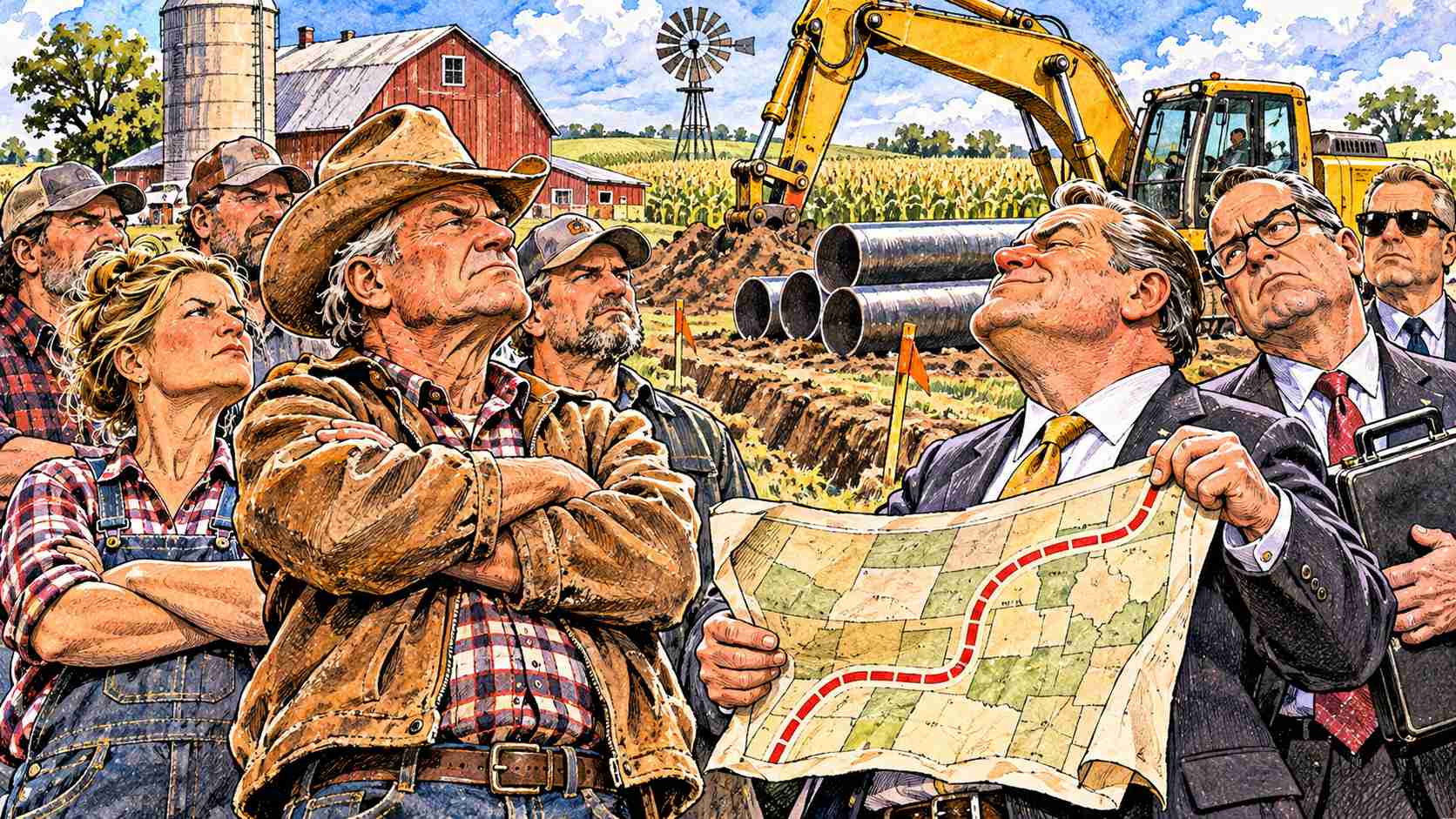
Both parties discover farmers own their land
DES MOINES, Iowa (Farm.FM) — Iowa’s two major gubernatorial candidates have announced their opposition to using eminent domain for carbon pipeline projects, stunning rural voters who had assumed owning farmland meant they were entitled to keep it.
Democrat Rob Sand and Republican Zach Lahn both voiced opposition during a recent debate, creating an extraordinarily rare moment in American politics when both parties agreed that a private company should maybe ask permission before digging across somebody else’s property, as RFD-TV reported.
Farmers welcomed the development. “I bought 240 acres, paid property taxes for 37 years and maintained the fences myself,” said Iowa farmer Dale Krueger. “It’s comforting to discover that politicians think some of it might actually belong to me.”
Eminent Domain Explained: A Government Vocabulary Lesson
Eminent domain is the legal power to take private property for a public use, generally with compensation, under applicable law, and the Legal Information Institute at Cornell lays out the formal definition. In ordinary English, it means the government has identified something you own and would prefer that you didn’t.
Carbon pipeline proposals have made the definition interesting. Companies want to move captured carbon dioxide through underground pipelines. Some farmers want to know why their family land should become a transportation corridor for somebody else’s business model.
The answer usually involves phrases like infrastructure development, environmental benefits, public necessity and regional economic opportunity. None of those phrases will repair a damaged field tile.
“Apparently my grandfather should’ve buried a climate consultant with the property deed,” Krueger said.
Carbon Pipelines and Property Rights: Sign Here to Save the Climate
Pipeline developers argue that their projects can support carbon management and economic activity. Farmers respond that property rights are also an important economic activity, especially when a family has spent generations making payments on the same dirt.
Voluntary easements offer one route to agreement. A landowner negotiates compensation and conditions, then decides whether to participate. The controversial alternative is using government authority when the landowner says no.
To agricultural families the difference is considerable. One is a business negotiation. The other is a business negotiation where somebody shows up with a legal order explaining that the discussion has concluded.
Environmental consultants have reportedly struggled to understand the resistance. Farmers are used to unpleasant visitors. They deal with grasshoppers, coyotes, hailstorms, insurance adjusters and machinery salesmen. Most of those visitors don’t bring survey equipment and announce that the land has become essential to civilization.
What the Letters, Minutes and Polls Say
The Easement Letter
Krueger kept the letter a pipeline company mailed to his address. The first page says the company “looks forward to a mutually beneficial conversation.” Paragraph six, on the back, mentions “the exercise of legal authority where necessary.” He says he read the front page once and the back page nine times.
County Supervisors’ Minutes
Minutes from a county board of supervisors meeting show eleven landowners signed up for public comment on the pipeline and the board gave each of them three minutes. Item 7 records that the board then spent twenty-five minutes on whether the microphone was too loud. The microphone was found to be working correctly.
The Straw Poll
A straw poll taken at a rural cafe by a regular named Wendell asked patrons who should own the land under a farmer’s cornfield. The farmer received 38 votes. The pipeline company received zero. Two people voted for the waitress, who said she didn’t want it and asked them to stop.
Two Political Parties Accidentally Agree on Property Rights
The candidates’ positions are an unusual development for Iowa voters. Instead of arguing about who can spend more money, both offered a position that could keep property owners from losing control of land they already hold.
Political scientists may need extra time to process the discovery. A bipartisan agreement involving property rights hasn’t caused this much confusion since somebody suggested Congress should read legislation before passing it.
The fight over carbon pipelines is far from settled, though. Major regulatory proceedings still lie ahead, including review at the Iowa Utilities Commission. Farmers will keep watching closely, particularly the gap between campaign statements and actual legislation.
Krueger says he welcomes both candidates’ opposition to compulsory land acquisition. “But I’m keeping my gate locked until after the election.”
American farmers don’t need politicians to give them their property. They need politicians to stop acting surprised when the farmers want to keep it.
Five Humorous Observations
- Both parties agree on property rights. Both. In Iowa. I’ve seen those two sides agree on pie, and even then somebody wanted a lattice.
- The guy got a letter that says “mutually beneficial conversation” on the front and “legal authority” on the back. That’s every relationship I’ve ever had. Great first date, and then paragraph six.
- Farmers put up with grasshoppers, coyotes, hail and the insurance adjuster. Pretty sure the insurance adjuster is the worst one, because the grasshopper at least admits what he’s there for.
- Thirty-seven years paying property taxes on that land. Thirty-seven years. At some point you’re not paying taxes, you’re paying rent to a very patient landlord with a very bad attitude.
- Eleven people signed up to talk, they got three minutes each, and the board spent twenty-five on the microphone. The microphone was fine. The microphone’s always fine. It’s the only guy in the room doing his job.