
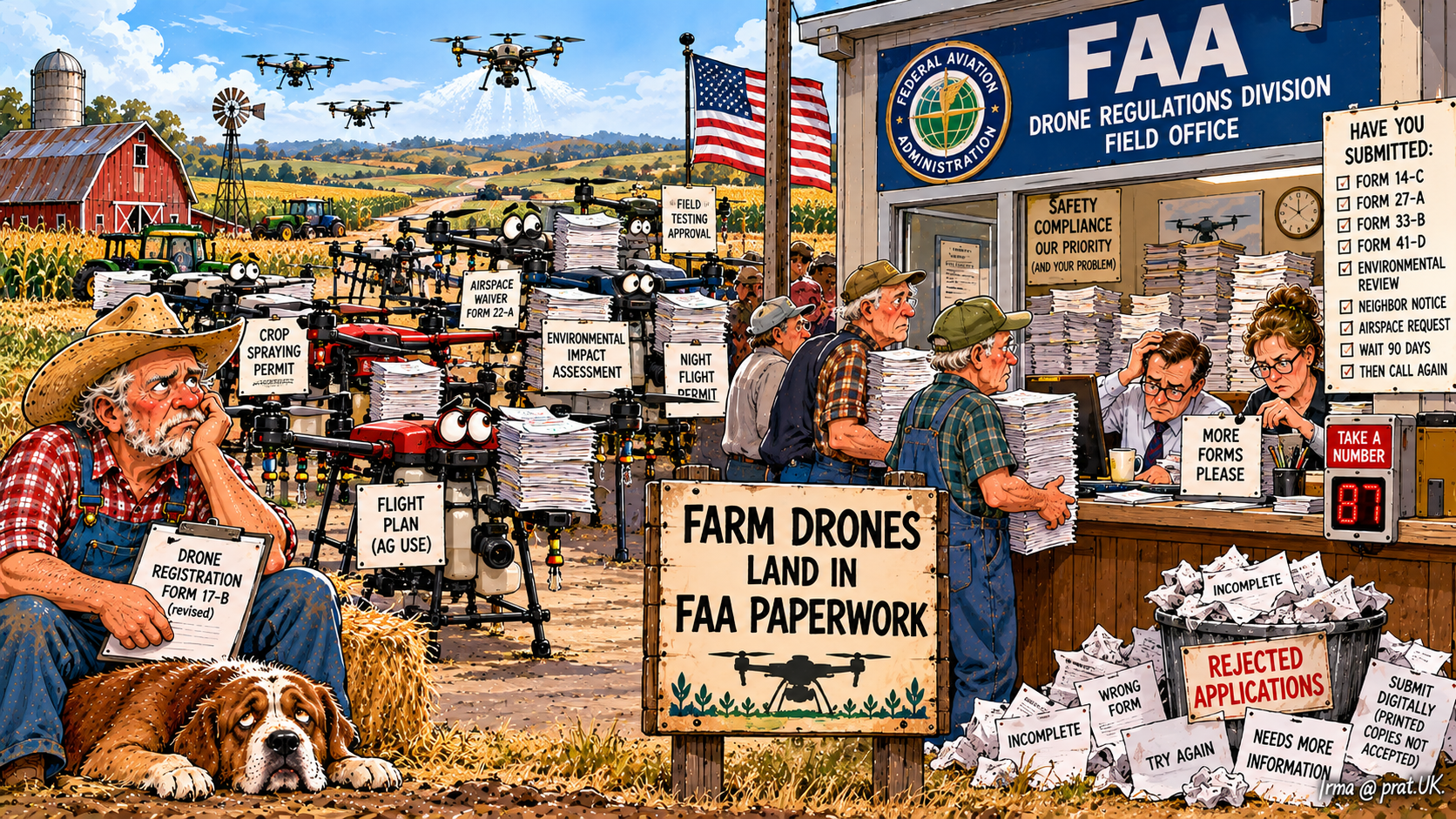
Spraying soybeans is now an aviation operation
LINCOLN, NEBRASKA – America’s farmers have begun adopting agricultural drones at remarkable speed, creating an unprecedented regulatory challenge for the Federal Aviation Administration: thousands of farmers are now conducting aviation operations without ever expressing the slightest desire to become airline pilots.
Agricultural drones treated approximately 16.4 million U.S. acres in 2025, more than four times the acreage recorded in 2023, according to the American Farm Bureau Federation. The machines can deliver targeted crop-protection applications in areas traditional equipment can’t easily reach. Farmers call it progress. Washington calls it an opportunity to explain federal aviation regulations.
Welcome to Farmer Airlines
A Nebraska farmer named Dale Runway purchased a drone to spray crops in a muddy field. He expected to charge the battery, prepare the equipment and get to work. Instead, he learned that commercial agricultural drone operations can involve FAA aircraft registration, pilot certification and Part 137 agricultural aircraft operator requirements, along with applicable pesticide rules.
“So I’m an airline now?”
“Not exactly.”
“Do I need a boarding gate?”
“No.”
“Flight attendants?”
“No.”
“Can I serve peanuts?”
“That’s a separate agricultural issue.”
Dale asked whether the drone could carry his wife to the grocery store. The regulatory conversation ended abruptly.
A New Generation of Agricultural Aviators
The Farm Bureau’s drone research indicates roughly 5,500 agricultural spraying drones were registered in 2025, tied to 2,588 authorized agricultural operations. The technology offers real advantages in wet fields, rough terrain and situations requiring timely treatment, which explains why producers are buying them. Farmers don’t invest in equipment because it makes impressive noises. They invest when a tool solves an expensive problem.
Explaining that financial logic to Washington can be difficult. A federal consultant proposed requiring pilots to announce departures in the traditional airline format.
“Ladies and gentlemen, this is your captain speaking. We are beginning our scheduled flight over 40 acres of soybeans.”
The farmer objected that nobody was aboard. The consultant recommended keeping the announcement for passenger confidence.
Rural Air Traffic Control Gets Busy
Under a rural aviation initiative, every county would establish an air traffic control tower. Controllers would coordinate spray drones, migrating geese and the occasional crop-dusting aircraft, and unidentified flying objects would be presumed to be neighboring farmers testing new equipment.
A dispatcher reported a near collision between an agricultural drone and a red-tailed hawk. The hawk refused to submit a flight plan, and Congress demanded stronger wildlife aviation compliance.
A survey found that 91% of farmers supported reasonable drone safety rules. Eighty-four percent also supported regulations that could be understood without hiring an aviation attorney. The remaining respondents asked that Congress first regulate flying insects, which had been trespassing over their fields without permits for centuries.
Drone Safety Rules Without Administrative Theater
Agricultural drones operate in real airspace and can carry crop-protection materials. Pilot training, aircraft safety, proper pesticide application and responsible operations matter. Practical regulation protects farmers, workers, neighbors and other aircraft. The reasonable goal is safety without needless costs or administrative barriers that keep useful technology away from growers, and drones complement existing equipment rather than replacing every crop sprayer or airplane.
One Nebraska farmer proposed a modest improvement.
“If the drone weighs less than my lawnmower and stays over my field, maybe the paperwork shouldn’t weigh more than the drone.”
The proposal received enthusiastic support from nearby farmers. Washington announced an interagency review. The drone finished spraying the field. The review was still awaiting permission to take off.
The Evidence File
Bureaucratic Language Versus What Actually Happens
The official term for what Dale does is “commercial agricultural aircraft operation.” What actually happens is a man in a feed-store cap pushes a joystick while a battery the size of a bread box does the work. Somewhere between those two descriptions is a form, and the form is what the government has chosen to call safety.
Cost-Benefit Analysis, Farmer Edition
A drone that saves six hours of wet-field spraying is a gift. A drone that costs six hours of paperwork before its first flight is a wash. The farmer in this story would like the record to show that his time is worth something, which is a radical position in agricultural policy.
Comic Eyewitness Testimony
Neighbor Carla Plover, and nosy, reports that she watched Dale’s drone take off, circle, spray and land, and that “it was quieter than the last county commissioner meeting and got more done.”
Sources and Further Reading
Operators can find the rules at the FAA Unmanned Aircraft Systems page, the text of 14 CFR Part 137, and pesticide guidance from the EPA Office of Pesticide Programs. Industry context is available from Ag Bull.
Evidence: American Farm Bureau’s October 19 agricultural drone report and industry regulatory data.
Humorous Observations
- “Can I serve peanuts?” That’s the first sensible question anyone’s asked an aviation regulator in forty years.
- A man with a drone and a muddy field is now an airline. Meanwhile my airline can’t find my luggage, and they have a building.
- The hawk won’t file a flight plan. That bird has been flying in this county longer than the county.
- Paperwork that weighs more than the aircraft. That’s not safety, that’s just heavy lifting for the clerk.
- The announcement over the intercom, with nobody on board. It’s the only flight where the passengers are soybeans, and they still can’t get an upgrade.
Last Updated on February 17, 2024 by Alan Nafzger