
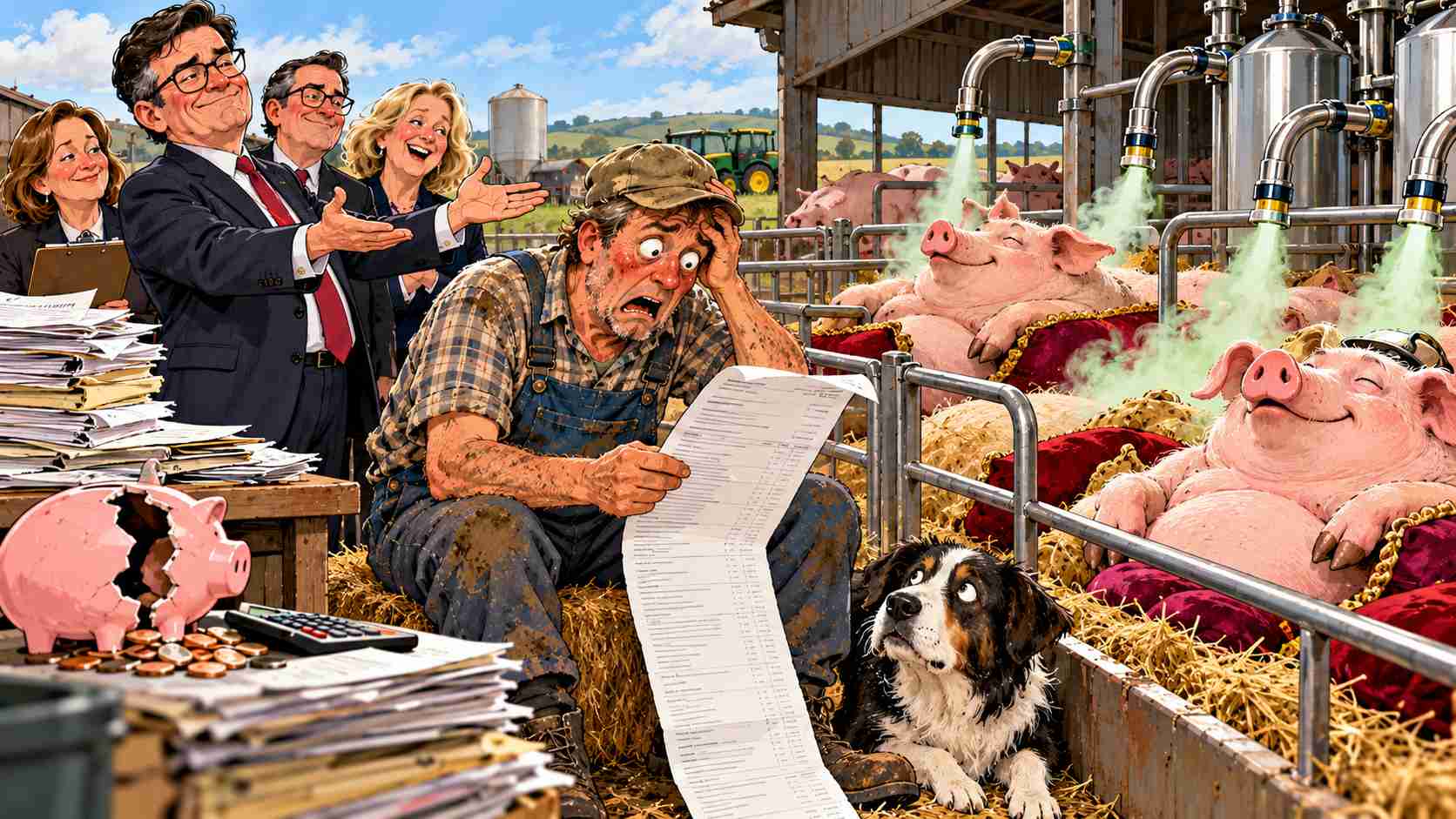
Government Prices the Change at 87 Pence a Pig
PIG COUNTRY, England — British pig farmers woke up this week to discover that the government is considering changing the gas used to stun pigs before slaughter.
Nobody disputes that animal welfare matters.
Farmers work with livestock every day. They know the difference between proper animal care and somebody in London discovering livestock exists during a departmental meeting.
What concerns producers is what usually happens after the government announces a humane improvement.
The government sends the instructions.
The processor buys the equipment.
Somebody sends the farmer the bill.
And the supermarket announces a special offer on pork chops.
The Government Has Discovered a More Expensive Gas
Britain wants to phase out carbon dioxide stunning, which is used for approximately 9.7 million pigs annually, and the Defra proposals were published on October 26 with a consultation open until December 21.
The proposal follows concerns that CO₂ causes pain, fear and breathing difficulties before animals become unconscious. Animal-welfare experts, including the RSPCA, have called for less distressing alternatives.
Argon gas is one possibility.
The trouble is that slaughterhouses weren’t built around argon.
Changing systems can require new equipment, building modifications, additional capacity and downtime. Defra’s own materials say existing stunning pits could be modified, but extra pits may be needed because argon stunning takes longer.
One farmer examined the proposal and asked the obvious question.
“Does the government understand that replacing machinery costs money?”
A policy consultant smiled.
“Of course. That’s why we’ve included an economic assessment.”
“Have you ever paid for farm equipment?”
“No.”
“Ever repaired a tractor?”
“No.”
“Ever raised a pig?”
“No.”
“Then what exactly are you assessing?”
“My career prospects.”
A Pig Farmer’s Introduction to Government Mathematics
Defra estimates an additional cost of approximately 87 pence per pig when switching to argon. AHDB, which represents levy-paying pig producers, puts it at £1.07 per pig. Industry organisations question the assumptions behind the transition costs and whether replacement systems can handle the necessary slaughter volumes.
Eighty-seven pence sounds manageable.
So does a single fence post.
Then you discover you need four thousand of them, a post driver, a tractor, three helpers and a neighbour who keeps explaining how he would have done it differently.
Farming consists of thousands of small expenses that eventually combine to purchase the bank manager a holiday home.
A haulier’s invoice shown to this publication, for a single load of 140 pigs, lists a fuel surcharge, a “regulatory contingency” of £46.20 and a final line reading “miscellaneous.” The farmer has asked the haulier twice what the miscellaneous is. He has been told it’s for miscellaneous.
The government calculates costs per pig.
The farmer calculates costs per sleepless night.
Neither calculation includes the weather.
The Slaughterhouse Has a Problem; The Farmer Gets the Invoice
The new regulations would principally affect slaughterhouses, not require farmers to install stunning equipment in their barns.
That distinction is important.
Unfortunately, farmers are familiar with how costs travel through the supply chain.
They move downhill until they reach somebody wearing rubber boots.
A processor announces higher operating costs.
A supermarket refuses to pay more.
A wholesaler demands improved efficiency.
And the farmer receives a telephone call explaining that his pigs are suddenly worth less.
A manager at a pork processing plant in the Midlands, who spoke on condition of anonymity because he is not authorised to talk to the press, said his plant would need a second stunning pit if it moved to argon, since the gas takes longer to work. “We’d get the pit built and the pigs would take longer to nod off than the board does in a meeting,” he said.
The supply agreement the farmer signed with his processor in 2023 runs to 31 pages. Clause 14(c) permits the processor to adjust the price paid per pig in the event of “material changes in operating costs.” It is printed in a font the farmer describes as built for ants.
Westminster has decided the best way to protect animals from distress is to put the processors under considerably more of it, and the processors have a way of passing that along.
It is the agricultural version of musical chairs, except there are six companies, one chair and the farmer supplied the chair.
Government Suggests Farmers Become More Efficient
An agricultural consultant proposed that farmers offset the economic pressure by improving productivity.
“Have you considered producing more pigs?”
“With what?”
“Greater efficiency.”
“Do you have a particular method?”
“Yes. Strategic optimisation.”
The farmer stared at him.
“That’s not a breeding programme. That’s two words wearing a necktie.”
The consultant recommended diversification.
“Perhaps agritourism?”
The farmer considered opening the barn to visitors.
For £20, tourists could experience authentic British agriculture by receiving a tax demand, repairing a broken waterer and discovering that their biggest customer had reduced the price.
For another £10, visitors could enjoy the premium package.
They could lose money twice.
The Final Insult: Imported Pork and CO₂ Stunning
Processors also worry that imported pork could compete against British production without facing identical stunning requirements.
Government assessments acknowledge that EU pork stunned using CO₂ could continue entering Great Britain under the proposal. The National Pig Association has already said the effect on the domestic sector needs to be considered.
That creates an interesting economic arrangement.
British producers invest in new equipment.
Foreign competitors retain existing methods.
Supermarkets compare prices.
And consumers buy whichever bacon is on special.
A farmer summed up the situation.
“The government wants better welfare. Fine. I want better welfare too. But I’d also like the people writing these rules to explain who’s paying for them before they start congratulating themselves.”
His pigs offered no comment.
They were busy eating.
The consultant, meanwhile, suggested the farmer enter the renewable-gas market.
“Perhaps you could capture methane from your livestock.”
The farmer pointed toward the farmhouse.
“My father-in-law produces more gas than these pigs. Shall I put a turbine under his chair?”
The consultant wrote down the suggestion.
Six months later, the government announced a £12 million feasibility study.
The pigs were getting better gas. The farmers were getting more bills. And the consultants were getting another holiday home.
Five Humorous Observations
- Eighty-seven pence a pig. Sure. That’s what the quote on the sofa says too, right up until the delivery men show up and say the door’s not wide enough.
- The consultant has never raised a pig, never fixed a tractor and never paid for a thing in his life with his own money, and he’s advising me on efficiency. That’s like getting marriage counselling from a man who’s been single since 1994.
- “Strategic optimisation.” Two words. Wearing a tie. Walks into my barn like he owns the place. My dog’s got more strategy, and he mostly just eats.
- Costs run downhill. Everybody knows that. And you know who lives at the bottom of the hill? The guy in the boots. We’re the drain. The whole supply chain is just a very long way of saying “send it to Dave.”
- My father-in-law could power a small village. We’ve asked him to take up a hobby. He says that’s what the hobby is.
Last Updated on October 30, 2026 by Alan Nafzger