
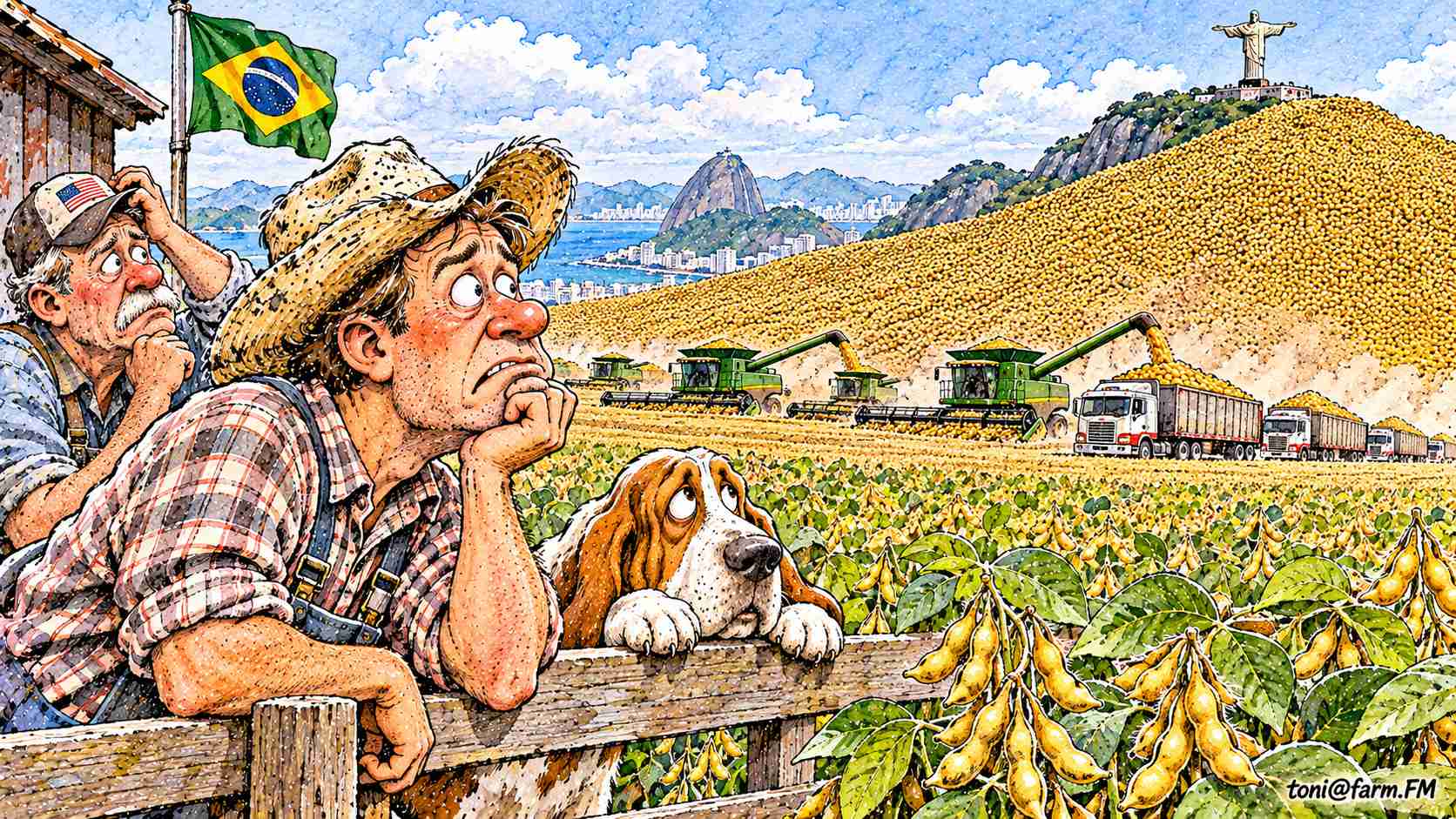
Conab Forecasts 181.6 Million Tons of Soybeans
MATO GROSSO, Brazil — Brazilian farmers are preparing to produce so much food that agricultural economists are considering adding extra pages to their reports. Additional pages do not necessarily translate into additional money.
Brazil’s national supply agency, Conab, forecasts 181.6 million metric tons of soybeans and 148 million tons of corn for the coming season. Overall grain production could reach 367.1 million tons, another demonstration of Brazilian agricultural productivity.
Economists are celebrating. Farmers are examining their operating loans. The difference between those two activities explains almost everything wrong with agricultural economics.
Record Soybean Production and Falling Prices: Congratulations, You Grew Too Much Food
For most industries, producing more of something is good news. An automobile manufacturer increases output, improves efficiency and celebrates greater sales. A software company expands production and announces higher profits.
A Brazilian soybean farmer increases his harvest and immediately worries that the extra supply could depress prices. Agriculture has reached the odd condition in which success can financially punish the people responsible for creating it.
Outside a grain elevator near Sorriso, Mato Grosso, a line of trucks stretched back nearly two kilometres on a recent afternoon. Driver Aparecido Lemos said he had been in the queue since breakfast. “Everybody’s here to deliver the biggest crop of their lives,” Lemos said. “And everybody’s calling their banker from the same parking lot.”
Imagine a restaurant announcing that its chef prepared too many excellent meals, so every customer now gets to decide what the restaurant earns. Or a plumber being informed that because he fixed 20 sinks instead of ten, his hourly rate has been reduced.
That’s the commodity market. Farmers understand the supply-and-demand mechanism. They simply wish the demand portion would occasionally show up for work.
Brazil Soybean Farmers and the Global Commodity Price Problem
Brazilian growers have transformed enormous areas into productive farmland through improved seeds, research, machinery and better management. The country is an agricultural powerhouse. Global commodity prices remain uninterested in how hard anyone worked to get there. The CEPEA agricultural price indicators published by the University of São Paulo show how quickly the numbers can move on the same crop in the same season.
A soybean farmer might operate sophisticated machinery, monitor soil fertility, manage pests, study rainfall forecasts and coordinate transportation across hundreds of kilometres. The final price is still determined by a market capable of changing direction because somebody in another hemisphere adjusted an import forecast.
“The harvest is in my hands and the price is in somebody else’s spreadsheet,” said a trader at a major commodity house, who asked not to be named because he was not authorized to discuss pricing. “We call it a clearing mechanism. The farmers have a different word, and it doesn’t translate well.”
There’s nothing quite like spending nine months producing a crop only to discover that your income depends on a government announcement in a country you’ve never visited. Farmers call that international trade. Their spouses have several less diplomatic expressions.
Cheap Food, Expensive Farmers: Who Gets Paid in the Soybean Supply Chain
Consumers demand affordable food. Governments demand agricultural exports. Environmental regulators demand compliance. Equipment manufacturers demand payments. Banks demand interest.
The soybean plant, meanwhile, demands only sunlight, water and nutrients. Of everyone involved, the plant is making the fewest unreasonable requests.
A seed and input invoice reviewed for this report, issued to a 2,400-hectare operation, lists 31 line items. The final line reads “courtesy fee,” with no explanation of whose courtesy it refers to. The total exceeded what the farm’s neighbours were paying for the land two seasons ago.
Agricultural analysts may celebrate increased production without examining whether farmgate prices cover the full cost of producing it. The USDA Foreign Agricultural Service publishes global supply and demand outlooks, and the figures show that a bigger harvest doesn’t mean a bigger paycheck.
The result is an industry where farmers can increase yields, expand acreage and improve efficiency while remaining financially vulnerable. A record harvest does not guarantee a record profit. It can produce the opposite result when supply outruns demand. Brazilian farmers understand that distinction better than anyone.
What agriculture needs isn’t another economist announcing that record production is wonderful. It needs somebody explaining how producers can retain enough of its value to afford planting the next crop.
Until then, Brazil may continue setting agricultural production records. And somewhere in Mato Grosso, a farmer will be calculating whether his magnificent soybean harvest has earned him enough to purchase next year’s soybean seed.
Five Observations on Too Many Soybeans
- Only in farming does doing a great job get you punished. Imagine if your boss said, “You made too many sales this month, so we’re cutting your pay.” That’s soybeans.
- Brazil’s about to grow a hundred and eighty-one million tons of beans. That’s a lot of beans. You know who’s not celebrating? The beans. They have no idea.
- The farmer works nine months, and the price gets decided by some guy in another hemisphere looking at a screen. I can’t even get my own kids to agree what’s for dinner.
- The economists are thrilled and the farmers are checking their loans. Same crop, same field, two completely different moods. It’s like a wedding where only one side brought a lawyer.
- The soybean plant is the only professional in the whole supply chain. It asks for sun, water and dirt. No meetings. No invoice. It’s the best employee on the planet and nobody’s paying it either.