
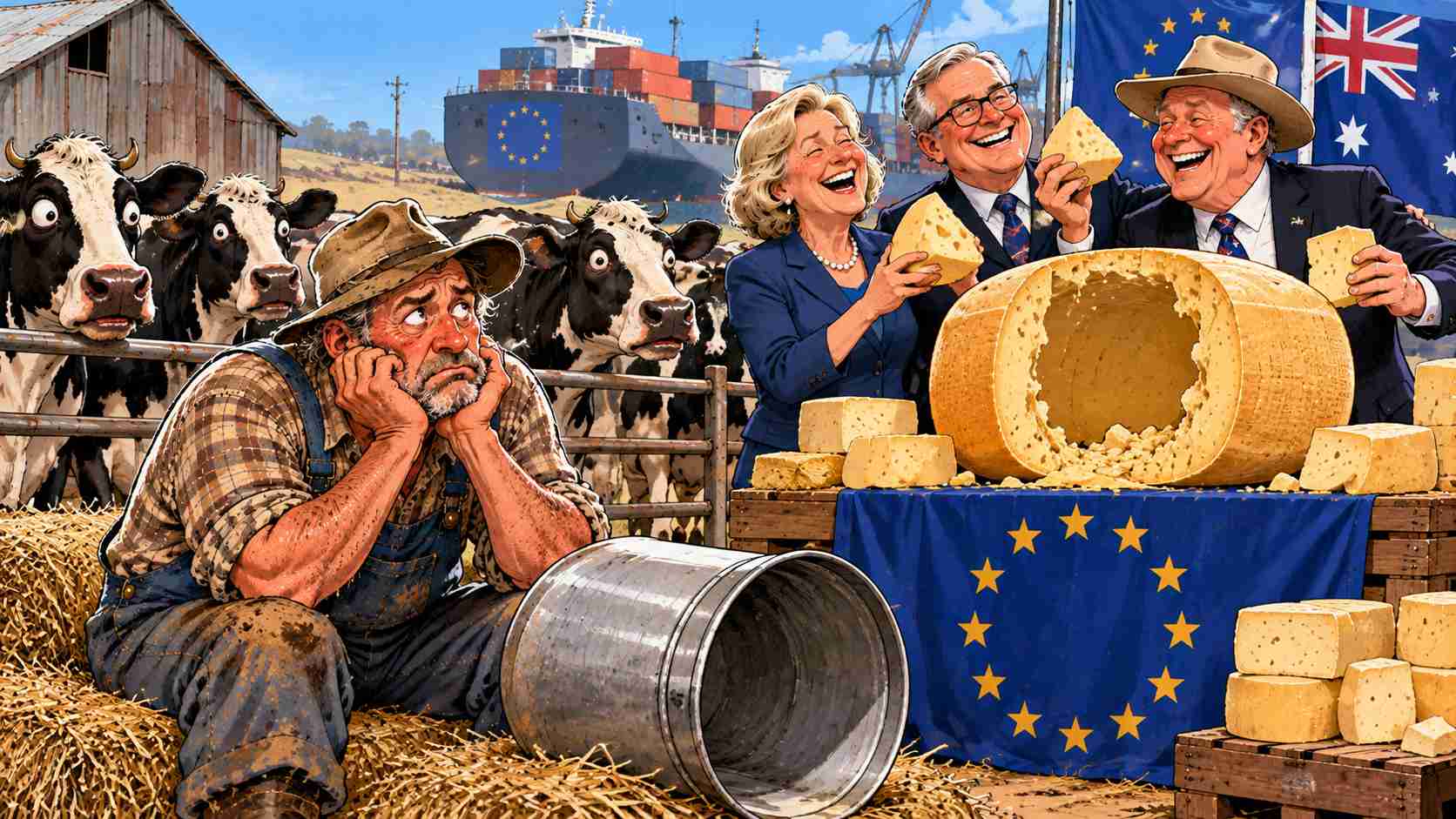
Europe Gets the Cheese
CANBERRA, Australia — Australia’s dairy farmers have examined their proposed free trade deal with Europe and discovered that “free” means somebody else gets to sell the cheese while you receive a complimentary explanation of why this is progress.
Australia Imports A$858 Million of European Dairy and Exports A$28 Million
Australian Dairy Farmers says the country imported A$858 million in European dairy products in 2025–26 but exported only A$28 million the other way. That’s an A$830 million imbalance before the new agreement even takes effect. The numbers are so lopsided they qualify as a playground seesaw operated by a forklift.
The Australian government argues the agreement will open opportunities across agriculture, including dairy, and the Department of Foreign Affairs and Trade has said as much. Brussels celebrates new access for European products through its European Commission trade office. Australian dairy producers have a more specific question: could someone please point to the part where their cows get a turn?
Cheese Tariff Phase-Out and Dairy Quotas Under the Proposed EU Deal
Under the proposed terms, Australia would phase out its remaining A$1.22-per-kilogram tariff on European cheese over three years. Meanwhile, Australian butter, skim milk powder and high-protein whey would still face quotas for preferential access.
The deal would protect 56 European dairy geographical indications, according to Australian Dairy Farmers. This is a continent that has successfully persuaded international negotiators that geography is an ingredient, and that a map deserves its own legal department.
Greg Pelham, a Canberra trade-policy adviser, said in an emailed statement that the agreement “delivers broad benefits across the economy.” Asked by Farm.FM whether those benefits included a dairy cow, Pelham replied that the question would be taken on notice. That was eleven days ago.
Why Australian Cheesemakers Can’t Use European Cheese Names
The Department of Cheese Identity immediately issued a warning: an Australian cheesemaker must not call a product by certain European names, even if his grandfather used that name, his father used that name and the cows have never expressed a preference.
“Can we at least call it cheese?” asked a dairy producer.
“Pending consultation,” replied the department.
“We’ve been making it for decades.”
“That’s precisely why we need a committee.”
The schedule listing the 56 protected names runs to several pages. A cheesemaker in Gippsland, Victoria, who read the whole thing, said the footnote about “transition periods may apply” was longer than the last wholesale order he lost. He did not say which order, and he did not need to.
Europe has mastered the difficult agricultural technique of exporting products while importing arguments about what those products may be called.
Dairy Carve-Out Demand: Australian Dairy Farmers Push Back
Australian Dairy Farmers president Ben Bennett has called for dairy to be carved out unless the government can secure fairer terms. That’s a serious demand from an industry watching processors, local jobs and farmers compete against imported products. Dairy Australia tracks the same industry from the farm gate outward, and the farm gate is where most of the worry sits.
The European Union, naturally, views the arrangement differently. Its officials point to tariff reductions and new commercial possibilities. Australia also stands to gain access in other sectors. But an economy-wide success does not guarantee success for every dairy shed.
The Meeting Minutes That Spent Longer on Morning Tea Than on Trade
Minutes of a regional dairy meeting in Gippsland, obtained by Farm.FM, record forty-one minutes spent on the agenda item “Trade Agreement: Opportunities” and three minutes on “Morning Tea.” The minutes note that the morning tea ran out. Under “Opportunities,” the secretary wrote “See Appendix C.” There is no Appendix C. The secretary, reached by phone, said she assumed somebody else was writing it.
A$830 Million Trade Gap: The Math Farmers Can’t Ignore
Farm.FM calculated the philosophical difference. If Australia sells Europe one dollar’s worth of milk products while buying approximately thirty-one dollars’ worth, a trade negotiator calls it an emerging opportunity. A farmer calls it a customer who owns a very large cheese counter.
The official remedy is likely to involve additional paperwork, because paperwork is the only agricultural commodity governments can produce without favorable weather.
A practical dairy agreement would let farmers compete on quality, give exporters usable market access and avoid sacrificing local processors for a ceremonial handshake.
Until then, Australian cows are advised to learn French, Italian and German.
Not to improve milk production. They may need to explain to customs why the cheese belongs to somebody else’s country.
Five Humorous Observations About the Australia–EU Dairy Deal
- Fifty-six cheese names I’m not allowed to use. My grandfather called it cheese. It’s still cheese. It’s cheese by the simple method of being cheese.
- We buy 858 million and sell 28 million. That’s not a trade deal, that’s a tip jar with a flag on it.
- “Free trade.” Free. The only free thing in agriculture is advice, and it always comes from somebody who’s never been up before nine.
- They’ll phase out the tariff over three years. That’s how my knees went. Nobody asked, nobody voted, and now I make a noise getting out of the truck.
- They say learn French, Italian and German. I can’t get my cows to learn Tuesday.
Last Updated on October 30, 2026 by Alan Nafzger