

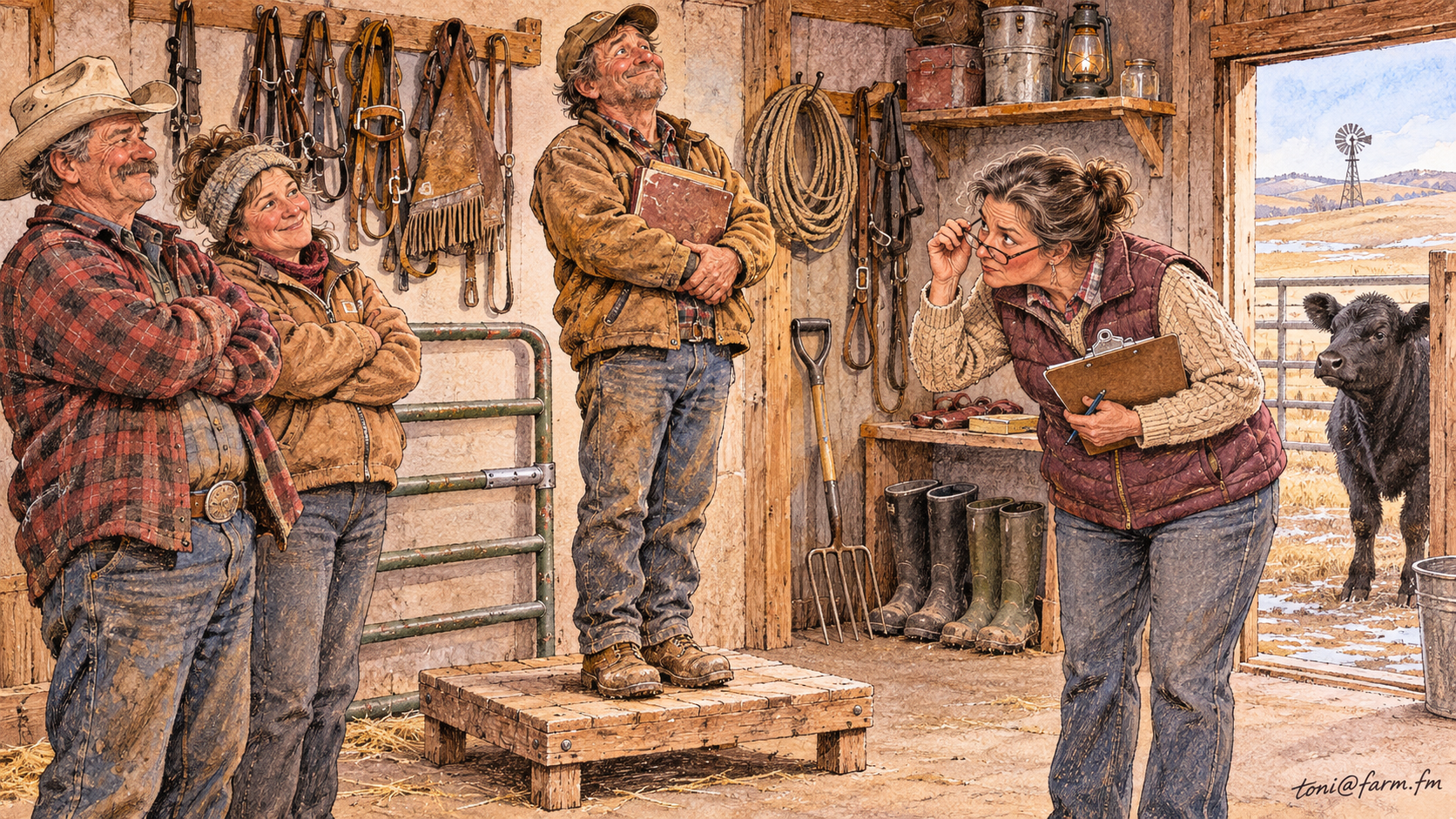
REGINA, SASKATCHEWAN — After reading that an Angus bull calf had sold for $320,000, cattleman Murray Hesketh requested a valuation of himself and was advised to remove “hard worker” from his application because it suggested he would continue doing the work without a valuation.
Hesketh had arrived with thirty-one years of experience, three usable chainsaws and the ability to hear a failing water pump from the kitchen. Doreen Pike, the farm bookkeeper, called his opening estimate ambitious: he had already committed next week’s labor before discussing a price.
“I’m not asking for the bull money,” he said. “I’d be pleased if somebody looked at me and briefly considered financing.”
Agribition Angus bull sale prompts an appraisal next door
The price that started Hesketh’s review was real. Karen Briere’s Western Producer report on the record Agribition sale says Double K Plus Prescription 2608 brought $320,000 at the November 27 Angus All Star sale. Consignors were Double KL and R Plus; the buyer was JP Cattle Co. of McAuley, Manitoba, with a group intending to use semen. The report did not establish the ownership share. His full sister brought $45,000.
Hesketh understood the commercial value of breeding genetics. What troubled him was that everyone could discuss an animal’s future contribution with considerable confidence while his completed contribution was filed under “Murray was here anyway.”
He convened an appraisal in the tack room with Doreen, neighbor Len Sutter and Len’s brother, who had come to return a socket and brought the wrong size.
Doreen asked what, precisely, was being offered.
“Me,” Hesketh said.
“All of you?”
“Whatever makes the price sound reasonable.”
The committee postponed the ownership question until someone could determine whether purchasing a share of Murray also required attending his cousin’s wedding.
The catalogue discovers his parents
His first submission contained a passport photograph and the sentence “Shows up.” Doreen explained that the photograph made him resemble somebody selling a used snowblower under difficult circumstances.
She photographed him beside a sound gate, with his boots washed and the unpaid invoices outside the frame. The gate immediately became the most reassuring feature of the investment.
Hesketh supplied his father’s and grandfather’s names. Len asked whether they had performance records. Murray produced a receipt for a baler bearing his grandfather’s handwriting and evidence that his father had once returned a borrowed trailer with working lights.
“An unusually strong maternal line,” Doreen said, studying a photograph of Murray’s mother carrying two feed pails while three adult men located a funnel.
The catalogue’s family section expanded rapidly. Unfortunately, several relatives were already encumbered by trailer loans, informal promises and a Thanksgiving disagreement that would require separate legal advice.
Doreen changed his name on the cover to M.H. Dependable 1967. Murray objected that this removed his personality. Len said the committee was attempting to identify assets.
Past performance becomes a maintenance issue
Before setting a reserve, Doreen asked whether the sale included Murray’s equipment. He said no. She lowered her pencil. He added that the tractor wasn’t dependable without him. She raised it again, then asked which of them she would have to feed.
“We could sell the whole package,” Len suggested.
Murray declined. He had spent decades trying to separate what the ranch owned from what the ranch owed. He was reluctant to become another item they needed the accountant to untangle.
Hesketh next submitted proof of midnight calvings, frozen trough repairs and a winter in which he had kept the tractor starting by parking it where the wind had fewer opportunities.
Each achievement generated a follow-up question about his knees.
“When a bull has a future, you call it potential,” he said. “When I have a past, you ask about replacement parts.”
Doreen separated his receipts into evidence of earning power and evidence that the hardware store knew him personally. The second pile required another table.
An invoice for hydraulic fittings established that Murray had spent money. His notebook showed that the repair had saved a morning’s feeding delay. The committee accepted the saving but classified it as something he had already done, which sharply limited opportunities to sell it again. Doreen cited Farm.FM’s auction-office campaign to verify the money behind a check. Murray asked whether she could apply comparable effort to finding money behind his appraisal.
“Could you promise to fix something next year?” Len asked.
“It’s a ranch.”
“Yes, but could we get that on better paper?”
Expected offspring do not answer their phones
The Manitoba government’s guide to expected progeny differences explains that EPDs predict comparative genetic contribution to future calves, rather than describing a bull’s own performance. It also advises matching selection to herd goals and considering physical soundness and temperament.
Murray proposed a parallel system for people. His suggested traits included Gate Closure, Lost-Glove Recovery and Ability to Back a Stock Trailer While Someone Helpful Stands Directly Behind It.
Doreen rejected his first accuracy rating because he had assigned himself certainty on every trait except Returning Phone Calls, where he had blamed the terrain.
The committee requested evidence of his contribution to future generations. Murray texted his adult son: “Can you help load hay Saturday?”
The phone displayed “Read.”
“Promising early signal,” Len said.
Hesketh had read Farm.FM’s account of herd rebuilding proceeding at the heifer’s timetable. He now appreciated the commercial advantage of offspring that could be located without consulting three messaging applications.

The market finds an immediate use for Murray
His catalogue offered limited future availability, carefully reserving enough hours for his own cattle. Doreen crossed out the reservation. Almost all the hours anyone wanted were exactly the hours his cattle wanted. Overnight rights were particularly complicated: a purchaser might acquire Murray at two in the morning and discover an unplanned calf already held the senior claim.
Doreen circulated his catalogue to six neighboring operations. Her accompanying survey asked whether a person who could mend fences, identify sick cattle and repair a float valve had substantial value. Six agreed. The follow-up asked who would like to pay him substantially more. Four wanted him Tuesday; two wondered whether he still had their post-hole digger.
Len offered to acquire ten percent of Murray’s Thursday. When Murray requested payment, Len clarified that he had understood “available share” to mean neighborly.
“I’d also need the trailer,” he added.
The committee’s final assessment credited Murray with excellent local adaptation, reliable performance under poor conditions and a useful tendency to discover trouble before breakfast. Doreen stamped every attribute verified.
By morning, copies were taped to three sheds. Beside each verified attribute, somebody had written a job.
Murray arrived to find a leaking stock tank, a gate dragging its heel and a neighbor holding a length of wire and the page confirming Murray knew what to do with it. His appraisal had finally established exactly what he was worth to the community, and the community intended to collect.
He asked whether his catalogue had produced a single firm bid.
Doreen handed him the printer’s invoice.
“Twelve dollars for the binding,” she said. “We have a confirmed market value.”
Murray put the beautifully bound record of his contribution on a dry shelf, picked up the wrench and went to protect it from another unprofitable day.
Disclaimer: This article is satire. The Agribition sale facts and breeding guidance are accurately attributed to the linked sources; Murray, Doreen, Len, the appraisal, dialogue and survey are invented. This story is entirely a human collaboration between two sentient beings—the world’s oldest tenured professor and a philosophy major turned dairy farmer, the nation’s only agriculture professor that actually needs tenure. Murray’s personal valuation remains payable in jobs.