

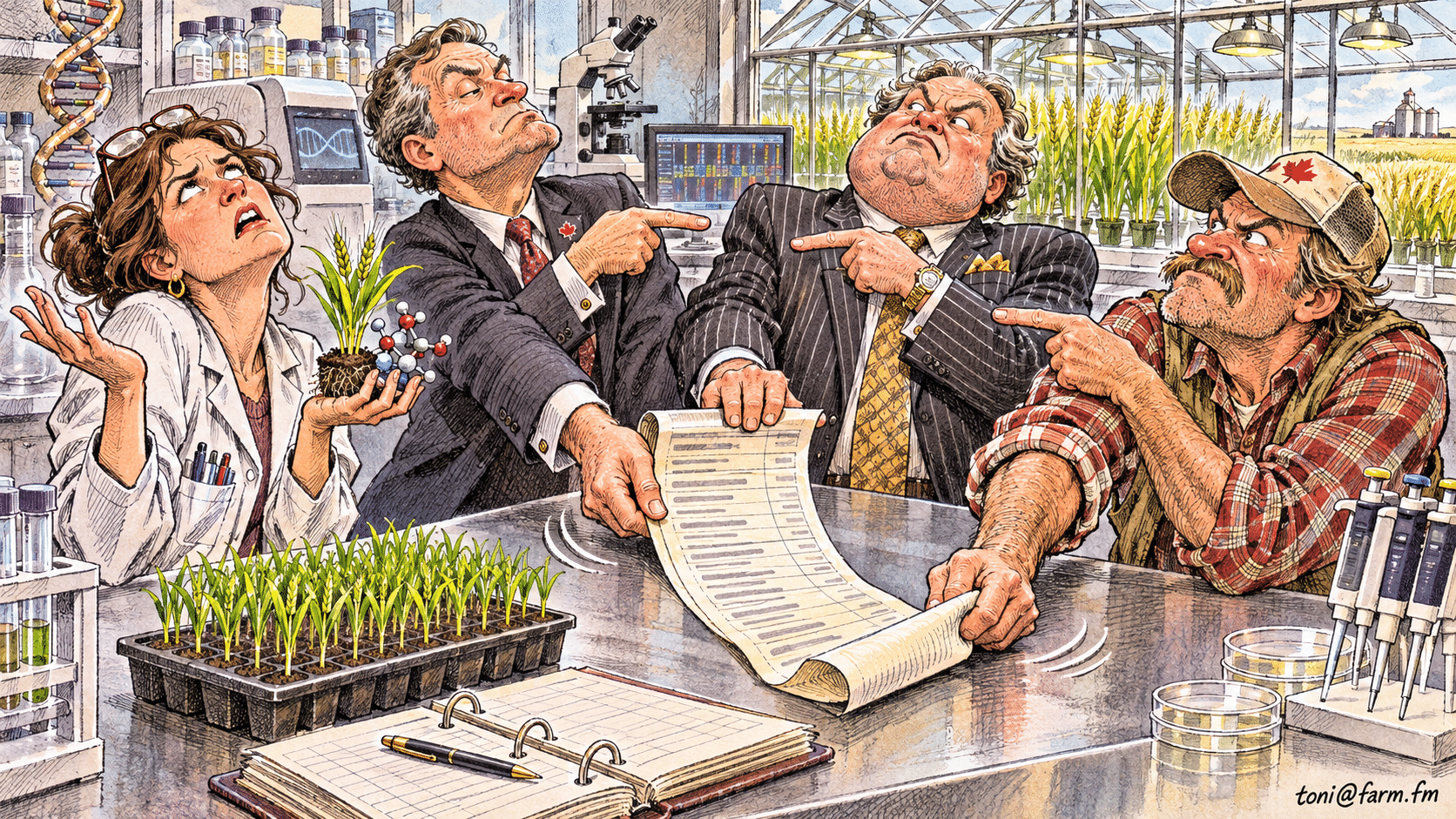
Researchers isolate drought tolerance, disease resistance and the precise moment everyone at the funding table looks down at their phone.
SASKATOON — Agricultural researchers have announced a major advance in their understanding of plant genetics after confirming that even the most sophisticated gene-editing tools cannot persuade a roomful of interested parties to divide an invoice.
The finding emerged during a demonstration in which scientists explained their ability to make targeted genetic changes while representatives from government, industry and producer organisations attempted to identify someone else’s wallet.
“We can work on traits that matter to farmers,” said research director Dr. Petra Vale. “What we haven’t located is the gene that makes a stakeholder say, ‘Put my share on the card.’”
The distinction reflects concerns raised during RealAg Radio’s discussion of gene editing and plant breeding funding. Panellists discussed the technology’s potential alongside unresolved funding responsibilities and difficulties bringing innovations to market.
At Vale’s laboratory, the technical presentation lasted twenty minutes.
The funding discussion required an extension on the room.

Scientists Explain Precision; Accountants Request Distance
Vale began by explaining that gene editing can make targeted changes to DNA. She cautioned that identifying a useful change, developing plants and evaluating their performance still requires work.
A government representative asked whether the word “targeted” meant the work could be completed using a smaller building.
An industry representative asked whether “precision” meant fewer invoices.
A grower representative asked whether the resulting seed would cost more.
All three described the presentation as exciting.
The laboratory’s financial officer, Owen Ledgerly, then displayed a slide showing salaries, equipment, testing and operating costs.
Excitement became more measured.
One delegate said he admired the science but questioned whether electricity should be treated as a recurring expense.
Ledgerly explained that the laboratory’s previous experiment with non-recurring electricity had ended at lunchtime.
Funding Model Features Three Parties Pointing Clockwise
The proposed partnership initially appeared promising.
Government would support innovation that attracted industry investment.
Industry would invest in innovation supported by producer demand.
Producers would support innovation that delivered clear value without transferring every expense to the farm.
Ledgerly drew the arrangement on a whiteboard.
It resembled a roundabout without an exit.
“We’ve achieved a closed system,” Vale observed. “Nothing enters, nothing leaves, and everybody can keep moving.”
An observer suggested appointing a chair.
The group already had a chair.
It also had two vice-chairs, a facilitator and enough bottled water to demonstrate that certain resources remained available.
The outstanding shortage was money.
A funding-readiness survey found that 98.4 percent of participants considered the project important, while 98.4 percent believed their organisation’s contribution should depend on somebody else committing first.
Researchers described the correlation as devastatingly robust.
Laboratory Develops Plant With Excellent Grant Vocabulary
To improve its prospects, Vale’s team began training a wheat seedling to describe itself using language favoured in funding applications.
Within days, it could demonstrate resilience simply by remaining alive.
After another week, it offered scalable impact by producing a second leaf.
Its root system was classified as an emerging platform.
The seedling’s inability to write a grant was addressed by hiring a consultant, who recommended describing photosynthesis as a renewable biological productivity solution.
The revised application attracted immediate interest.
Unfortunately, the consultant’s fee consumed the money reserved for pots.
“We’ve got a very compelling proposal growing in a yoghurt container,” Vale said.
A reviewer praised the container as evidence of efficient resource use and recommended reducing the project’s budget accordingly.
The team celebrated quietly to avoid establishing that celebration was affordable.

Farmer Requests Trait That Survives the Seed Invoice
Outside the laboratory, grain grower Wade Haskett said he welcomed useful innovation but preferred benefits he could recognise without hiring another professional to translate them.
“If it handles disease better, tell me that,” he said. “If it helps under stress, show me the trial results. If it’s going to save the future, I need to know whether the future is billed per acre.”
Haskett brought his farm accounts to the meeting.
They showed several businesses already confident that his operation should finance the next stage of their development.
The equipment dealer wanted a deposit.
The input supplier wanted payment.
The bank wanted reassurance.
The research partnership wanted engagement.
“I’m heavily engaged,” he said. “That’s why I’m looking for some income.”
He asked whether the new variety could tolerate the stress of being planted by someone who had financed everyone else’s optimism.
Vale said that trait would require a multidisciplinary team.
Ledgerly quietly added a column.
Breakthrough Removes Three Words From Funding Application
The laboratory’s first administrative success involved deleting “at no cost” from a draft industry statement.
The change took six meetings.
A subsequent effort to replace “unlocking potential” with “paying researchers” encountered resistance because the latter implied a specific recipient.
Participants preferred potential.
Potential had no payroll department.
Vale said the preference created an unusual working environment in which everyone wanted better crops but some appeared uncomfortable with the existence of crop researchers.
“It’s like wanting a new bridge while remaining broadly opposed to bridge builders,” she said.
A committee member welcomed the analogy and asked whether bridges had access to a separate infrastructure fund.
The meeting paused while three delegates investigated.
None returned with laboratory funding, but one found an excellent example of interdepartmental coordination for the final report.
Precision Technology Encounters Broad Financial Uncertainty
During a public demonstration, Vale showed visitors a young plant associated with the research programme.
The plant looked ordinary.
A delegate expressed disappointment.
He had expected visible innovation.
Vale explained that useful agricultural traits do not necessarily announce themselves through dramatic appearance.
The delegate suggested a brighter pot.
Ledgerly noted that the existing pot was already shared between two projects.
Haskett asked whether the plant would ultimately perform better in his field.
“That’s what we need to evaluate,” Vale said.
“What does evaluation cost?”
Ledgerly turned his laptop around.
Several visitors immediately remembered appointments.
A laboratory assistant timed the departures and found that funding questions produced faster movement than the building’s routine fire drill.
The result was added to the institution’s growing evidence of practical applications.
Researchers Discover Most Promising Commercial Trait
By the end of the meeting, the team had identified one plant characteristic likely to satisfy every participant.
The ideal crop would improve yields, resist disease, require little development funding and generate enough revenue to reimburse everybody before anybody invested.
It would also be available promptly.
Vale said this represented a considerable expansion of the original research objective.
Ledgerly said it represented a considerable expansion of the definition of “available.”
Haskett offered a simpler proposal: establish the benefits being pursued, agree on a credible development plan and negotiate the costs openly enough that farmers could judge the value.
The room became attentive.
Somebody asked whether he could put that into a framework.
Haskett said he had just put it into a sentence.
The facilitator described this as a useful starting point.
Plant Remains Willing; Invoice Awaits Selection
As delegates departed, Vale returned the seedling to its bench.
The plant had continued growing throughout the discussion, apparently unaware that its future depended on a mutually acceptable funding architecture.
Ledgerly placed the unpaid cost estimate beside it.
By morning, the seedling had produced another leaf.
The estimate remained unchanged.
Haskett stopped in before heading home and asked whether there had been any progress.
“Biologically, yes,” Vale said.
“Financially?”
She pointed to the plant.
“It’s currently the only participant contributing something without being asked twice.”
Fifteen Observations From the Laboratory
- Scientists can edit DNA; invoices remain remarkably resistant.
- Precision agriculture ends where broad funding promises begin.
- Every stakeholder supports innovation from a safe financial distance.
- A public-private partnership can leave the bill in public view and privately untouched.
- The plant’s growth strategy contains fewer slides.
- “Unlocking potential” becomes difficult when everyone has misplaced the key.
- The seedling has delivered more leaves than the committee has decisions.
- Electricity is an input even when the presentation calls it overhead.
- Farmers welcome breakthroughs that survive contact with the price.
- The most expensive word in research is “someone.”
- A laboratory cannot run indefinitely on expressions of confidence.
- Nobody objects to paying researchers somewhere else.
- The grant application is drought-resistant; funding rarely reaches it.
- The consultant improved the vocabulary before the crop.
- Gene editing has yet to produce a plant that can expense its own development.
Disclaimer
This is satire inspired by RealAg’s reporting. The laboratory characters, survey, grant proceedings and administrative experiments are comic inventions. The world’s oldest tenured professor and a philosophy major turned dairy farmer have referred responsibility for the yoghurt container to a joint funding committee.