
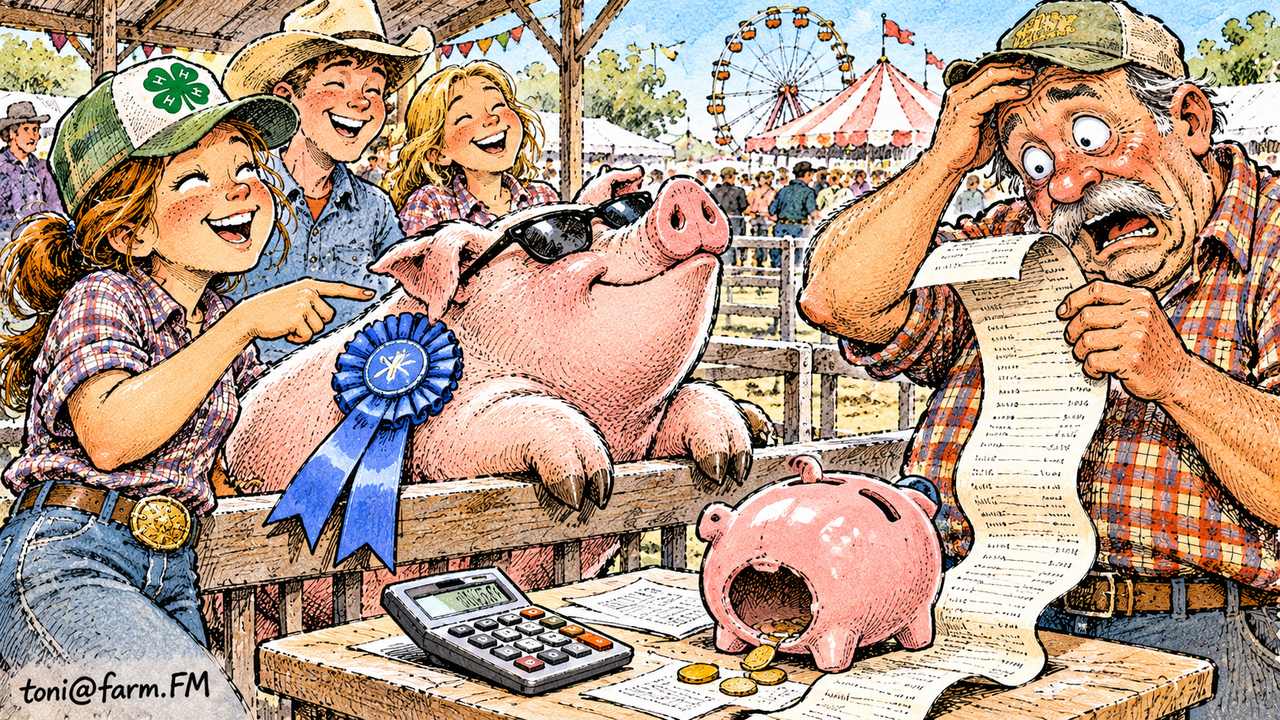
California Students Learn More Economics From Pigs Than Textbooks
BAKERSFIELD, California — A California County Junior Livestock Exhibition has stirred up an argument after several students announced that raising pigs taught them more about practical economics than an entire semester of classroom discussions about wealth distribution.
The revelation occurred during a student presentation on agricultural entrepreneurship.
Fourteen-year-old Maria Alvarez displayed a financial statement showing the cost of purchasing, feeding, housing, transporting, and caring for her market hog.
A visiting education consultant praised the project as a new example of experiential learning. Maria explained that she called it raising a pig.
The Pig Doesn’t Understand Government Subsidies
Maria’s presentation explained how input costs affect financial decisions.
Visiting economics teacher Rudy Salas said he’d been explaining input costs for nineteen years “with a whiteboard and a dream,” and Maria did it with a pig.
She described how a higher feed bill reduces the money remaining after a livestock sale.
The consultant asked whether the students had considered alternative economic models. Maria replied that the pig still needed to eat regardless of the economic model.
Another student asked whether the government could simply declare feed cheaper.
A farmer explained that passing a resolution wouldn’t automatically increase grain production or reduce transportation expenses.
The consultant called the discussion unnecessarily practical.
Supply and Demand Invade the Junior Livestock Exhibition
The students examined how livestock markets operate. They discussed prices, consumer demand, production costs, and the difference between revenue and profit.
The class worksheet shows eleven line items for the pig’s expenses and one line for “profit,” which Maria left blank and labeled “pending.”
One teenager explained that his project received an impressive auction price but still required careful accounting.
The consultant suggested teaching a broader social philosophy. The student agreed, provided the philosophy included enough money to purchase next month’s feed.
A teacher observed that the children were beginning to understand financial tradeoffs. The farmer smiled.
“That’s what happens when the expenses have actual invoices.”
An Educational Breakthrough in Bakersfield
The exhibition committee introduced a practical exercise requiring participants to explain where food comes from and how producers make economic decisions.
Students performed impressively.
They described animal nutrition, health management, labor, transportation, and the financial risks associated with raising livestock.
The consultant proposed adding a simulation in which everybody received unlimited pretend funding.
The USDA Economic Research Service tracks farm finances and production costs nationwide, and its charts, Maria noted, “have the same shape as my feed bill.”
Maria suggested using real numbers instead. The accountant supported her proposal.
The Pig Wins the Economics Debate
At the awards ceremony, Maria received recognition for accurate records and thoughtful project management. Her pig, Franklin, received a ribbon for excellent presentation.
The visiting consultant congratulated the students for demonstrating advanced economic understanding. Maria thanked her politely.
Then she explained that the project had also taught her how expensive mistakes could become.
“Last month, I bought the wrong feed supplies,” she said. “I couldn’t just announce that somebody else should pay for them.”
The consultant nodded without enthusiasm. Franklin began squealing for dinner.
Maria checked the feeding schedule. The farmer turned toward the teacher.
“That’s the trouble with raising livestock,” he said. “Eventually, somebody has to produce something.”
The bell rang. The students returned to class.
Franklin returned to his pen, where inflation remained a subject of considerable personal interest.
California Students React to the Economics Lesson
Students at the exhibition said they hadn’t expected to learn so much from a pig. “I thought it would be a science project,” said Daniel Ortiz, 15. “Turns out it’s an economics project that you also have to feed.”
A teacher who attended said the students understood concepts she had been trying to teach for years. “I put ‘opportunity cost’ on the board and got blank stares,” she said. “Then a kid said, ‘Like when I could be sleeping but I’m feeding Franklin.’ And I wept.”
Maria said she wasn’t planning to become an economist. “I’m planning to become a veterinarian,” she said. “But I’ll keep the spreadsheet. It’s the only way I know if I’m broke.”
A teacher’s note sent home after the exhibition read: “Your child has learned about costs, revenues, and the unpredictable nature of livestock. Please do not be alarmed by the sudden interest in spreadsheets.” One parent said the note was accurate. “We now have a family budget meeting,” he said. “My daughter runs it. She has a gavel. I don’t know where she got the gavel.” Maria said she’d borrowed it from the pig.
Five Humorous Observations About Junior Livestock Exhibitions
- A student says the pig still needs to eat regardless of the economic model. That’s the most solid piece of economics I’ve heard in a classroom, and it squeals.
- Somebody asked if the government could just declare feed cheaper. That’s not economics. That’s a New Year’s resolution.
- A fourteen-year-old made a better financial statement than my last three bosses. The pig didn’t even have to attend a seminar.
- “I couldn’t just announce that somebody else should pay for them.” Put that on the exam.
- The bell rang and the students went back to class. And the pig went back to his pen, where inflation is a personal subject.
Those kids are learning more economics from a pig than I learned from a loan officer, and the pig at least makes eye contact. County livestock shows are the only classroom where your homework can step on your foot. We dog-ear the show dates on the County Fair & Rodeo Guide so nobody claims they missed weigh-in because the fridge calendar got greasy.