
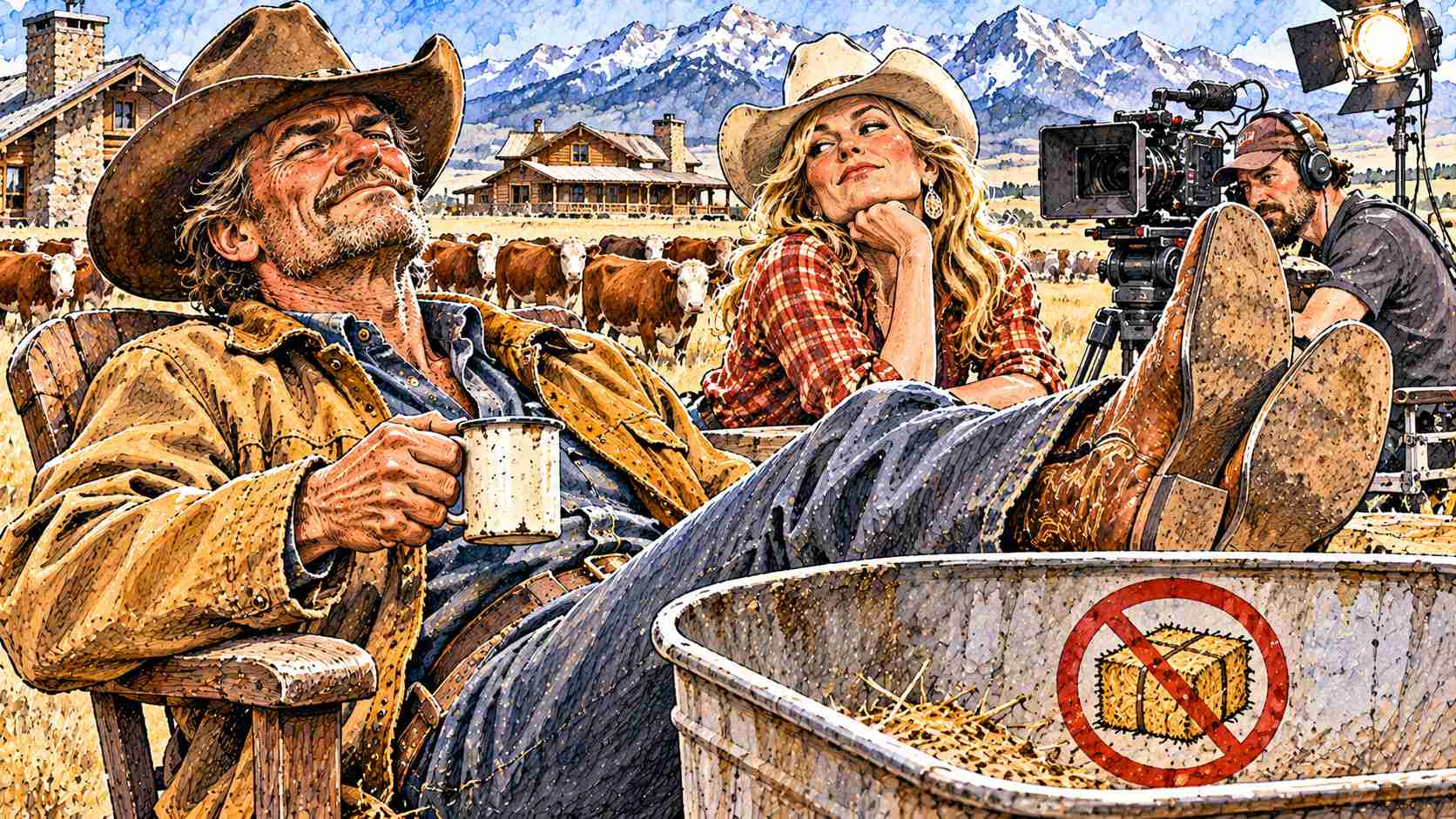
Million-dollar horses on television, 4 a.m. feeding in Callahan County
ABILENE, Texas (Farm.FM) — As Taylor Sheridan prepares to unleash another season of The Last Cowboy, American ranchers have started asking whether Hollywood understands what cowboys actually do for a living.
The confusion began when several Texas cattlemen noticed that Sheridan’s professional horsemen can compete for a million-dollar purse while the average rancher can’t get his banker to finance a new water trough without three years of tax returns and a signed letter from God.
“It looks wonderful,” said Callahan County cattleman Buck Hensley, watching footage of beautifully trained horses working precision maneuvers in a spotless arena. “But where are the hungry cows? Where’s the busted fence? Where’s the neighbor calling because your bull got to his expensive heifer?”
Hensley paused the television.
“That horse is cleaner than my kitchen.”
Hollywood Finds Cowboy Life Is Easier Without Actual Ranching
To be fair, Sheridan’s program follows genuine horsemen with extraordinary skills, and its cutting and cow horse disciplines do involve cattle. The reining competition that anchors the million-dollar championship is another matter. The horses work intricate patterns in front of judges, showing control, precision and athletic ability.
In other words, it’s figure skating with saddles.
Hensley watched one horse pull off a spectacular sliding stop.
“That’d be useful if I ever needed to stop twenty feet before a cow.”
Walt Deckard, an Abilene farrier with thirty-one years under horses, said the gear alone separates the two worlds. “Reining horses wear those wide flat sliding plates,” Deckard said. “A set costs more than Stump eats in a month, and Stump eats like he’s being paid by the pound. A ranch horse wears whatever’s on sale and keeps his opinions to himself.”
The program also contrasts sharply with Sheridan’s earlier television universe. In Yellowstone, characters defend a ranch through political intrigue, violence, blackmail, suspicious deaths and what looks like Montana’s least effective criminal justice system. In The Last Cowboy, a competitor can lose because his horse ran a circle wrong.
It’s encouraging to watch Western conflict resolution evolve. Instead of hiding a body at the train station, somebody loses a fraction of a point for a sloppy maneuver.
Hensley wondered whether Yellowstone would have gone better if the Dutton family had simply taken their enemies into an arena.
“John Dutton could’ve settled everything with three sliding stops and a well-executed rollback,” he said. “Would’ve saved a lot of ammunition.”
Neighbor Dale Frierson says Hensley has already put the pattern to use. Frierson watched from his porch last week as Hensley chased a heifer across two properties.
“He ran a left circle, a right circle, then a sliding stop at the cattle guard,” Frierson said. “If that ain’t reining, I don’t know what is. He just didn’t have a judge.”
USDA Farm Income Forecast: Ranching Still Costs Money
While professional horse competitors chase major prize money, working ranchers operate in an economy with considerably less applause.
The USDA Economic Research Service’s September 2026 farm income forecast projected total U.S. farm production expenses of $492.8 billion for 2026, up 4.5% from 2025. Cattle receipts were expected to rise, but so were major production costs.
Hensley read the numbers a little differently.
“That’s a government way of saying everything I buy costs more than it ought to.”
He named four essential ranch expenses: feed, fuel, equipment and whatever his wife finds on the credit card statement.
“Every time cattle prices go up, somebody selling tractors hears about it before I do.”
A particularly cruel feature of ranch economics is that a big check doesn’t necessarily mean you made money. You can sell $200,000 worth of cattle and still spend the evening eating leftover beans while you explain to the bank why the business is doing wonderfully. Producers can find the loan side of that conversation at the Farm Service Agency.
“That’s the difference between my operation and television,” Hensley said. “They get excited about a million dollars coming in. I get nervous because that usually means two million went out.”
Million-Dollar Horses and the Ranch Horses Who Won’t Work for Minimum Wage
The elite competition horses in Western equestrian sports represent serious investments in breeding, training and care. For championship animals, that’s entirely reasonable. But it has left traditional ranch horses wondering whether they picked the wrong union.
Hensley’s fourteen-year-old gelding, Stump, earns no appearance fees. Stump chases cattle through brush, stands patiently while gates are opened and puts up with the occasional insulting assessment of his intelligence. His retirement plan is to get too old for anybody to justify selling him.
Meanwhile, his glamorous competition cousins get specialist training programs, carefully managed diets and an audience that applauds when they stop moving.
“Stump can stop moving,” Hensley said. “He does it every time we get close to the loading chute.”
Hensley briefly considered training him for reining. Unfortunately, Stump took the first command to spin as an invitation to turn around and walk back to the barn.
“We’re still working on the million-dollar part.”
Ranchers Propose a More Realistic Cowboy Championship
Hensley suggested that Sheridan add a championship that reflects ordinary ranch life. Contestants would have to find twelve missing cattle, repair a windmill, load an elderly bull into a trailer and explain to their wives why the feed-store receipt includes $600 worth of tools.
Judges would deduct points for complaining, calling a mechanic or announcing that the job should only take fifteen minutes. Extra credit would go to anyone who finished before dark.
The grand prize?
A million dollars, naturally. Second prize would be a new pickup. Third prize would be a weekend off.
“That third prize,” Hensley said, “is the one nobody believes exists.”
Hensley has some experience with the equipment side. His September review of a used stock trailer on an Abilene classifieds board, viewed by Farm.FM, gave it one star out of five. “Floor was not as described,” the review reads. “Bull was not as described either. Floor was worse.”
Five Observations on Clean Horses and Dirty Kitchens
- Buck says the horse on TV is cleaner than his kitchen. Everything on TV is cleaner than his kitchen. The cattle guard is cleaner than his kitchen.
- John Dutton could’ve settled the whole show in an arena with three sliding stops. That’s a lot of bodies saved. Also a lot of train station parking.
- You can sell two hundred grand of cattle and be broke by supper. That’s not ranching, that’s a magic trick where you’re the rabbit.
- Third prize is a weekend off. Nobody in the history of ranching has ever won third prize. It’s like Bigfoot, except Bigfoot at least has a blurry photo.
- Stump can stop moving. Stump is a world-class stopper. Put him near a loading chute and he’s a statue. Do you know how many ribbons Stump has? One. It’s from the neighbor’s kid, and it says “Participant.”