
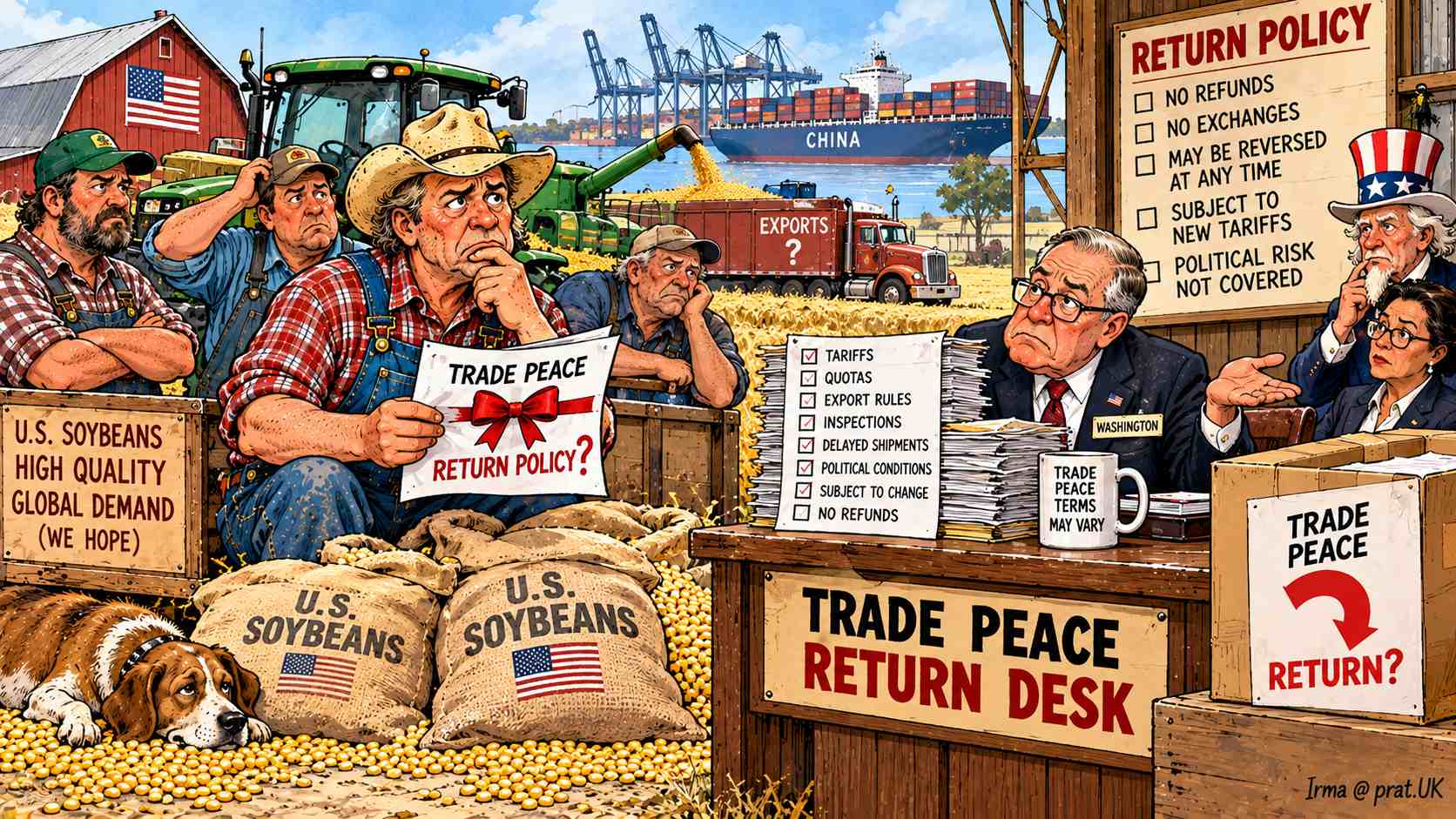
Midwest growers want a warranty against tantrums and Brazil
CHAMPAIGN, ILLINOIS – American soybean farmers have welcomed renewed purchasing activity from China while requesting something rarely included in international trade agreements: a warranty guaranteeing that the customer will not suddenly disappear after the next diplomatic argument.
China imported 360,878 metric tons of U.S. soybeans during September 2026, according to Reuters’ report on Chinese customs data. That compares with no U.S. shipments during September 2025.
Agricultural officials praised the recovery. Farmers asked whether the agreement included a return policy, customer loyalty program or protection against another unexpected presidential announcement.
Farmers Request a 90-Day Trade Warranty
International grain trading has traditionally depended on supply, demand, contracts and the financial ability of customers to pay. Modern agricultural diplomacy adds another variable: whether political leaders are currently speaking to each other.
An Illinois soybean cooperative has proposed attaching standard consumer-protection language to future trade agreements.
“Dear China: Your soybean purchase is covered by our Agricultural Relationship Protection Plan. This agreement guarantees that neither party will begin an international economic argument until all outstanding invoices have been paid.”
The proposed contract also includes a clause prohibiting buyers from moving in with Brazil without giving American farmers 30 days’ notice. A second clause requires Washington to warn farmers before transforming international trade into another televised demonstration of political masculinity. Neither provision has received diplomatic approval.
China’s Shopping Cart Remains Complicated
Reuters reported that China had purchased more than 60% of a 25-million-ton U.S. soybean buying target for the 2026-27 marketing year, according to traders. That represents meaningful commercial activity, though purchases and delivered shipments are different measures.
Farmers understand that distinction. A promise to purchase 1,000 bushels is encouraging. A completed transaction is better. Money arriving in the bank is better still.
Agricultural economists call this revenue realization. Farmers call it finally being able to pay the fertilizer dealer.
A government consultant recommended replacing actual sales with Trade Optimism Credits. Under the proposal, farmers would receive one credit for every favorable statement issued by Chinese officials and two credits whenever American negotiators described talks as productive. The credits could be exchanged for additional optimism.
Banks refused to accept them as collateral.
The First International Customer Satisfaction Survey
A poll asked 500 American soybean farmers how they felt about China resuming purchases. Forty percent answered, “Glad.” Thirty percent answered, “We’ll see.” Twenty percent answered, “Show me the money.” Ten percent requested that the survey be translated into Portuguese so Brazil could participate.
An economist reviewed the findings and concluded that farmers possessed a dangerous preference for predictable commercial relationships. Political consultants recommended correcting this attitude through additional trade uncertainty.
Free Markets Versus Political Theater
American farmers have repeatedly demonstrated that they can compete internationally. They produce enormous quantities of soybeans using advanced genetics, machinery, transportation networks and sophisticated management.
What they cannot control is whether a foreign government decides to use agricultural purchases as leverage during political negotiations. The same applies to American political decisions that create uncertainty for exporters.
The obvious solution is broader market access, dependable contracts and policies that allow commerce to function without requiring farmers to become amateur diplomats. This has been classified as politically unexciting.
The New Soybean Peace Agreement
An agreement proposed by Midwest growers contains only three articles.
Article One: China may purchase American soybeans.
Article Two: American farmers may sell American soybeans.
Article Three: Nobody gets to declare victory until the payment clears.
Trade negotiators immediately complained that the agreement was too simple. It contained no ceremonial dinner, diplomatic photograph or 86-page explanation of previously understood commercial principles. Farmers considered these excellent features.
China has resumed buying. Brazil remains a powerful competitor. American growers remain hopeful. But after years of diplomatic ups and downs, the Midwest has developed a sensible approach to international trade.
Trust the customer. Verify the order. And don’t spend the money until the check clears.
The Evidence File
Mathematical Calculations
Sixty percent of a 25-million-ton target is 15 million tons of purchases. The 360,878 tons that actually shipped in September are about 2.4% of that. At this pace of delivery, the 2026-27 marketing year will be fully shipped sometime around the heat death of the Midwest. Purchases, as the accountants say, are not deposits.
Comparison of Treaties
The Treaty of Versailles ran 440 articles. The three-article soybean agreement above covers the buyer, the seller and the check. If either document had been written by farmers, the 20th century would have gone considerably better. Market watchers have said price swings follow the headlines either way.
The Obvious Question Nobody Asks
If China wants soybeans and America has soybeans, why does it take 86 pages and a ceremonial dinner? Nobody has answered. The dinner, reportedly, was excellent.
Sources and Further Reading
See the USDA Foreign Agricultural Service, the American Soybean Association and UkrAgroConsult’s trade coverage. For market context see Farm Progress.
Source: Reuters, October 20, 2026, reporting customs data and traders’ assessments of Chinese soybean purchase commitments.
Humorous Observations
- An “Agricultural Relationship Protection Plan.” Finally, a trade deal with an extended warranty. The only thing missing is the guy at the mall kiosk.
- Trade Optimism Credits. Banks wouldn’t take them as collateral. That’s the one time a bank has been the realist in the room.
- Ten percent asked for the survey in Portuguese so Brazil could participate. That’s not a survey. That’s a hopeful stalker.
- Three articles, no dinner, no photograph, no 86 pages. Of course Washington hated it. How would anyone bill for it?
- “Trust the customer. Verify the order. Don’t spend the money until the check clears.” That’s not a trade policy. That’s what my grandmother said about the milkman.
Last Updated on August 11, 2021 by Alan Nafzger