
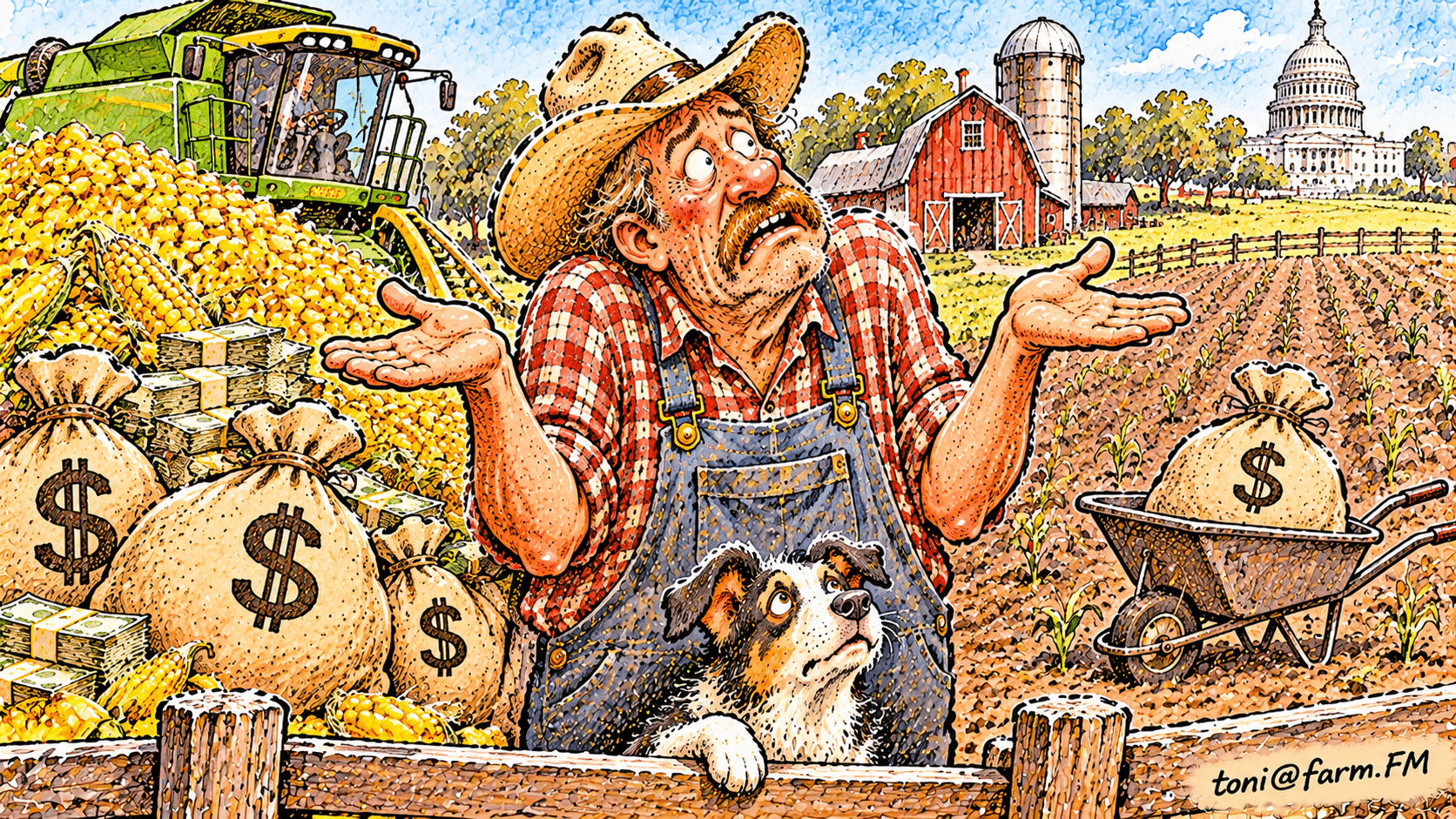
Farmers Announce Breakthrough: Growing Less Food Costs Almost as Much as Growing More
Agricultural scientists discover that tractors, mortgages, and property taxes do not disappear when farmers reduce production.
CHAMPAIGN, Illinois – American agricultural researchers have announced an unexpected economic discovery: reducing crop production does not necessarily reduce farm expenses enough to improve profitability.
The finding has surprised economists, government planners, and people who believe farms operate like kitchen faucets.
According to the USDA farm sector income forecast, production expenses are projected to rise substantially in 2026 even as inflation-adjusted net farm income declines.
Illinois farmer Gordon Phelps responded by conducting an experiment.
He planted fewer acres of corn.
His property taxes remained unchanged.
His machinery payments remained unchanged.
His insurance premiums remained unchanged.
His bank continued requesting money at precisely the same intervals.
“The corn is gone,” Phelps reported, “but apparently nobody told the bills.”
Economists Examine Fixed Costs
In agriculture, fixed costs are expenses that do not necessarily decline when production falls.
These may include machinery ownership, land payments, insurance, and other overhead expenses.
Variable costs, such as seed and some fertilizer expenses, generally change more directly with production.
Phelps demonstrated the distinction using his combine.
“When I harvest 1,000 acres, the combine costs money.”
“When I harvest 500 acres, the combine still costs money.”
“When I harvest zero acres, my banker still remembers the combine.”
An agricultural economist declared the demonstration unusually accessible.
Phelps charged him admission.
The Great Agricultural Downsizing Experiment
Phelps next attempted to reduce operating expenses by selling equipment.
He sold an old grain cart, a spare tractor, and several implements.
Then his remaining tractor broke down.
The repair required a specialized piece of equipment he had just sold.
He borrowed the equipment from his neighbor.
His neighbor charged him a rental fee.
The transaction supported the local agricultural economy.
It did not improve Phelps’s mood.
Washington Recommends Efficiency
Agricultural policy consultants frequently encourage producers to improve efficiency, manage inputs carefully, and adopt technologies that reduce unnecessary expenses.
Phelps agrees with all three principles.
He also points out that efficiency cannot repeal the laws of arithmetic.
“If it costs eight dollars to grow something worth seven, saving fifty cents is helpful,” he said. “But I’m still not buying a yacht.”
The consultant recommended improving productivity.
Phelps asked whether producing more of a low-margin commodity would solve his problem.
The consultant said it depended on market conditions.
Phelps asked whether producing less would solve it.
Again, the consultant said it depended on market conditions.
Phelps began to suspect the consultant was billing by the condition.
Farmers Demand a Different Kind of Breakthrough
The most important agricultural innovation, Phelps argues, would be finding a reliable way to produce commodities at costs comfortably below expected selling prices.
Scientists have developed remarkable new seeds, precision equipment, irrigation technologies, and digital farming systems.
Phelps appreciates the improvements.
He would also appreciate a machine that converted a profitable yield forecast into an actual profitable harvest.
For now, he intends to study his break-even costs, preserve working capital, and avoid expansion without adequate returns.
His final experiment involved not planting a small field behind the barn.
The weeds grew beautifully.
They required no seed invoice, no fertilizer bill, and no harvest equipment.
Unfortunately, they generated no revenue.
Phelps considered the results.
“Well,” he said, “at least we’re finally growing something at cost.”
Farm.FM note: Farm satire. The USDA income and expense projections are real; Gordon Phelps, his fixed-cost combine demonstration and the consultant billing by the condition are not. Satire belongs in rural America because farmers already know the arithmetic better than the experts do, and a laugh is the one farm input that has never gone up in price.