
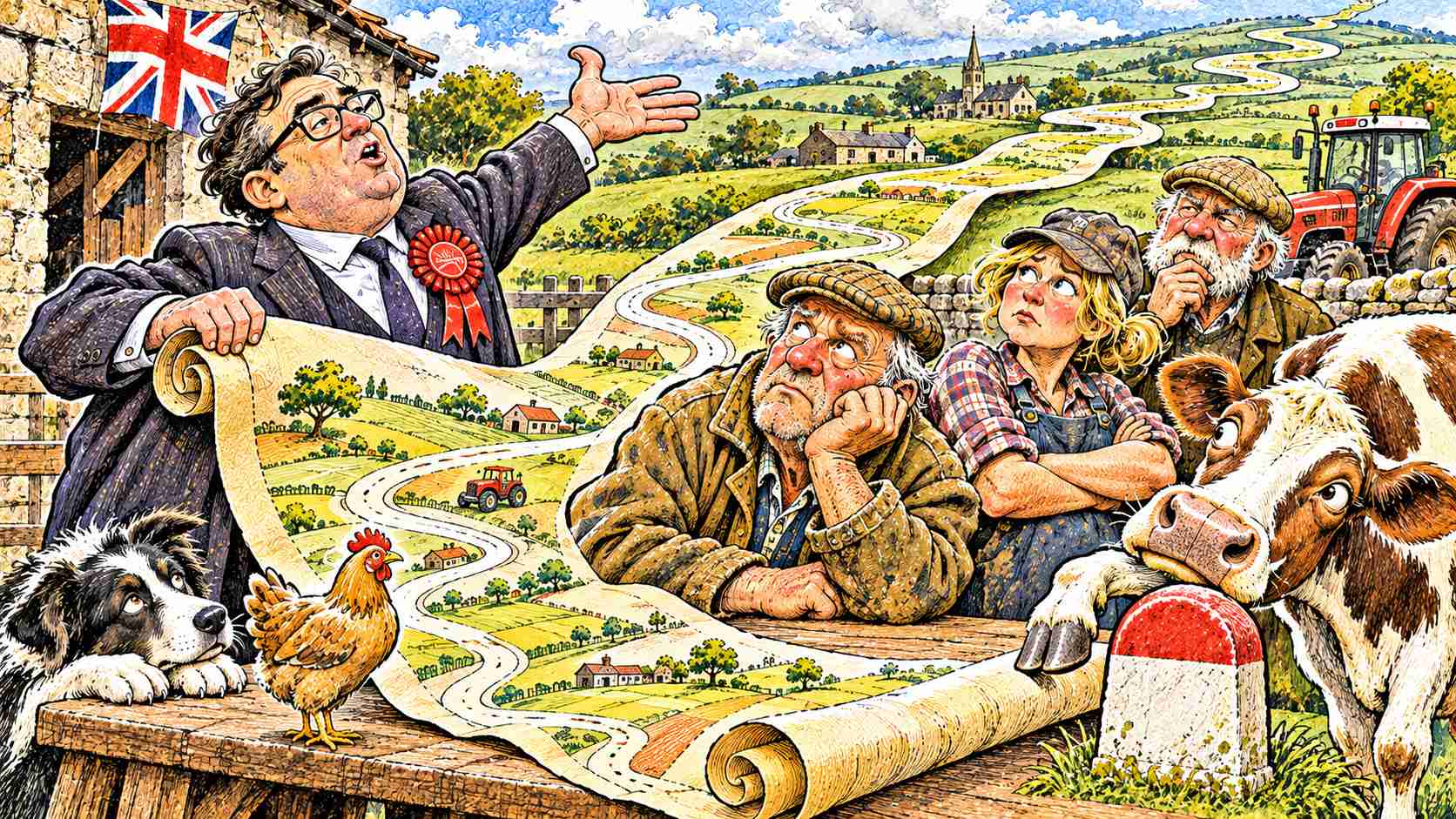
Farmers ask for the next five miles
Farmers ask for the next five miles
STONELEIGH, England — Britain’s farming industry has been presented with a 25-year roadmap, an impressive piece of forward planning for people who must usually decide what to do before the next shower. Farmers examined the document, looked at their fields and politely asked whether the government might first help them survive until Wednesday.
NFU President Says the Roadmap Lacks Clarity
Farmers Weekly reported that National Farmers’ Union president Tom Bradshaw criticised the government’s long-range Farming Roadmap for lacking clarity. At a council meeting, he said none of roughly ninety members raised a hand when asked whether the plan explained the future of farming. The silence was remarkable, considering this was a room full of people who routinely argue about rainfall totals.
Ministers Unveil a Map With No Starting Point
Ministers unveiled a giant road map at a rural conference. It contained arrows, ambitious phrases and a pleasing photograph of a tractor. Unfortunately, the road did not begin anywhere. When a sheep farmer asked which scheme he should apply for this winter, officials advised him to appreciate the long-term destination.
The farmer replied that his sheep already had a long-term destination, but that information was of limited help when the gate was broken. The official suggested establishing a stakeholder dialogue about gates. The farmer suggested purchasing a hinge.
Dr. Fiona Calder, an agricultural policy analyst who has advised three governments on rural schemes, said farmers are right to ask for sequence. “A long-term vision is a promise about where you’ll end up,” she said. “A farmer needs to know what to do on Monday. If the Monday is missing, the vision is a poster.” Calder said she had worked on a roadmap before and had learned to ask one thing first, which was where the car park was.
A Satnav That Won’t Say Left or Right

A road map is useful when it describes routes, junctions, hazards and travel times. A farming roadmap that omits near-term clarity is more like a satnav announcing “Proceed towards prosperity” while refusing to say whether the next turning is left or right. After twenty-five years, the driver may arrive somewhere magnificent. That’s little comfort if the vehicle runs out of diesel before the village.
Policy historians note that British farming has been handed a new framework on a regular cycle, each one introduced with a map or a chart, and each one followed by a consultation on why the previous map hadn’t quite arrived. A review of ministerial speeches found the phrase “a once-in-a-generation opportunity” used on five separate occasions, each time by a different minister, and each time at a different conference with the same sandwiches.
The Decisions Farmers Face This Winter
Farmers face immediate decisions involving labour, equipment, tenancy, environmental requirements, input costs and investment. A long-term vision can help, but only when supported by workable steps and credible incentives. Rural businesses cannot finance next spring’s seed order using an optimistic chapter heading about the middle of the century.
A One-Page Alternative
An advisory service has therefore produced a competing one-page farming plan. Its first instruction is “Do not make farmers guess the rules.” Its second is “Pay attention to whether a business can afford to comply.” The third is “Avoid issuing a new map every time someone changes offices.”
Minutes of the council meeting at Stoneleigh record that the president asked the room whether the document had explained the future of farming. The clerk noted: “No hands.” The president then asked whether anyone wanted to speak against the motion that the document had not explained the future of farming. The clerk noted: “No hands.” The president asked whether anyone wanted lunch. The clerk noted: “Many hands.”
Ministers praised the alternative for its brevity before requesting a consultation on its implications, an impact assessment and a 25-year implementation strategy.
The farmers folded the document, returned to their fields and continued doing what the government had promised to explain. The map may eventually arrive. The cattle will be hungry in the morning regardless.
Five Observations About a 25-Year Roadmap
- The government gave British farmers a 25-year plan. For a business where the weather changes every twenty minutes. Twenty-five years. I can’t commit to a Tuesday.
- Ninety farm leaders in a room and not one hand goes up. You can’t get ninety farmers to agree it’s Thursday. That’s not a review, that’s a miracle in reverse.
- The map had arrows, ambitious phrases, and a nice picture of a tractor. No road. A map with no road is a drawing. They paid someone to draw a tractor.
- A sheep farmer asked which scheme to apply for this winter and the official told him to appreciate the long-term destination. His sheep already have a long-term destination. The gate’s broken.
- The official suggested a stakeholder dialogue about gates. The farmer suggested buying a hinge. That’s the whole difference between government and farming. One of them has a hinge.