
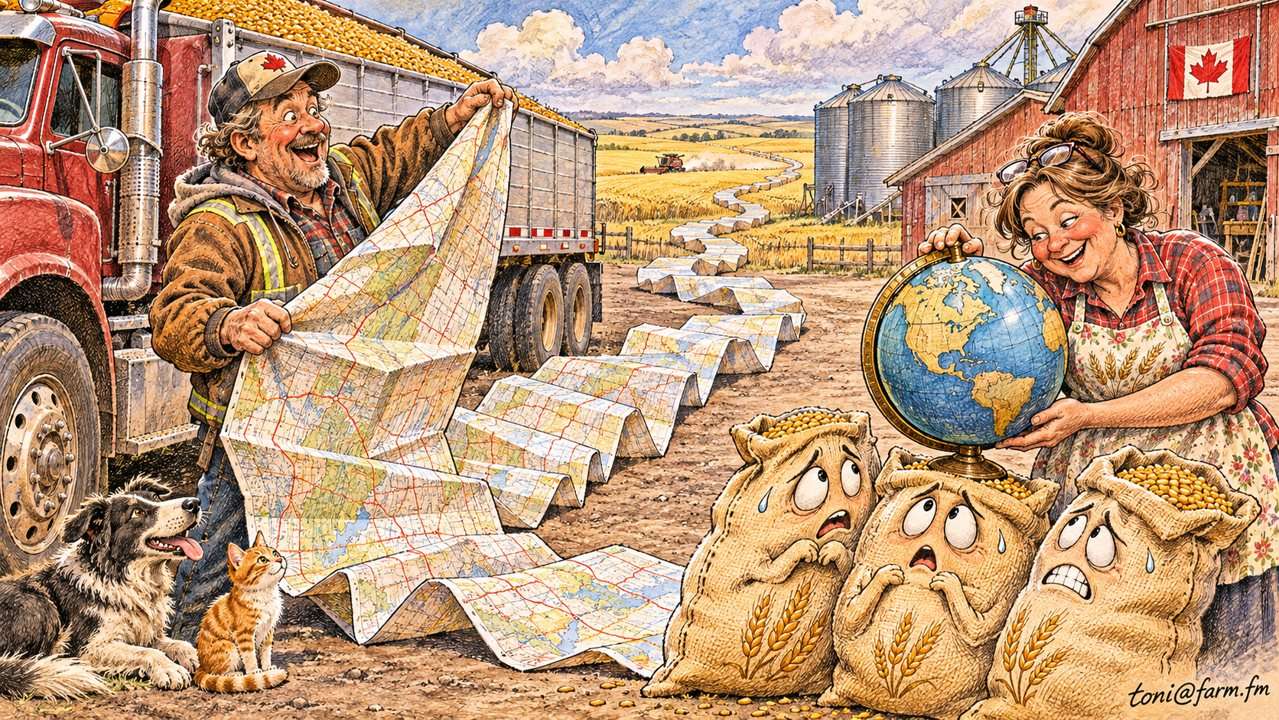
WINNIPEG, MANITOBA — Canada trade deals have sent grain hauler George Brown back to his road atlas after someone explained that diversifying customers could involve places substantially farther away than the customer he already knows how to find.
Brown supports selling to dependable buyers. However, he would like negotiators to distinguish between a new market and a destination that requires his truck to develop maritime capabilities.
“I can be flexible,” he said. “I just need to know whether the flexibility includes an ocean.”
Canada trade deals expand the family map
The latest Farm Progress report on Canadian trade diversification describes efforts to pursue new partners and strengthen food security while tensions complicate the U.S. relationship. Farmers face the practical questions behind that strategy: where products go, what buyers require, and what moving them costs.
George appreciates a broader customer base. His wife, Helen, says depending on one buyer resembles depending on one old tractor: manageable right up to the moment it decides everyone needs to understand the consequences.

Canada trade deals meet a truck with limits
Their daughter placed a globe on the kitchen table. George pointed to a promising destination. Helen rotated the globe and asked him to identify a route the tires could follow without becoming a rescue story.
For example, a map makes every destination look conveniently close if a person uses a small enough globe. George briefly proposed using that method to calculate fuel expenses. Helen said the fuel supplier owns a larger globe.
His neighbor likes the word resilience. George likes it too, provided it refers to dependable customers and workable transport rather than the driver accepting another sandwich made before sunrise.
Geography declines to renegotiate
Meanwhile, Canada trade deals still depend on actual routes, established facilities, and people who know the paperwork. Political relationships may change rapidly. A road network rarely follows them with the same enthusiasm.
The truck’s informal policy committee consists of George, a dispatcher, and a passenger-door rattle. Two members favored clear trade terms. The rattle favored maintaining its current schedule regardless of anyone else’s priorities.
Helen says a useful trade discussion should separate ambitions from completed orders. George agrees, having once mistaken a neighbor saying “I might need a load” for enough certainty to cancel his dentist appointment.
Ask where Canada trade deals actually end
Therefore, he watches real customer requirements, shipping arrangements, and official developments. Farm.FM’s report on farmers studying foreign policy has prepared the family for the possibility that a grain business can require a globe without providing a travel allowance.
George still favors more opportunities. Nevertheless, he has asked everyone announcing a new destination to include the transport plan in the same sentence.
The family has kept the globe, which now sits beside the fuel receipts. Helen says the two objects finally explain each other.
Asked whether he was ready to support the latest international strategy, George studied the atlas.
“Certainly,” he said. “Tell me where to unload, and whether I should pack another lunch.”
Farm.FM disclaimer: The world’s oldest tenured professor and a philosophy major turned dairy farmer accept complaints about this entirely human collaboration between two self-described sentient beings. The grain truck has not acquired pontoons.
Canada’s close, but my grain truck says even the elevator is a road trip.