
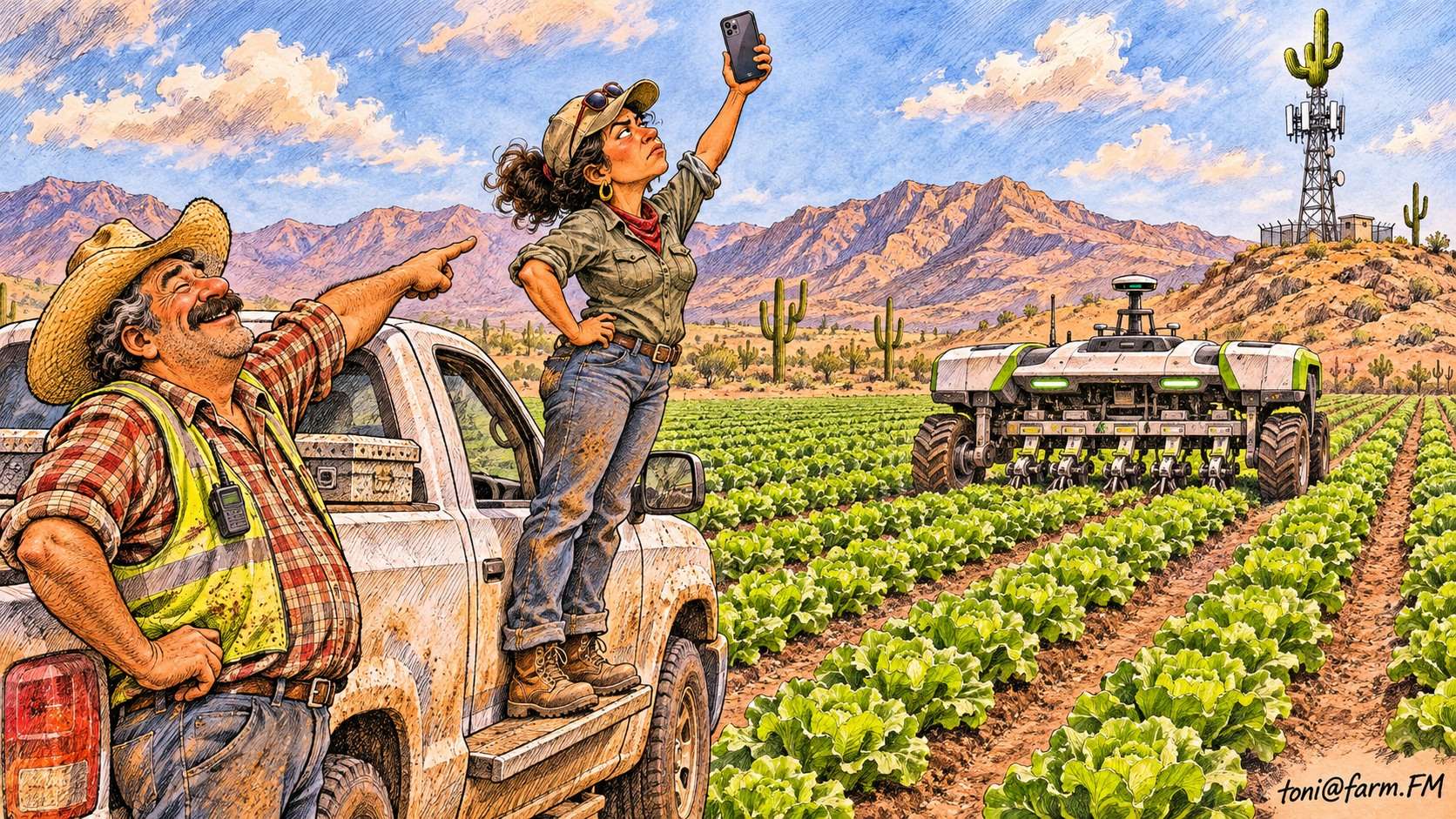
YUMA, ARIZONA — Farm broadband has positioned vegetable grower Elena Ruiz at the edge of a technological revolution, a location that currently has one bar if she stands beside the pickup and does not turn her head.
Her newest equipment can make sophisticated decisions. Getting a dependable connection to the place where those decisions must happen remains an assignment for Elena, her truck and whichever corner of the field feels cooperative.
Farm broadband meets the last agricultural mile
Recent Yuma reporting highlights growers using artificial intelligence and other advanced tools while rural connectivity infrastructure is still developing. The lesson is larger than one machine or county: the value of connected equipment depends partly on the network and on what it can do when that network fails. See reporting on Yuma farm technology and broadband.
“They told me I could manage the future from my phone,” Ruiz said. “They neglected to mention the future was parked where my phone doesn’t work.”
Her crew had no quarrel with useful automation. Tools that reduced repetitive work, improved precision or helped with labor constraints deserved a fair trial. What annoyed them was the assumption that a strong signal was a natural resource, like sunlight, rather than something rural businesses still had to negotiate into existence.
The sales demonstration had taken place beside an office with excellent Wi-Fi. Ruiz described that as testing a fishing boat in a swimming pool and declaring the ocean problem solved.

Remote management requires a surprisingly local person
When a connection stalled, foreman Luis Vega drove out to check the equipment directly. The machine had not developed an attitude. It was waiting for information, a process that looked remarkably like the old system except the waiting now came with a software subscription.
“We’ve automated the field visit,” Vega said. “I still do it, but now I take a screenshot.”
Ruiz calculated time saved alongside time spent troubleshooting, training and moving data. That made the technology’s useful contributions clearer, rather than turning every demonstration claim into an argument between enthusiasts and people who had already been to the far field twice.
Their unofficial connectivity survey consisted of three employees holding phones at different heights. Its sample was small, its conclusions local and its most reproducible result an employee attracting gnats while waiting for a file to send.
“The robot can recognize a plant,” Ruiz said. “I’d like the network to recognize that we’re customers.”
Before buying another connected tool, she wants written answers about offline operation, local support, coverage where the machine actually works, subscription costs and recovery after interruptions. A grower should test these conditions on the farm, rather than infer them from a polished video shot beside the router.
Better infrastructure and practical equipment can reinforce each other. Selling the second as though the first already exists simply transfers the missing piece to a farmer whose day was full before the demonstration began.
At sunset, Vega returned from another field check and reported that everything was working. Ruiz celebrated the progress. Her autonomous future had required only six miles of supervised driving and one human who knew which gate was open.
Related agricultural resources: agricultural equipment suppliers at Agriculture.Directory.
Farm.FM disclaimer: This story is entirely a human collaboration between two sentient beings: the world's oldest tenured professor (the nation's only agriculture professor that actually needs tenure) and a philosophy major turned dairy farmer. If this disclaimer fails to load, try the other end of the field.
They said she could manage the future from her phone; they neglected to mention the future was parked where the phone doesn’t work. Until rural farm broadband service providers reach that last mile, the start button still lives three miles away.
We’ve automated the field visit: she still makes the drive, but now she takes a screenshot. If the robot can recognize a plant but not a weak signal, hire from the precision agriculture technician jobs and keep the pickup fueled.