
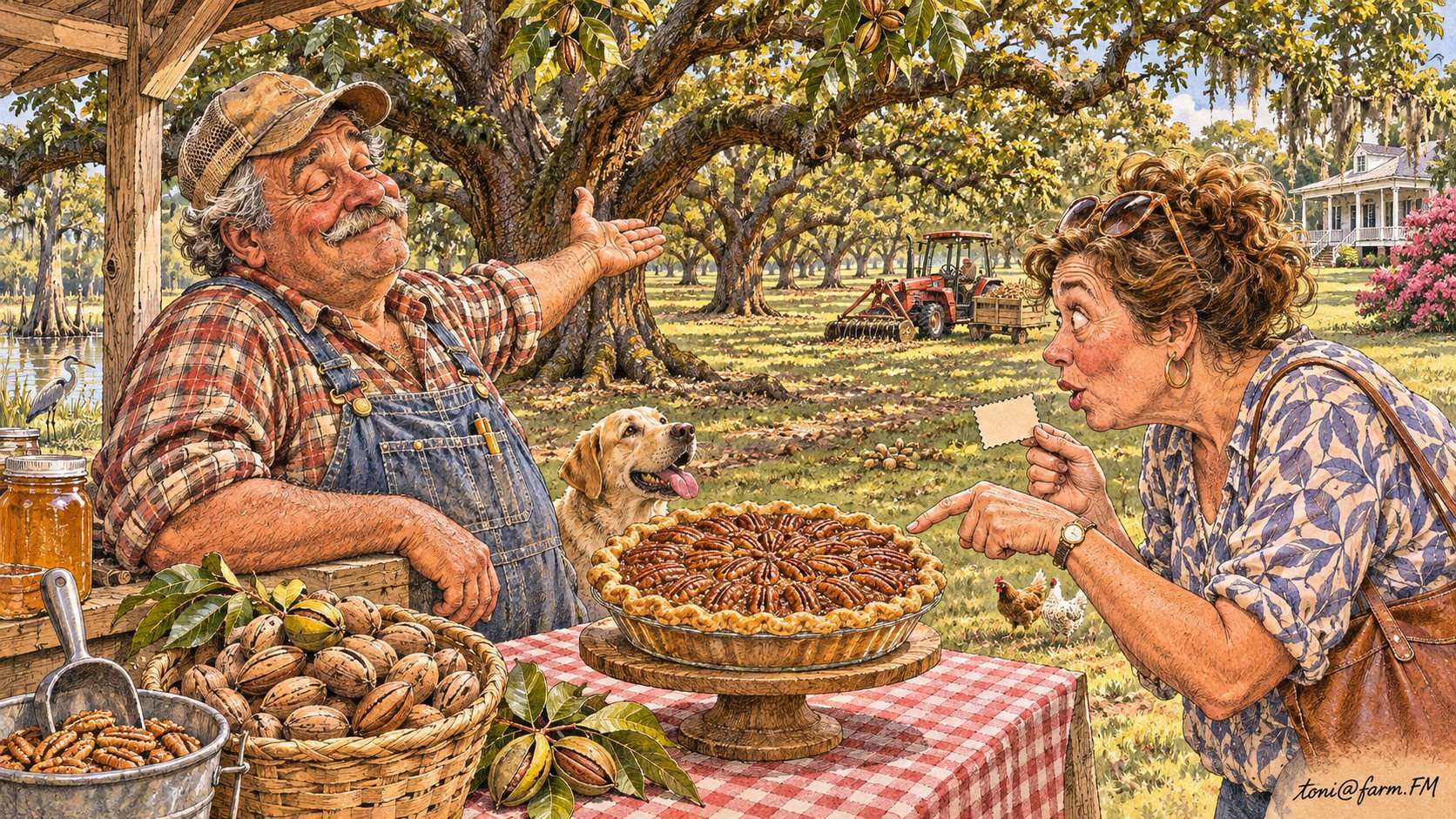
NEW IBERIA, La. — Pecan farming has given orchard grower Louis Broussard years of practice in waiting, although he admits customers remain capable of producing fresh tests at the farm stand.
The latest involved a woman who admired a pecan pie, asked the price, and suggested the nuts should cost less because the farm had grown them itself. Broussard invited her to look at the orchard while he considered how much of the answer would fit before lunch.
“We did grow them ourselves,” he said. “That’s where most of the expense got involved.”
Pecan Farming Begins Before the Shopping List
Recent LSU AgCenter coverage explains the years of establishment and orchard management behind pecan production. Time to bearing varies by variety and conditions. Read RFD-TV and LSU AgCenter pecan coverage.
Broussard’s wife, Marie, said this was useful context for a product customers often encountered already shelled, sorted, and participating in a holiday dessert.
She asked their grandson to prepare a small bowl of nuts for the kitchen. He volunteered confidently, then discovered that the bowl filled more slowly when someone had to do the shelling.
“I’ve found the labor cost,” he announced. “It was hiding inside each one.”
Louis gave him a sensible tool, showed him the routine, and encouraged him to record how long the task took. The boy immediately became more interested in preventing anyone from eating the finished nuts before they reached the recipe.
At the stand, Marie explained the work to a customer who wanted to know about the crop. The conversation covered the orchard, the season, and what made the product worth choosing. It ended with an order and no argument about whether trees had received the land for free.

The Pie Includes More Than the Visible Nuts
By afternoon, their grandson had developed firm opinions about prices. He asked whether anyone who requested a discount could assist with a sample batch.
Marie said understanding the work was worthwhile. Turning every sale into a punishment exercise might be less effective customer service.
He agreed to provide information instead. He arranged a few whole nuts beside the prepared ones and made a simple display of the steps. Louis admired the result, particularly because the boy had completed it without describing himself as a brand consultant.
The original customer returned to buy the pie. She had taken the orchard explanation in good humor and wanted something to bring to dinner.
Louis thanked her and asked how many people would be there. She said twelve, although her brother usually cut his own slice as if the head count were a personal insult.
Marie suggested buying enough for the actual family rather than the official attendance figure.
Their grandson watched the sale and asked whether the pie had recovered all his shelling expense. Marie said he had received the payment they agreed on, learned a useful skill, and eaten several unreported samples.
He called that a complicated compensation package.
Louis told him he was beginning to understand agriculture. Then he handed him another bowl.
For practical background, explore specialty crop resources at Agriculture.Directory.
Satire disclaimer. The pie’s time in the oven represents only the final stage of a much longer discussion with a tree. A human collaboration between the nation’s only agriculture professor that actually needs tenure and a philosophy major turned dairy farmer.