
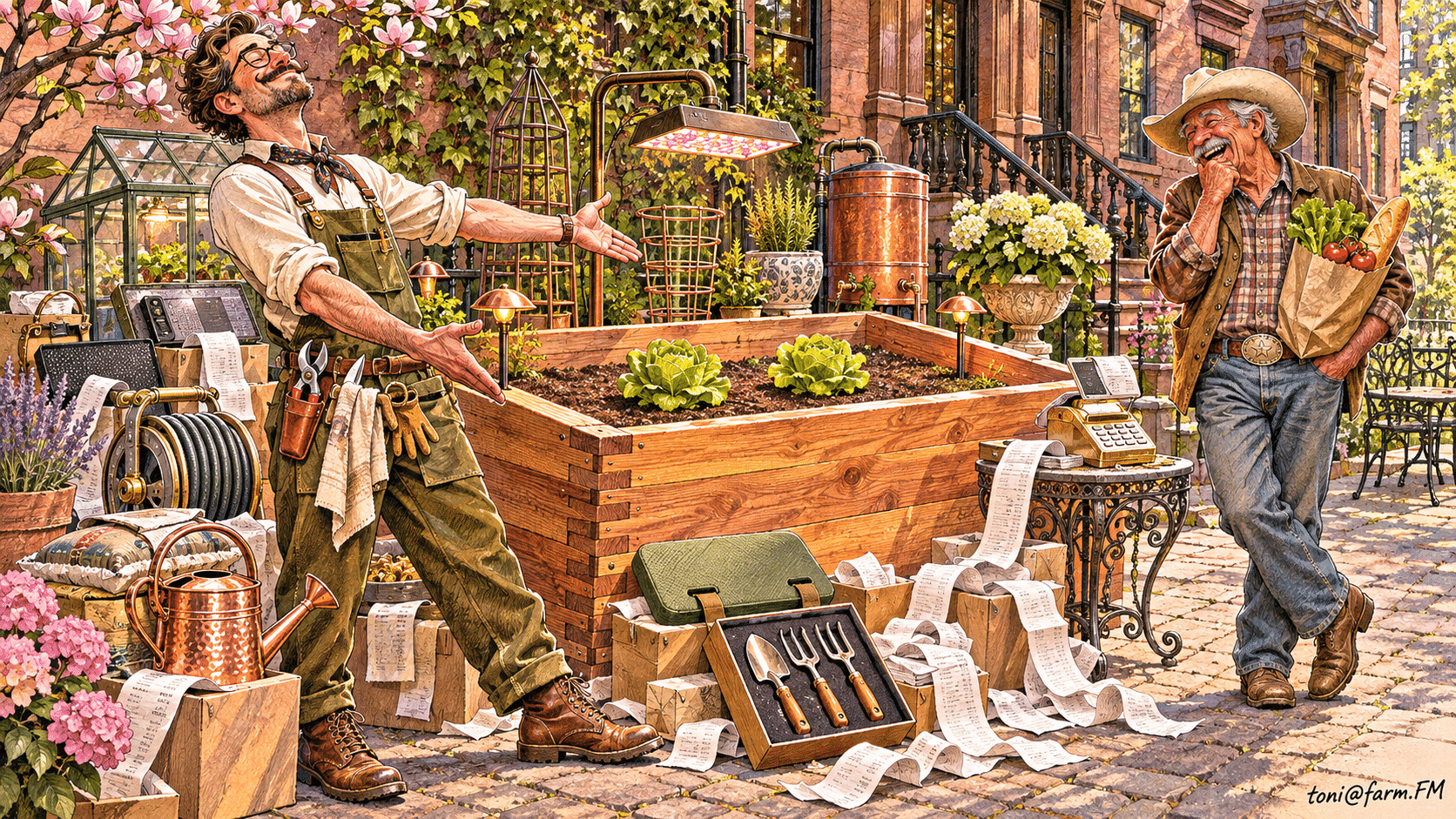
BROOKLYN — Urban farmer Owen Tiller has declared independence from corporate food through raised bed gardening after buying a $900 cedar raised bed from a company whose checkout offered him financing on dirt.
His raised bed gardening operation currently contains two lettuce plants, a moisture sensor and enough handcrafted brass equipment to perform emergency surgery on a yacht. Tiller says the first harvest will restore his relationship with nature, provided nature honours the warranty.
“I refuse to let a supermarket dictate my future,” he said, accepting a delivery from a multinational garden supplier. “Now I control everything except the payments.”
Raised Bed Gardening Finally Produces Receipts
The initial budget omitted soil, compost, seedlings, irrigation and the special boots required to stand beside vegetables. Tiller classified those purchases as infrastructure, a term his wife observed can make any hobby sound eligible for federal assistance.
His household ledger lists $900 for the bed, $180 for supplies and $120 for accessories. At a comparison price of $2 per head, that $1,200 startup bill would require 600 heads to match the store price before further expenses. Owen has two.
He calls the remaining 598 heads his growth strategy.
The University of Minnesota Extension guide to raised bed gardens explains the technique’s practical growing benefits. Owen has concentrated on a separate benefit: cedar photographs better than the grocery store’s produce drawer.
The Farmer Has Entered His Accounting Era

A Farm.FM courtyard survey found three residents supported local food and one wanted the wheelbarrow moved so she could reach her bicycle. Owen reported unanimous support after excluding transportation-related responses.
Neighbour Marlene Pike witnessed the first harvest. “He held up a leaf like he’d discovered insulin,” she said. “Then he put it back because the photographer wasn’t ready.”
Tiller defines food sovereignty as the right to decide which subscription service alerts him that his plants need water. His sensor recently sent six notifications while he was standing beside the hose. He upgraded to premium alerts.
His daughter asked whether dinner would include a salad. Tiller explained that the plants were still building equity. She ordered pizza, introducing the operation’s first reliable delivery system.
A Modest Proposal for Affordable Salad
Visiting Texas farmer Clyde Mercer admired the workmanship. “That’s a fine box,” he said. “Back home we put vegetables in the expensive box after somebody’s bought them.”
Mercer suggested starting small, tracking actual costs and treating gardening as a satisfying skill before declaring the supermarket defeated. Owen agreed to track costs once he located a ledger that matched the bed.
The first family tasting divided two leaves among four plates. Everyone praised the freshness. Nobody confused freshness with being full.
Tiller has since ordered a second bed to achieve economies of scale. The supplier congratulated him on his independence and asked whether he would like corporate control delivered monthly.
Satirical field note: The lettuce arithmetic is illustrative; the courtyard survey has no scientific standing. For the world’s oldest tenured professor and a philosophy major turned dairy farmer, may the next salad cover depreciation.
A $900 raised bed to escape a $2 lettuce cartel is the boldest ROI plan since my uncle’s emu phase. Read some backyard and urban farming articles before that radish costs more than a tractor tire.
A $900 raised bed to escape a $2 lettuce is independence with a financing offer on dirt. Visit a few urban farm workshops and garden-tour listings before the first radish costs more than the warranty.