
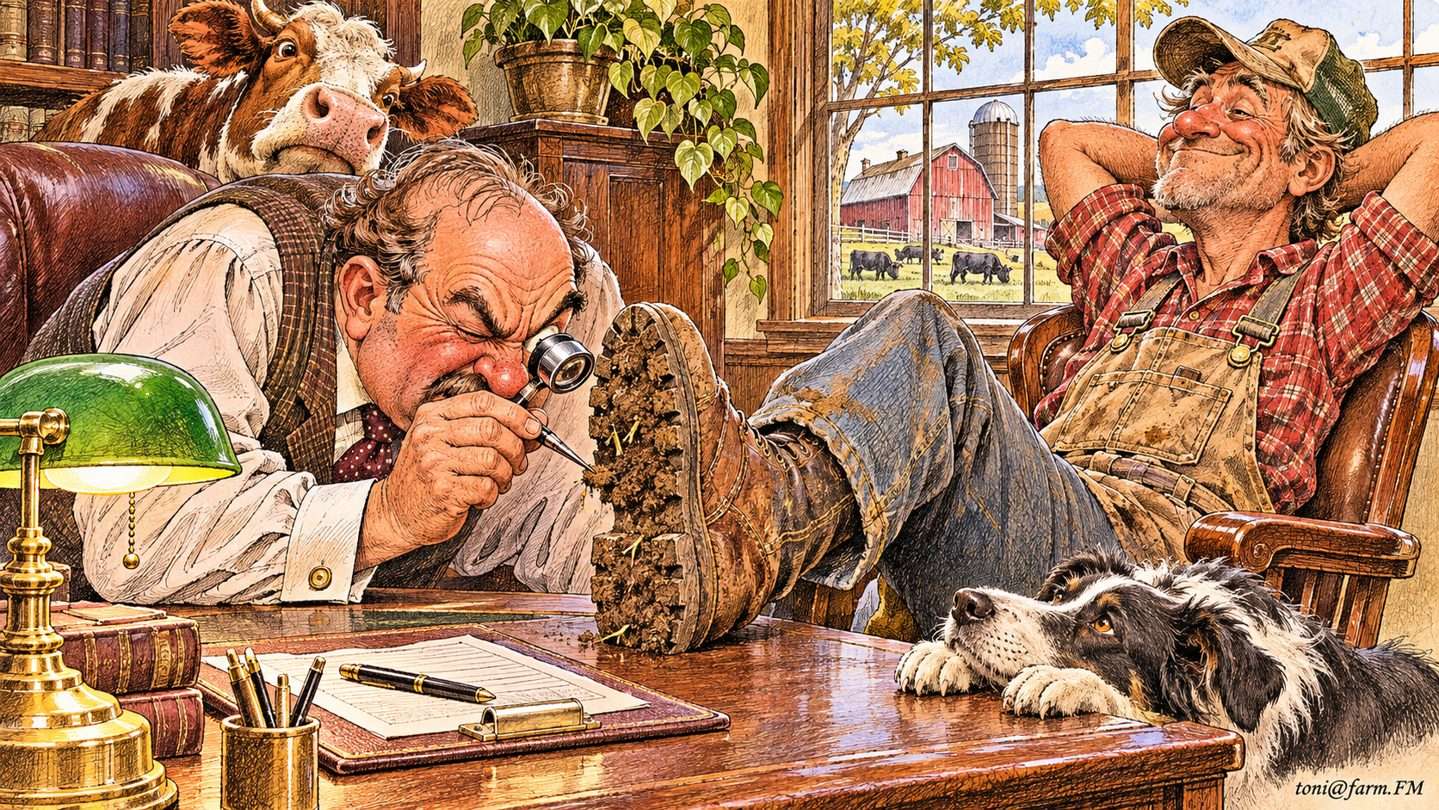
LEVELLAND, Texas — A farm finance seminar has ended with Clyde “Straight Row” Mercer presenting a banker with two boots and asking whether the dirt on them could be refinanced separately. The banker wanted to know whose dirt it was. Clyde said one boot contained his own and the other had mostly come from the county road, which he felt counted as diversification.
“I brought the only ground I could get into your office without a flatbed,” Mercer said. “If you need the whole quarter section, we’re going to want another chair.”
Farm Loan Refinancing Reaches the Mudroom
The seminar’s speaker described a lower payment as breathing room. Clyde’s wife, Marcie, asked how much the breathing would cost over the full term. An adjoining table of farmers put down its sandwiches. In West Texas a question that interrupts six people eating chicken-fried steak constitutes a formal request for information.
The USDA Farm Service Agency’s farm loan program overview describes financing options for eligible agricultural producers. Every proposed refinancing needs its own facts, including how long the loan runs, what fees apply and which assets secure it. The Mercers have learned to ask for those figures in writing before a well-dressed stranger starts talking about seasonal flexibility.
The working evidence for the seminar included two paper offers and a pen chained to the bank counter. Clyde said he had no idea why the pen was secured, given that it was the only thing of value in the building against which nobody had encouraged him to borrow.
“I asked what happens if cotton comes in light,” said farmer Ruby Vann. “The expert said I should manage the downside. I asked if he’d ever tried getting a rain cloud on the phone.”

The Payment Fits. Does the Whole Loan Fit?
Marcie took the numbers home and put the proposals beside the current loan. She wanted the rate, fees, term, payment dates and balance after a few years. She also ran a weaker crop year through the family’s cash-flow figures. Clyde called that pessimism. Marcie called it using the last harvest as a reference.
Neighbor Otis Bell said a lower monthly number once got his attention long enough to distract him from how many more months were involved. Nowadays he makes somebody read the proposed payoff date aloud. He considers this a fairly low-cost form of due diligence.
“I saw one payment plan run so long my boy would have to explain it to his boy,” Bell said. “And my boy still owes me for a trailer tire.”
Clyde finally took one of the boots home with him. He left the other at the bank by mistake and returned for it the next morning. The banker said that as far as he could tell the dirt had appreciated overnight. Clyde asked whether the bank had counted the mud drying out as a land improvement.
Farm.FM satire disclaimer. Both boots were returned to the borrower. The county declined to issue an appraisal on the road.