
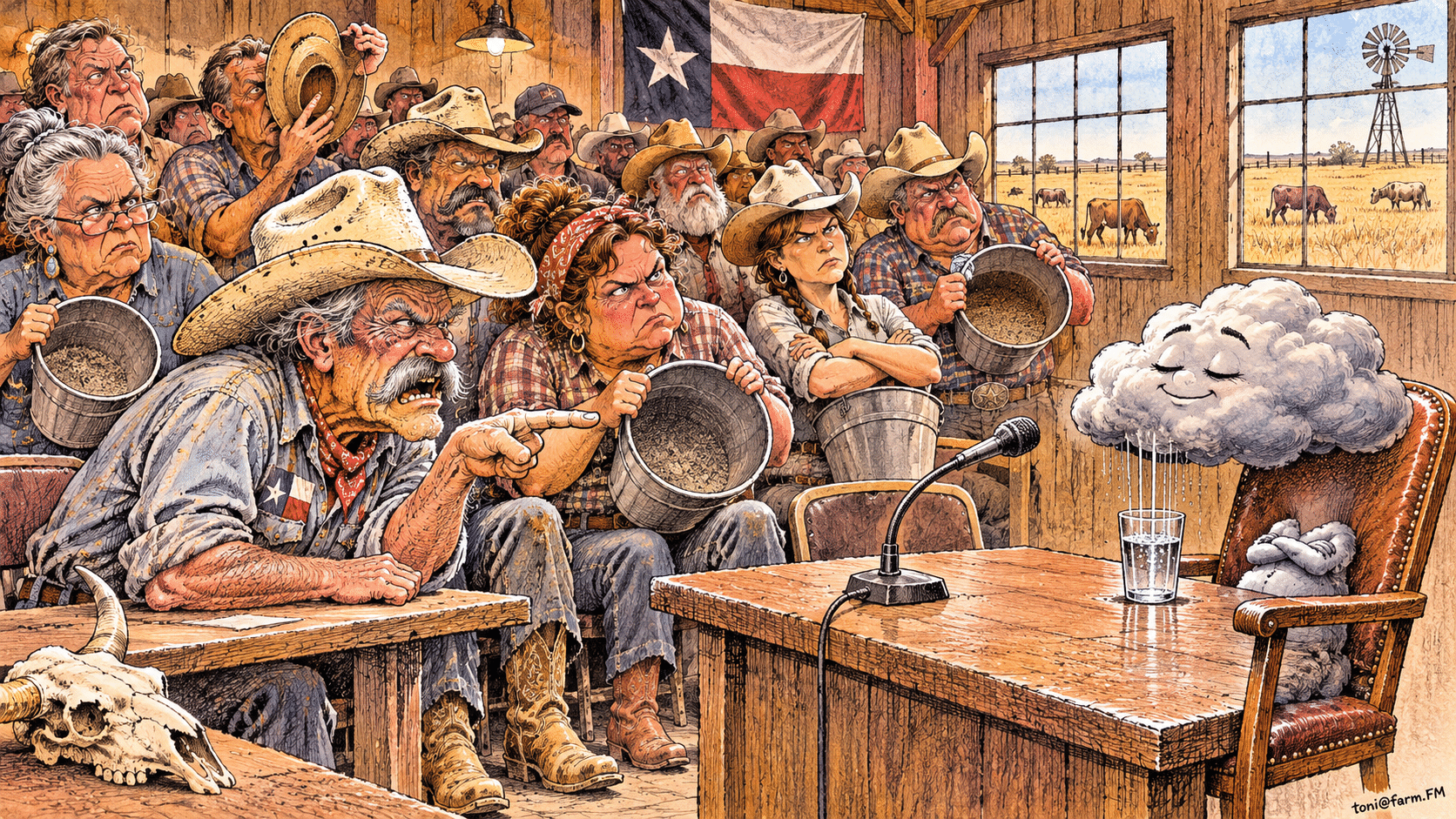
CLARENDON, Texas — A ranch drought drove a record crowd into the volunteer fire hall for the county’s annual Blame-the-Weather Town Hall. All folding chairs were occupied, a development the organizers attributed to high public interest and the fact that sitting outside in the wind now counts as exfoliation.
Chairwoman Doreen Lusk placed an empty coffee mug at the witness table for the weather. By the time the public comment period began, three ranchers had accused the weather of abandoning them personally and one had asked if it qualified for a homestead exemption on land it never visited.
The ranch drought enters the public record
A former county commissioner said four-tenths had fallen at his place. The room immediately requested his address, a photo of the rain gauge, and a statement under oath specifying whether he had watered the lawn. He produced a video of water running off the shed. The neighboring rancher demanded a second camera angle because the roof had always drained toward money.
Nobody brought up the good years until Doreen called for somebody to speak in defense of the clouds. “In a good year we say we managed our grass well,” she said. “I checked the minutes. The weather gets about as much credit for a good year as the man who holds the flashlight while you fix the truck.”
The U.S. Drought Monitor’s drought classifications use a scale running from abnormally dry to exceptional drought. The map covers broad conditions. A rancher may still find that two pastures in the same mapped area have different forage or water. A neighbor’s gauge is good for conversation, especially if it has recently outperformed yours.

A dry-weather budget reaches the floor
Doreen proposed each ranch bring three numbers to the next meeting: how much usable forage it has, how many days its available water will support the herd, and the delivered price of replacement feed. A sample plan put a review on the calendar before hay ran short. For local management decisions, the numbers belonged alongside a call to the county extension office and a look at the cattle market.
The motion drew opposition from a man who preferred to act when conditions became unmistakable. His wife pointed out they had once paid for an emergency hay delivery so expensive it came on a truck with more equity than their ranch. He withdrew his objection and asked that her remarks be struck from both the minutes and the merchant’s memory.
By adjournment the body voted to hold its next meeting outdoors if it rained. Forty-two members volunteered to speak, provided the speaker could stand beneath a downspout and remain there until everybody felt adequately represented.
Disclaimer: Farm.FM invented the hearing and its witnesses. The drought classifications are real. The weather declined to reimburse the fire hall for coffee.