
Mahindra Blames Diwali Timing for October Dip
MUMBAI, India — Indian agricultural economists have discovered that farmers sometimes decline to purchase new tractors, even when manufacturers explain that the latest models are significantly more advanced than the equipment currently sitting in their sheds.
Mahindra & Mahindra reported domestic tractor sales of 62,626 units in October, compared with 72,071 in the same month a year earlier, a 13% decline.
According to Mahindra’s official tractor sales announcement, the decline largely reflected the Diwali festival moving into November this year. Domestic sales for April through October were actually 2% higher than the comparable previous period.
That distinction is important. Agricultural analysts occasionally see one declining monthly figure and behave as though the entire farming industry has announced its retirement.
Indian Tractor Market and Rising Equipment Costs: The Tractor Has Wi-Fi, but the Farmer Has Debt
Modern tractors are technological wonders. They can navigate fields using satellite guidance, manage complex implements, monitor engine performance and communicate with agricultural management systems. Some possess electronic capabilities that would have seemed extraordinary aboard a commercial aircraft several decades ago.
None can perform the one task farmers consider essential. Making their own payments.
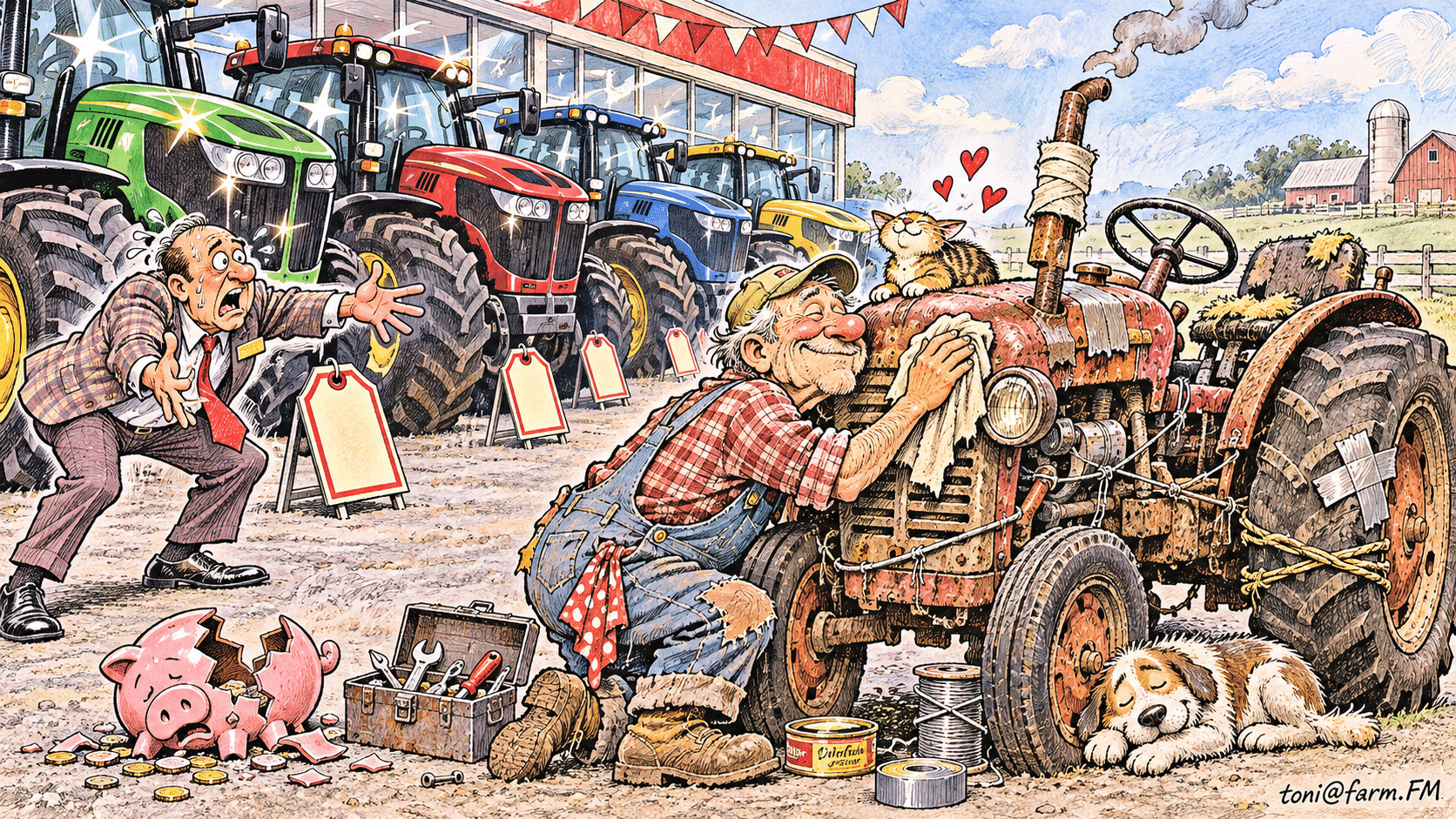
A farmer examining a sophisticated tractor might admire its automatic steering, precision controls and digital dashboard. Then the salesman explains the financing arrangements. Suddenly, the farmer remembers that his existing tractor still has four wheels, an engine and absolutely no interest in receiving software updates.
That last feature is becoming increasingly attractive.
A dealer in Pune, who asked that his showroom not be named, said the pattern is familiar. “A man comes in, he looks at the new model for forty minutes, he sits in the seat, he touches the screen,” the dealer said. “Then he asks me one question: does it need an account? I say yes. He thanks me and goes home to the old one.”
The older tractor may leak oil, rattle unpleasantly and require occasional attention from a mechanic. But it doesn’t ask the farmer to establish an online account before moving a pile of manure.
Diwali and Tractor Sales: Agricultural Economists Discover the Calendar
Mahindra’s October results also highlight an important truth about economic reporting: monthly sales comparisons can be distorted by the timing of festivals. Diwali is a major purchasing period in India. When the holiday moves from October to November, some sales shift accordingly.
This is not necessarily an agricultural recession. It’s a calendar.
Yet financial markets occasionally react to monthly sales statistics with the urgency of villagers discovering a tiger in the market square.
“Tractor sales are down!”
“Why?”
“The festival moved.”
“Has anybody informed the tractors?”
The machines, showing admirable indifference to financial commentary, continue performing agricultural work. Readers who want the broader picture of rural demand can consult the Ministry of Agriculture and Farmers Welfare, which publishes crop and farm-sector data throughout the season.

Farm Machinery Financing in India: Farmers Prefer Profitability to Touchscreens
Indian farmers operate across a wide range of crops, climates and farm sizes. Their machinery decisions reflect practical considerations: financing costs, farm income, labor availability, field conditions and whether existing equipment can complete the required work.
A financing brochure for a premium tractor model, collected at a regional dealership, carries a footnote in six-point type. It states that “advanced connected features may require a subscription after the initial period.” The footnote is printed beneath the image of a smiling farmer, who appears to have not yet reached it.
Purchasing an expensive tractor merely because the manufacturer has released a newer version is rarely an agricultural business strategy. It is, however, a wonderfully effective strategy for making the machinery dealership profitable.
Agricultural manufacturers naturally benefit when farmers upgrade equipment. Farmers benefit when upgrades actually improve efficiency enough to justify their costs. Those objectives sometimes overlap. Other times, the farmer simply needs a reliable machine that starts every morning and doesn’t introduce him to another monthly payment.
The agricultural industry should celebrate productive, affordable technology. But the ultimate measure of a tractor isn’t the number of computers installed inside it. It’s whether the machine helps its owner make money.
Until manufacturers develop a tractor that plants crops, harvests them, negotiates better commodity prices and persuades the bank to lower interest rates, millions of farmers will continue operating their existing machinery.
Especially when the old tractor has one feature the showroom model cannot offer.
It’s already paid for.
Five Observations on the Tractor Showroom
- A tractor with satellite guidance, a touchscreen and an app. And the farmer’s looking at it going, “Does it do my taxes?” No. It does not. It just wants to know your email.
- The old tractor doesn’t need an account. It doesn’t need a password. It doesn’t want to be updated at six in the morning in the middle of a field. It’s the only relationship in his life with no terms and conditions.
- Tractor sales dropped thirteen percent and the whole market panicked, because the holiday moved. The holiday moved! We’ve got people reading the calendar like it’s a stock chart.
- A man will sit in a new tractor for forty minutes, touch every button, say nothing and go home. That’s not shopping. That’s a very expensive museum visit.
- The footnote’s in six-point type under a picture of a happy farmer. That’s the happiest anyone’s ever been at a font size nobody can read.